→
The average abandoned AI initiative costs $7.2M, and that's only what organisations tracked (Deloitte, 2025).
→
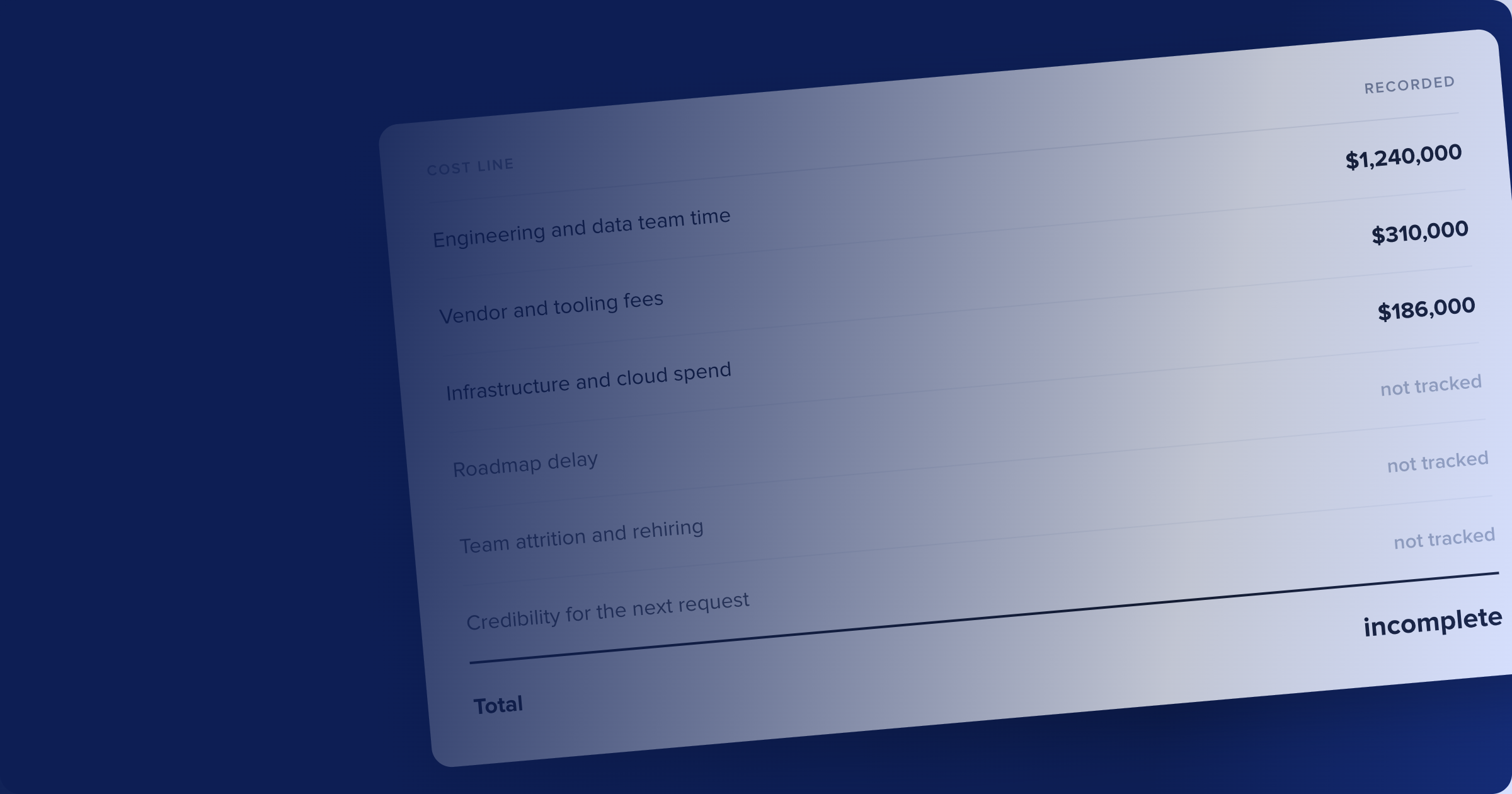
Most teams measure only direct costs. The largest losses usually come from roadmap delays, competitive momentum lost, and board credibility spent costs that often take 12–18 months to recover.
→95% of enterprise AI pilots deliver no measurable P&L impact. The dominant failure modes are structural, not technical, and are largely preventable.
→
For a mid-market SaaS company, the true cost of a failed pilot can range from $2M–$12M when direct, opportunity, strategic, and trust costs are calculated honestly.
→
Prevention starts before the pilot: choose the right use case, build compliance into the architecture from day one, and establish clear ownership before development begins.
Next step:
Not sure what your failed pilot actually cost?
Use Linnify's free AI Pilot Cost Calculator below.
You approved the budget. Your team spent six months building. The demo was impressive. Then compliance review killed it, or UAT (User Acceptance Testing) failed, or it shipped and quietly died in production with no one using it.
The invoice is closed, but the cost is still accumulating.
A failed AI pilot is rarely just a budget line.
The direct spend is the number everyone talks about. The indirect, strategic, and trust costs are the ones that compound quietly for the next 12 to 18 months, and the ones most executives don't account for until they're trying to justify the next AI investment to a skeptical board.
This article gives you a framework to calculate the full cost of a failed AI pilot: the number you can walk into a board conversation with, and the number that should inform how you approach your next initiative differently.
Why is the budget number always wrong?
Research highlight
42%
of companies abandoned at least one AI initiative in 2025
$4.2M
average sunk cost per abandoned AI project
Large enterprises abandoned an average of 2.3 AI initiatives, while mid-market companies abandoned 1.1. The median time to failure was 11 months, suggesting organisations often continue investing long after warning signs appear.
But that $7.2 million figure is almost certainly understated. It captures vendor costs, engineering hours, and tooling licenses. It doesn't capture what happened to the team, to the roadmap, or to the CTO's next board presentation.
The real cost of a failed AI pilot has four components. Most organizations only measure one.
The four categories of cost
1. Direct costs: the visible budget
This is what appears on the invoice. It includes:
Engineering and data team time
The salaries and contractor fees for the people who built the system.
Vendor and tooling fees
LLM API costs, vector database licenses, orchestration platforms, and other software subscriptions required to build and operate the solution.
Infrastructure and cloud spend
Compute, storage, networking, and other cloud resources consumed during development and deployment.
External consultants or agencies
Costs associated with third parties involved in scoping, building, reviewing, or evaluating the AI initiative.
For a typical 6-month enterprise AI pilot, direct costs range from $400,000 to $2 million depending on team size, complexity, and vendor stack.
These are the numbers that are easy to track and easy to defend, which is exactly why organizations tend to anchor on them exclusively.
They are also the least important part of the full cost.
2. Indirect costs: team time and opportunity
The most underestimated category.
Every person involved in a failed AI pilot had a roadmap they weren't executing. Every sprint spent debugging a system that never shipped is a quarter of product development you didn't do.
Consider what a 6-month failure actually costs in opportunity:
Product roadmap delay
Features, improvements, and strategic initiatives that were deprioritized in order to allocate resources to the AI initiative.
Engineering bandwidth diverted
Senior engineering capacity is finite. Every month spent on a failing AI project is a month not spent improving the core product or serving customers.
Stakeholder time
Time invested by CTOs, CPOs, business unit leaders, and other stakeholders who attended planning sessions, demos, reviews, and steering meetings that ultimately produced no business outcome.
Research highlight
72%
of CIOs report their organisations are breaking even or losing money on AI investments.
According to Gartner's 2025 AI Maturity and Operations Survey, most organisations have yet to realise positive financial returns from their AI initiatives. In many cases, the largest costs are not technical expenses, but the hidden opportunity costs of delayed roadmaps, diverted engineering bandwidth, and executive attention spent on projects that never reach production value.
Opportunity cost is real cost. It just doesn't appear on the invoice.
3. Strategic costs: momentum and market positioning
A failed pilot doesn't just consume resources; it consumes momentum. And in AI, momentum is the resource that's hardest to recover.
Time-to-market delay
Every quarter your competitors are shipping AI features is a quarter you're rebuilding trust internally to try again. Organisations that successfully moved AI into production in 2024 and 2025 are already compounding that advantage. Teams still recovering from failed pilots are starting from a greater distance and with less momentum.
Budget risk aversion
Failed initiatives create institutional memory. The next CTO or CPO requesting funding for an AI programme will face a CFO who remembers the last unsuccessful investment. Approval cycles become longer, scrutiny increases, and the scope of future initiatives often shrinks to fit a lower organisational risk appetite.
Research highlight
40%+
of agentic AI projects are expected to be cancelled by the end of 2027.
Gartner attributes the projected failure rate to escalating costs, unclear business value, and inadequate risk controls. In practice, these are often symptoms of a broader issue: organisations lose strategic momentum long before they formally cancel a project.
This is the category that keeps CTOs up at night, and the one that never appears in a post-mortem.
Internal trust
Your engineering team built something that didn't ship. Your product team deprioritized their roadmap for it. Your business unit leaders sat through months of updates and reviews without seeing a meaningful outcome.
The next time AI is proposed, the room will be quieter. The questions will be sharper. The enthusiasm will be lower.
Board credibility
When a CTO presents a failed initiative, they're not just reporting a budget miss. They're spending credibility they'll need for the next initiative, and the one after that.
A 2025 MIT NANDA study found that 95% of enterprise generative AI pilots deliver no measurable P&L impact, and those results are increasingly visible to boards that approved the investment.
Failed pilots often trigger vendor reviews, platform migrations, or decisions to bring capabilities in-house — all of which add additional cost and complexity.
According to 2025 research on enterprise AI governance, 74% of CIOs report regret regarding at least one vendor or platform decision made in the previous 18 months.
Estimate the roadmap value of the engineering capacity consumed.
If 3 senior engineers spent 6 months on a failed pilot, and their fully loaded cost is $200k/year each, the opportunity cost floor is $300k, but the real cost is the value of what they didn't build.
Example scenario
1
A 10-person SaaS engineering team diverts 4 engineers for 6 months to an AI initiative.
↓
2
With a blended cost of $150k per engineer per year, the direct salary investment reaches approximately $300k.
↓
3
Those same engineers were supposed to deliver a billing upgrade needed to move the company upmarket.
↓
4
The delay pushes the feature back by six months, causing the company to miss two enterprise sales cycles.
$160k–$320k
Estimated ARR impact from delayed enterprise deals — before accounting for churn, competitive disadvantage, or the trust cost of a failed initiative.
Step 3: Strategic delay impact
If your closest competitor shipped an AI feature in the same period, estimate the revenue or retention impact. If you can't quantify it, use a conservative proxy: 1 quarter of product velocity delay = X weeks of competitive disadvantage.
Example scenario
1
While your team was rebuilding from a failed AI pilot, your main competitor shipped an AI-powered reporting feature.
↓
2
Three enterprise prospects mentioned that competitor feature in your most recent sales conversations.
↓
3
Even if only one deal is genuinely at risk, the commercial exposure is already meaningful.
$120k
Strategic delay premium for this quarter alone, based on one at-risk enterprise deal at $120k ACV. Across a full pipeline, the number compounds quickly.
Step 4: Trust cost (qualitative)
Assess: did this failure change internal risk appetite? Did it affect your relationship with the board or specific stakeholders? These don't have a dollar value, but naming them is essential for framing the next investment conversation correctly.
You can calculate your own costs now:
AI pilot failure cost calculator
Estimate the direct cost, opportunity cost, and strategic delay created by an AI initiative that did not reach production.
Estimated total cost
$0
This estimate combines direct spend, engineering time, opportunity cost, and strategic delay. Trust cost is assessed qualitatively below.
Trust cost checklist
For most enterprises, the full cost of a failed AI pilot, calculated honestly, lands between $2 million and $12 million when opportunity and strategic costs are included.
The $7.2M average from Deloitte's data is a reasonable midpoint for a 6-month initiative at a team of 5–10.
What the data says about why this keeps happening
Research highlight
80.3%
of AI projects fail to deliver their intended business value.
The MIT and RAND data point to a structural problem, not a talent problem. According to RAND Corporation's 2025 analysis, AI project failure rates are roughly double those of non-AI IT projects.
The common failure modes aren't about choosing the wrong model or the wrong vendor. They are:
Starting with tools instead of value
Building technical capability before identifying the workflow, business process, or operational constraint the system is supposed to improve.
No compliance path from day one
Teams spend months building a solution only to discover legal, security, privacy, or data governance requirements that prevent deployment.
Evaluation frameworks designed for demos, not production
Systems perform well during demonstrations and user acceptance testing, but fail when exposed to real-world inputs, edge cases, and production-scale conditions.
No internal owner after handoff
The implementation team moves on, but nobody inside the organisation is accountable for maintaining, improving, and ensuring adoption of the system.
These are solvable problems. But they require a different approach to AI implementation than most organizations use, one built around engineering discipline, not experimentation.
How Linnify approaches this differently
At Linnify, we've built our entire delivery methodology around avoiding the failure modes that drive this cost.
Our framework, ARC (Agentic Release Control), treats agentic AI implementation as a software engineering discipline, not a research project.
The most important phase is the first:
Phase 1 (Identify Value), in which we run a structured Red Ocean Analysis before a single line of code is written. It scores every potential AI opportunity on process repeatability, ROI clarity, data availability, and compliance risk.
The goal is to select the initiative most likely to reach production, not the one that sounds most impressive in a slide deck. The result is that the pilots' Linnify runs don't stay pilots. The foundation: data governance, human-in-the-loop design, compliance architecture, production monitoring, is built into the system from day one, not bolted on when problems emerge.
The question isn't whether you can afford to run an AI pilot. It's whether you can afford to run one that fails.
Frequently asked questions (FAQ)
The average sunk cost per abandoned enterprise AI initiative was $7.2 million in 2025, according to Deloitte.
This figure includes direct engineering and vendor costs but typically underestimates indirect, strategic, and trust costs, which can double the total when calculated honestly.
The most common failure modes are building for the demo rather than the production workflow, skipping compliance architecture until late in the project, using evaluation frameworks designed for models rather than agents, and having no internal owner after handoff.
These are structural problems, not technical ones.
Recovery timelines vary, but the strategic and trust costs typically take 12–18 months to rebuild.
Board risk appetite, internal team enthusiasm, and vendor relationships all take time to restore after a high-visibility failure.
Prevention starts before the pilot begins.
Define success metrics before development starts, build compliance and governance into the architecture from day one, and choose initiatives based on workflow fit and ROI clarity rather than technical ambition.
The organisations that consistently move AI into production treat governance, evaluation, and ownership as design decisions, not post-build activities.
Lorem ipsum dolor sit amet, consectetur adipiscing elit. Suspendisse varius enim in eros elementum tristique. Duis cursus, mi quis viverra ornare, eros dolor interdum nulla, ut commodo diam libero vitae erat. Aenean faucibus nibh et justo cursus id rutrum lorem imperdiet. Nunc ut sem vitae risus tristique posuere.
Let’s build your next digital product.
Subscribe to our newsletter
Thank you! Your submission has been received!
Oops! Something went wrong while submitting the form.


.svg)

.svg)







.png)
