

.svg)

.svg)

Why enterprise AI Pilots FAIL, and what you can do differently


.png)
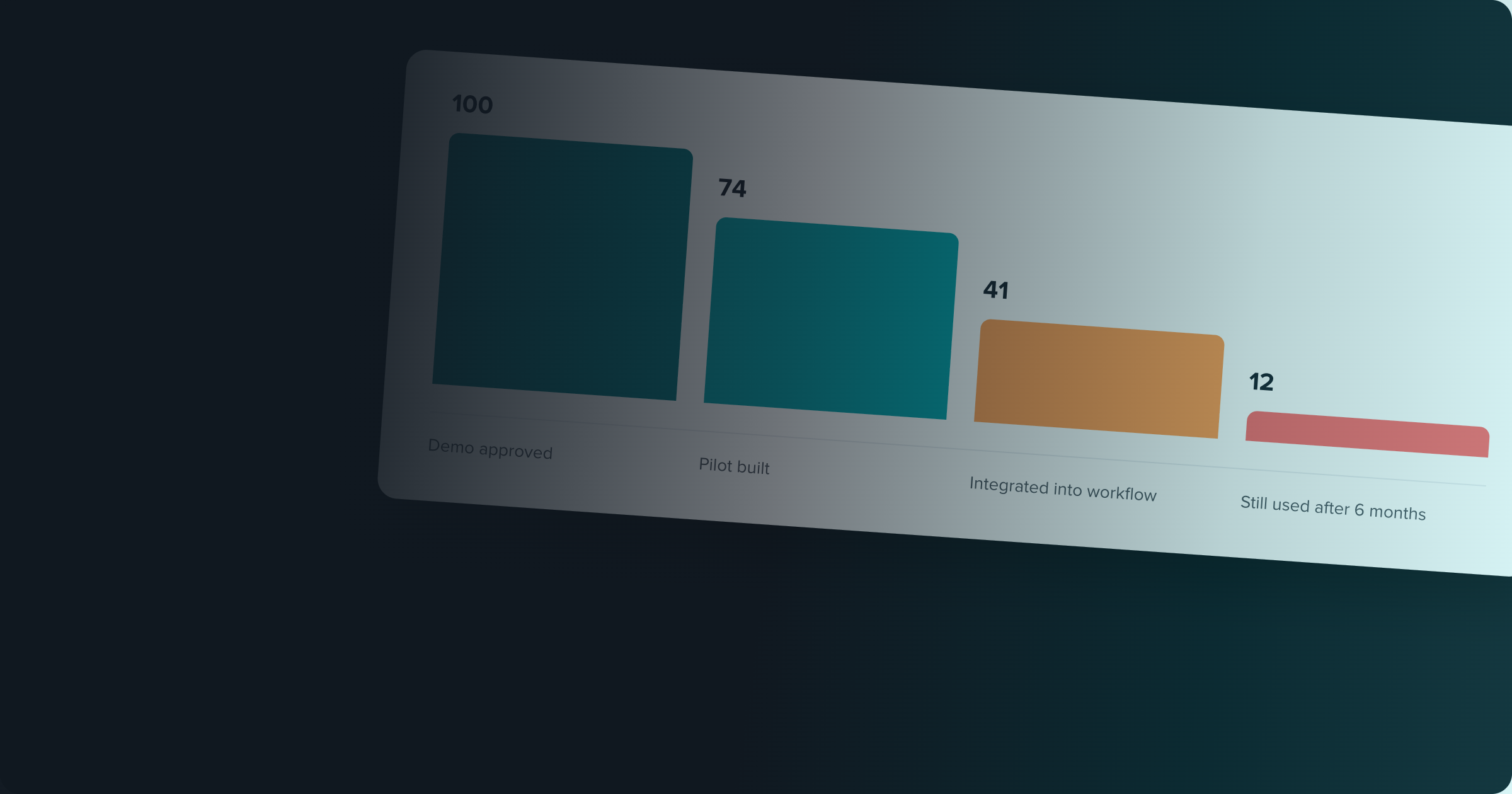
The demo worked. The stakeholders approved the budget. The team was energised. Then the project stalled not with a dramatic failure, but with a quiet series of delays that eventually became a cancellation nobody announced officially.
This is the most common pattern in enterprise AI right now. Not failure stagnation. Pilots that worked in controlled environments and never made it into the workflows they were supposed to improve.
When you trace these failures back to their root cause, the AI model is almost never the problem. What breaks is everything surrounding it: how the system was designed, how it was validated, how it was integrated into real workflows, and who was supposed to own it after it shipped.
Here are the six failure modes we see most often and what changes when teams get them right.
What are the 6 reasons enterprise AI pilots fail?
1. Built for the demo, not the workflow
Most AI pilots are designed to answer one question: can this work? That's the wrong question. The question that determines whether a pilot reaches production is: can this work inside the specific, messy, exception-laden way our business actually operates?
A demo environment is clean. The inputs are well-formatted, the edge cases are known, and the scenarios are chosen to show the AI at its best. A production environment is none of those things. Real data is inconsistent. Real workflows have exceptions that nobody documented. Real users do things the system wasn't designed for.
The fix isn't to run better demos it's to design for production from the first day of the pilot. That means starting with a genuine workflow audit: what decisions are actually being made, what does the data actually look like, and what are the failure modes the system needs to handle gracefully.
2. No compliance path from day one
This is the failure mode that kills the most promising AI initiatives.
The team builds a working system. It performs well in evaluation. Then it goes to legal and compliance review, where it's discovered that the system doesn't have adequate audit trails, the data processing doesn't meet GDPR requirements, or the governance documentation doesn't satisfy the internal risk framework.
At that point, the cost of fixing the compliance issues is often higher than rebuilding. Projects get shelved. Budgets get reallocated.
The cause is always the same: compliance was treated as an external check at the end of the project rather than as a design constraint at the beginning. The teams that get through compliance review fastest are the ones who involve their compliance, legal, and security stakeholders in the initial architecture decisions not the final review.
For companies operating in the EU, this is especially critical. The EU AI Act introduces specific requirements for high-risk AI systems: human oversight mechanisms, accuracy documentation, and conformity assessments. These cannot be bolted on after the fact.
The governance gap is particularly acute in agentic AI. Deloitte found that:
3. No defined standard for what 'good' looks like
How do you know your AI system is working? If the answer is "it seems to be producing good outputs," you don't have an evaluation framework you have an impression.
A structured evaluation framework defines, in measurable terms, what good output looks like across the full range of inputs the system will encounter in production. It includes accuracy benchmarks, edge case coverage, human escalation criteria, and regression tests that run every time the system is updated.
Most teams build this after deployment, when problems have already surfaced. By then, the business has made decisions based on system outputs it had no reliable way to validate.
The evaluation framework should be built in the pilot phase before a single line of production code is written. If you can't define what "correct" looks like before you build, you're not ready to build.
4. Human oversight designed around the system, not into it
Human oversight is not a safety net you add to an AI system that's already been designed. It's an architectural decision that shapes the entire system.
When human-in-the-loop is bolted on at the end because a compliance requirement surfaced it, or because leadership asked for it in a late-stage review it typically doesn't work properly. The escalation criteria are vague, the handoff between the AI and the human reviewer is clunky, and the feedback from human decisions doesn't feed back into the system in a structured way.
The result is a system that technically has human oversight but doesn't benefit from it and often creates more friction for the people who are supposed to be reviewing its outputs.
Human-in-the-loop design starts with a question that should be asked in the first week of a project: which decisions in this workflow should a human always review, and why? The answer shapes the architecture from that point forward.
5. No internal owner after handoff
An AI system without an internal owner doesn't survive its first production incident.
When something breaks and in any production system, something eventually will the team needs someone internally who understands the architecture, knows how to diagnose the problem, and has the authority to act on it. If that person doesn't exist, the incident sits in a queue waiting for the external build team to respond, or it escalates to leadership, or it's quietly deprioritised until it becomes a bigger problem.
The ownership issue usually surfaces at the handoff stage, but it starts much earlier. If the internal team isn't involved in the build process, they don't develop the understanding they need to own the system. By the time the build team is ready to hand over, the internal team isn't ready to receive.
Production-ready deployment means the internal team can maintain, update, and iterate on the system independently. Getting there requires deliberate knowledge transfer throughout the build not a documentation dump at the end.
6. Success metrics defined after deployment
If you don't define what success looks like before you deploy, you can't demonstrate value after you deploy.
This sounds obvious. It's almost universally ignored.
Teams deploy AI systems, see them running, and call it done. Six months later, a leadership review asks: what has this delivered? Without pre-defined metrics time saved, accuracy improvement, cost reduction, revenue impact there's no answer. Systems that can't demonstrate value get defunded or deprioritised.
The metrics question needs to be answered in the assessment phase, before any build work begins: what measurable change in the workflow will tell us this system is working? Those metrics become the evaluation benchmark during build, the success criteria at deployment, and the reporting framework for ongoing performance.
Failure mode at a glance
Additional failure modes for EU-regulated deployments
What separates the pilots that actually ship?
MIT Project NANDA’s State of AI in Business 2025, covering more than 300 AI initiatives and 153 executive surveys, found that 95% of companies fail to achieve measurable financial impact from generative AI. That figure has become something of a go-to reference in enterprise AI conversations, and for good reason: it is consistent with what teams working in production observe every day.
The 5% that ship share one thing the rest don’t: they treat domain expertise as infrastructure, not input.
In most failed pilots, subject matter experts are consulted at the beginning to define requirements, then largely absent until the end when they’re asked to validate outputs. Everything in between, the architectural decisions, the evaluation criteria, the edge case handling, the escalation logic, gets made without the people who actually understand the work.
The pilots that reach production are built differently. Domain experts are embedded throughout, not as reviewers, but as co-designers. They define what correct output looks like before a line of production code is written. They surface the exceptions that never appear in clean test data. They set the performance benchmarks that determine whether the system is ready to ship. And because they’ve been part of the build, they’re equipped to own it after deployment.
This is not a process refinement. It is an architectural one. AI systems don’t run on models; they run on encoded expertise. The quality of the system is bound by how well that expertise has been captured, validated, and operationalised. Which means the path from pilot to production isn’t a technical problem to be solved after the human work is done. It’s a human problem from the start, with technology as the medium.
That question, answered seriously, is what separates the pilots that ship from the ones that don’t.
This is also the thinking behind ARC, Linnify’s Agentic Release Control framework. Rather than treating compliance, evaluation, and human oversight as phases you add before launch, ARC structures them as design constraints from the first week of a project. Not because it’s the responsible thing to do, but because it’s the only approach we’ve found that consistently closes the gap between pilot and production.
Frequently Asked Questions (FAQ)
References & further reading
Gartner, "Gartner Predicts Over 40% of Agentic AI Projects Will Be Canceled by End of 2027," June 25, 2025. https://www.gartner.com/en/newsroom/press-releases/2025-06-25-gartner-predicts-over-40-percent-of-agentic-ai-projects-will-be-canceled-by-end-of-2027
Deloitte. (2026). State of AI in the Enterprise, The Untapped Edge. https://www.deloitte.com/content/dam/assets-zone3/us/en/docs/services/consulting/2026/state-of-ai-2026.pdf
Linnify, "How to Move Agentic AI from Pilot to Production," 2026. https://www.linnify.com/ai-insights/how-to-move-agentic-ai-from-pilot-to-production
MIT Project NANDA, “The GenAI Divide: State of AI in Business 2025,” July 2025. Reported by Fortune, 18 August 2025. fortune.com/2025/08/18/mit-report-95-percent-generative-ai-pilots-failing




.png)
