

.svg)

.svg)


Building agentic AI that simulates real work

.svg)
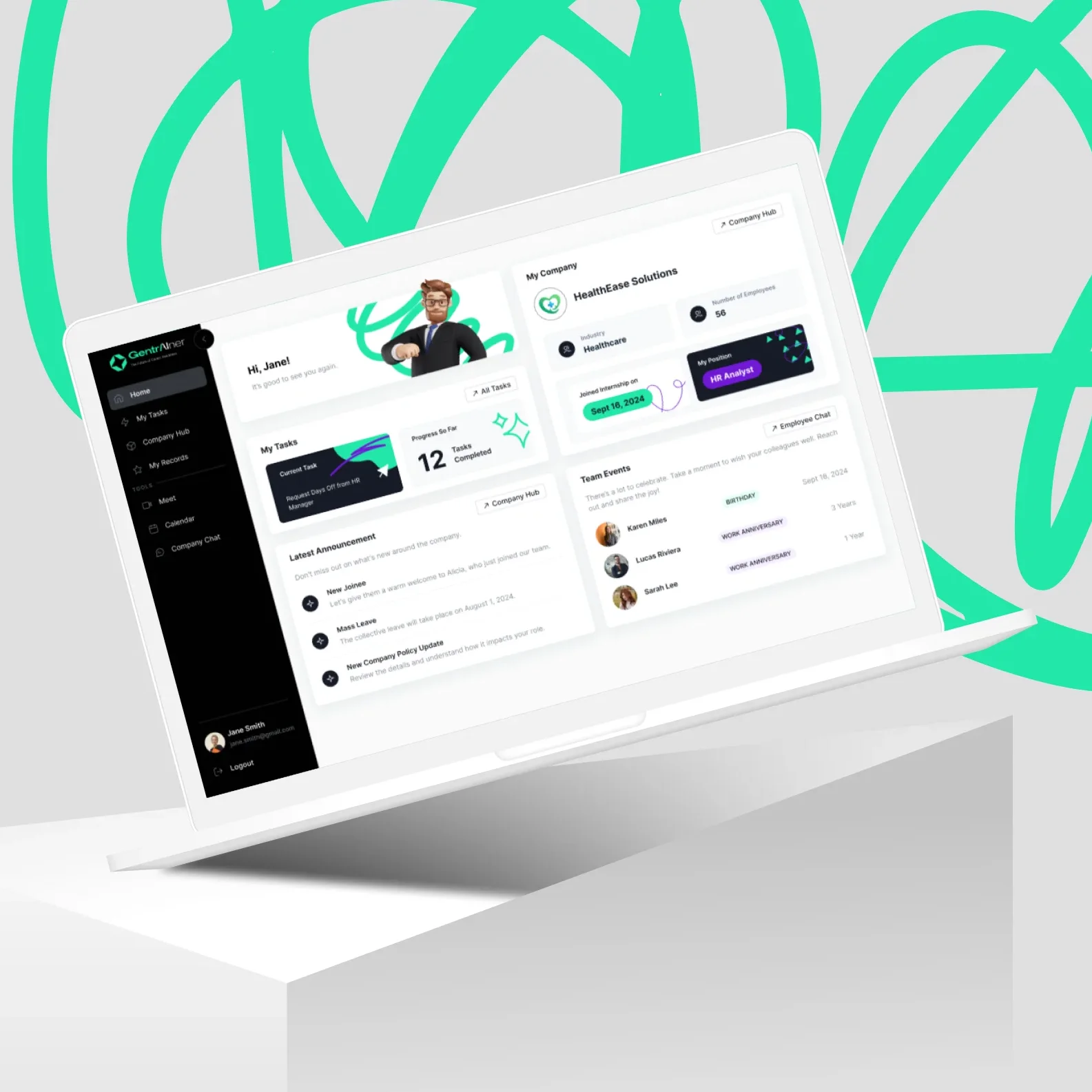
GentrAIner is an AI-powered virtual internship platform built for the US higher education market. It's mission is to close the career readiness gap that leaves the majority of US college studentsunderprepared for their first job.
The platform delivers full-length, semester-aligned virtual internships where students interactwith AI agents that act as real colleagues, supervisors, and evaluators.
Universities use GentrAIner to scale career readiness programs beyond the limits of traditionalinternship pipelines. While employers gain access to candidates with measurable, standardisedcompetency data before they ever interview.
Linnify partnered with GentrAIner from early-stage product validation through to productiondeployment, contributing product strategy, full-stack engineering, experience design, and theAI architecture that powers GentrAIner's agentic simulation engine. The partnership is ongoing.
The career readiness gap is not an education problem. It is an access problem.
Only 41% of US college students have access to any internship experience before graduating. For first-generation students and those at public universities, that number drops to 27-36%. The students who do get internships earn, on average, $15,000 more in their first job than those who do not.
Aaron Meyers, GentrAIner's founder, surveyed 177 higher education career center professionals and assessed student proficiency against NACE's eight career readiness competencies. The results were stark:
Professionalism — 27.1%
Communication — 31.6%
Leadership — 41.6%
Teamwork — 48.2%
Career & Self Development — 49.2%
Critical Thinking — 53.1%
Equity & Inclusion — 66.4%
Technology — 82.7%
Source: Independent research survey, Aaron Meyers, 2023. Assessed against NACE career readiness competencies.
The problem is not that students lack knowledge. They lack practice.
The workplace skills that matter most, professionalism, communication, judgment under pressure, are developed through experience, not coursework.
Why conventional software could not solve this
A traditional LMS can deliver content and track completion. It cannot simulate a supervisor who remembers what you did last week, a colleague who reacts to how you handled a conflict, or a performance review that reflects your actual behaviour across a six-week arc.
Rule-based systems and scripted chatbots collapse the moment a student does something unexpected, which is exactly what real workplaces demand.
GentrAIner needed AI that could hold context, adapt to individual students, maintain coherent personas over time, and respond naturally to the full range of human workplace behaviour. That required agents, not workflows.
A multi-agent agentic AI system
GentrAIner's simulation engine is built on four AI agents, each with a distinct role, persistent memory, and defined behavioural boundaries:
Colleague Agents
Handles day-to-day workplace interaction: task delegation, status updates, interpersonal dynamics. They react contextually: a student who communicates well gets different responses than one who is passive or unresponsive.
The Supervisor (Boss Bot)
This is the student's primary relationship throughout the internship. It sets expectations, gives structured feedback, conducts performance reviews, and escalates based on behaviour patterns. It remembers everything and behaves accordingly.
The Technical Evaluator
Assesses domain-specific outputs: documents, decisions, presentations. It scores against professional standards calibrated by human workplace experts, not generic rubrics.
The Scenario Orchestrator
Manages the internship arc, unlocking new challenges based on performance, triggering edge cases, and ensuring the simulation evolves in response to how each student progresses.
The system runs eleven workplace scenario types across a 15-16 week semester: onboarding, project management, conflict resolution, crisis management, interdepartmental collaboration, feedback sessions, ethical decision-making, networking, time management, inclusive leadership, and virtual pitch/presentation.
Why this is agentic AI, not automation
The word "agentic" is overused. In GentrAIner it has a precise meaning: the AI acts withautonomy and persistence in a defined role, over time, in response to what the user does,without following a pre-scripted path.
Each agent maintains memory across the internship lifecycle. A student's behaviour in week twoshapes how the supervisor responds in week six.Page 3Administrators can review agent outputs, modify internship parameters, and flag anomalies, allwithout touching underlying prompts. This is human-in-the-loop as architecture, not as a patch.
Key architectural decisions
Agentic Release Control
Linnify built GentrAIner's agentic infrastructure through ARC (Agentic Release Control), a proprietary delivery framework that treats agentic systems the way good engineering teams treat software: with phased delivery, release discipline, versioning, and human oversight at every layer.
ARC gave GentrAIner's agentic system a structured path from identifying the right opportunity (career readiness simulation) through expertise ingestion (encoding what a real internship looks like), prototype validation, production deployment, and continuous improvement.
The result is an aOS (Agent Operating System) that GentrAIner owns, governs, and can extend as the platform grows.
Working on GentrAIner was one of those projects that showed us the real potential of AI in education. We were not just building another e-learning tool, we were shaping an experience that simulates the workplace in ways traditional programs cannot. What inspired me most was seeing how quickly students adapted to interacting with AI-driven colleagues, gaining both confidence and clarity in their abilities.

What changed after launch
Scale without proportional cost
GentrAIner can now run thousands of virtual internship sessions without scaling human facilitators. The bottleneck that made quality internship access scarce, human time and geographic proximity, no longer applies.
Consistent, calibrated practice for every student
Every student gets the same quality of agent interaction. Unlike real internships, where quality depends entirely on the luck of the mentor, GentrAIner guarantees calibrated, professional-standard practice regardless of background or institution.
Equity at scale
The 59% of US students without any internship access can now practice in a system that reflects diverse workplace contexts. GentrAIner's data model was built from the start to mirror US demographic diversity, not as a feature, but as a founding principle.
A platform that compounds
Because Linnify built the agentic infrastructure as a versioned, componentised aOS (agent operating system), new industry-specific internship modules can be added without rebuilding from scratch. Each new module is faster and cheaper than the last.
Hear it directly from the people who built it
In March 2026, Linnify hosted an unofficial SXSW EDU side event at the University of Texas at Austin, using GentrAIner as a live case study in building agentic AI for real-world readiness.
The panel featured Aaron Meyers (CEO, GentrAIner), Russ Finney (Assistant Professor & Director of MIS Undergraduate Programs, McCombs School of Business, UT Austin), and Catalin Briciu (Co-Founder & Co-CEO, Linnify).
They discussed:
Why agentic AI was chosen over simpler alternatives
How agent behaviour that mirrors real colleagues was designed
The trade-off between realism, control, and predictability
What changed for students and educators after launch
Honest lessons from building this in production
This is not a polished success story. It is the kind of honest conversation product and technical leaders need before making a decision about AI.
Beyond technical expertise, what truly sets Linnify apart is their partnership mindset. Linnify has shown me they are not just a software development company, they are genuine partners invested in my mission as much as I am. They celebrate wins with me, challenge ideas with creativity, and continually push boundaries to bring GentrAIner to life as a transformative product.




.png)