Model Context Protocol (MCP): Complete 2027 Guide to Connecting AI with Real-World Data
RegisterListen now
at


Key Takeaways
Model Context Protocol (MCP): Complete 2027 Guide to Connecting AI with Real-World Data
Summary
The Model Context Protocol (MCP) is the open standard for giving large language models (LLMs) access to real-world data, tools and workflows. Instead of building fragile, one-off APIs or plugin systems, MCP lets developers connect AI applications such as ChatGPT, Claude, Gemini or Microsoft Copilot to business systems through one standard interface. Whether you are building AI agents, assistants or internal copilots, this 2027 guide gives you the technical insight and business rationale to implement MCP, including what changed in the 2026 specification and how MCP relates to the A2A protocol.
The Model Context Protocol (MCP) has become the standard way AI applications connect to external data and tools. Since Anthropic introduced it in November 2024, it has been adopted by OpenAI, Google DeepMind, Microsoft and Anthropic itself, and in December 2025 it moved to the Linux Foundation's Agentic AI Foundation, so no single vendor controls it. For anyone building AI products in 2027, MCP is a core skill.
According to Demis Hassabis, CEO of Google DeepMind, who confirmed MCP support for Gemini models in April 2025, describing the protocol as "rapidly becoming an open standard for the AI agentic era".
This comprehensive tutorial will guide you through everything you need to know about MCP, from basic concepts to building production-ready servers that can scale to enterprise demands.
Whether you're a developer expert looking to integrate AI capabilities into existing systems or a newcomer eager to understand the future of AI connectivity, this guide provides the practical knowledge and step-by-step instructions you need to succeed with Model Context Protocol implementation.
Updated November 2026: what is new in this guide
- Every section refreshed for 2027: current adoption figures, the Streamable HTTP transport and the stateless 2026 specification
- What changed in MCP since 2025 (section 10)
- What the A2A (Agent2Agent) protocol is, and how it differs from MCP (sections 11 and 12)
- How to use MCP and A2A together in a multi-tenant SaaS product (section 13)
1. What is the Model Context Protocol (MCP) and why does it matter in 2027?
The Model Context Protocol represents a paradigm shift from fragmented, custom integrations to a standardized, universal framework.
Unlike traditional API integrations that require unique implementations for each AI model and data source combination, MCP provides what Anthropic calls "the USB-C port for AI applications", a single standard that works across all platforms.
According to Anthropic's official announcement, "MCP addresses this challenge. It provides a universal, open standard for connecting AI systems with data sources, replacing fragmented integrations with a single protocol".
Key differentiators of MCP:
- Universal compatibility
One integration works with Claude, ChatGPT, Gemini, Microsoft Copilot and future AI applications - Bidirectional communication
Real-time data flow between AI systems and external tools - Built-in security
An authorization framework based on OAuth 2.1, plus tool annotations that flag read-only or destructive actions - Developer velocity
Official SDKs and more than 10,000 public MCP servers (December 2025, according to Anthropic) mean teams reuse integrations instead of rebuilding them
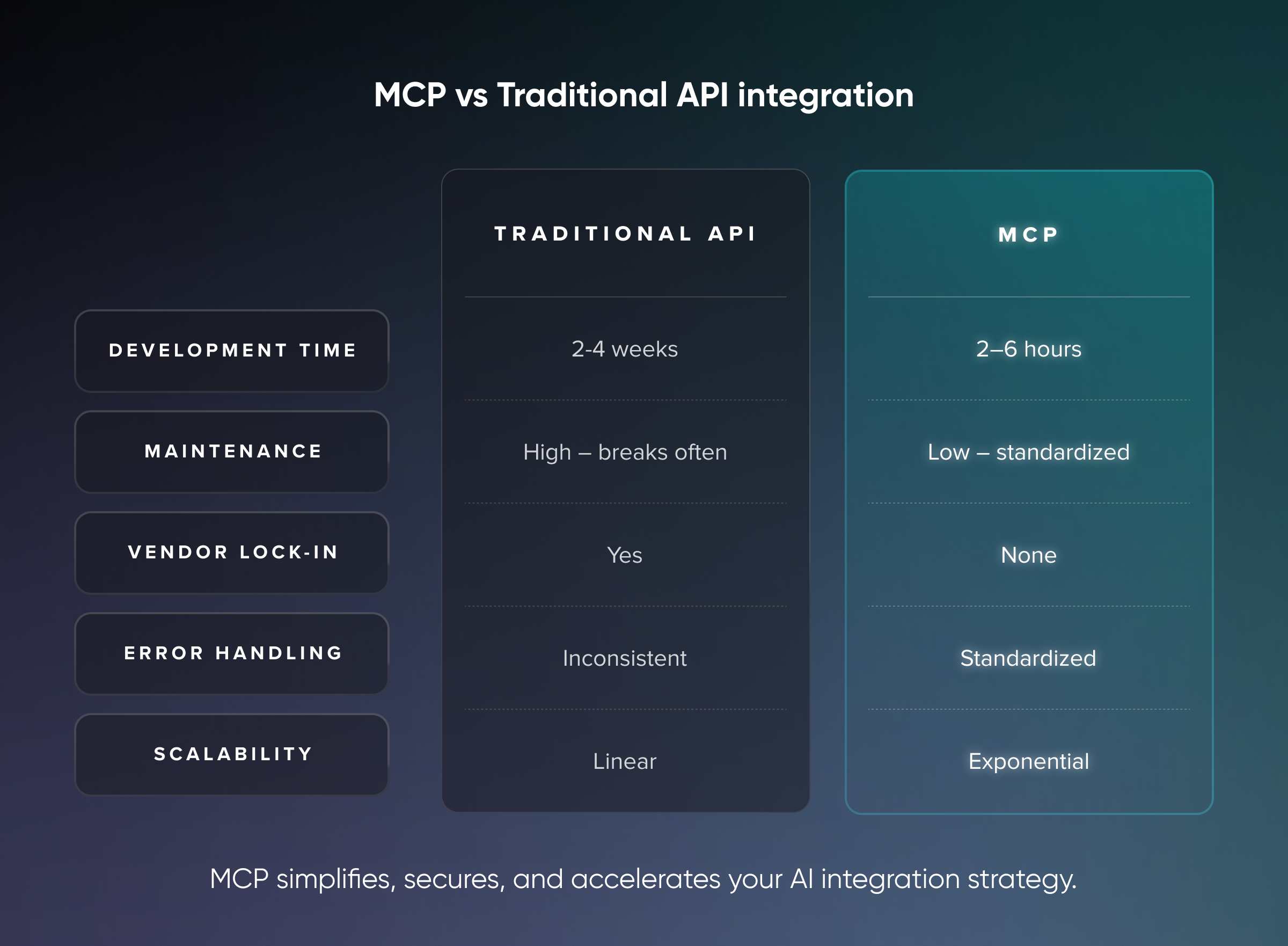
MCP vs Traditional API integration: the complete comparison
The MCP revolution: beyond traditional API Limitations
Unlike traditional API integrations that require custom implementations for each data source, MCP provides a unified framework that allows AI models to seamlessly access diverse contexts and capabilities.
This revolutionary approach addresses one of the biggest challenges in AI development: connecting sophisticated models to the systems where data actually lives.
Key advantages over traditional methods
Universal standardization
Replace hundreds of custom integrations with a single, standardized protocol that works across all AI models and data sources.
Bidirectional communication
Unlike static APIs, MCP enables real-time, two-way data flow between AI systems and external tools.
Vendor independence
Switch between different AI models (Claude, ChatGPT, Gemini) without rebuilding integrations.
Enhanced security
Built-in security patterns, OAuth 2.1 support, and enterprise-grade access controls.
Developer velocity
Reuse pre-built servers and standard patterns instead of writing a new integration for every AI application.
2. Why should software businesses adopt MCP in 2027?
What integration challenges did MCP solve for AI systems?
If you're running a software business in 2027, you're facing an unprecedented challenge: every competitor is racing to add AI features, but most are building expensive, fragmented solutions that will become technical debt within 12 months.
The statistics are sobering:
- 88% of organizations use AI in at least one business function, up from 78% a year earlier, but only 23% are scaling AI agents (McKinsey, The State of AI in 2025)
- Failure rate: 80%+ of AI projects fail to reach production (RAND Corporation Research 2024)
- Zero return: 95% of enterprise organizations got zero return from their generative AI efforts (MIT NANDA, The GenAI Divide, August 2025)
- Value is arriving for a few: nearly half of companies now generate value from AI, but only 7.5% are “future-built” leaders (BCG Applied AI Index, September 2026)
The fundamental problem: Traditional AI integration approaches create vendor lock-in, maintenance nightmares, and limit your ability to adapt to rapidly evolving AI landscape, as documented in Anthropic's MCP announcement.
Direct benefits MCP delivers to any software business
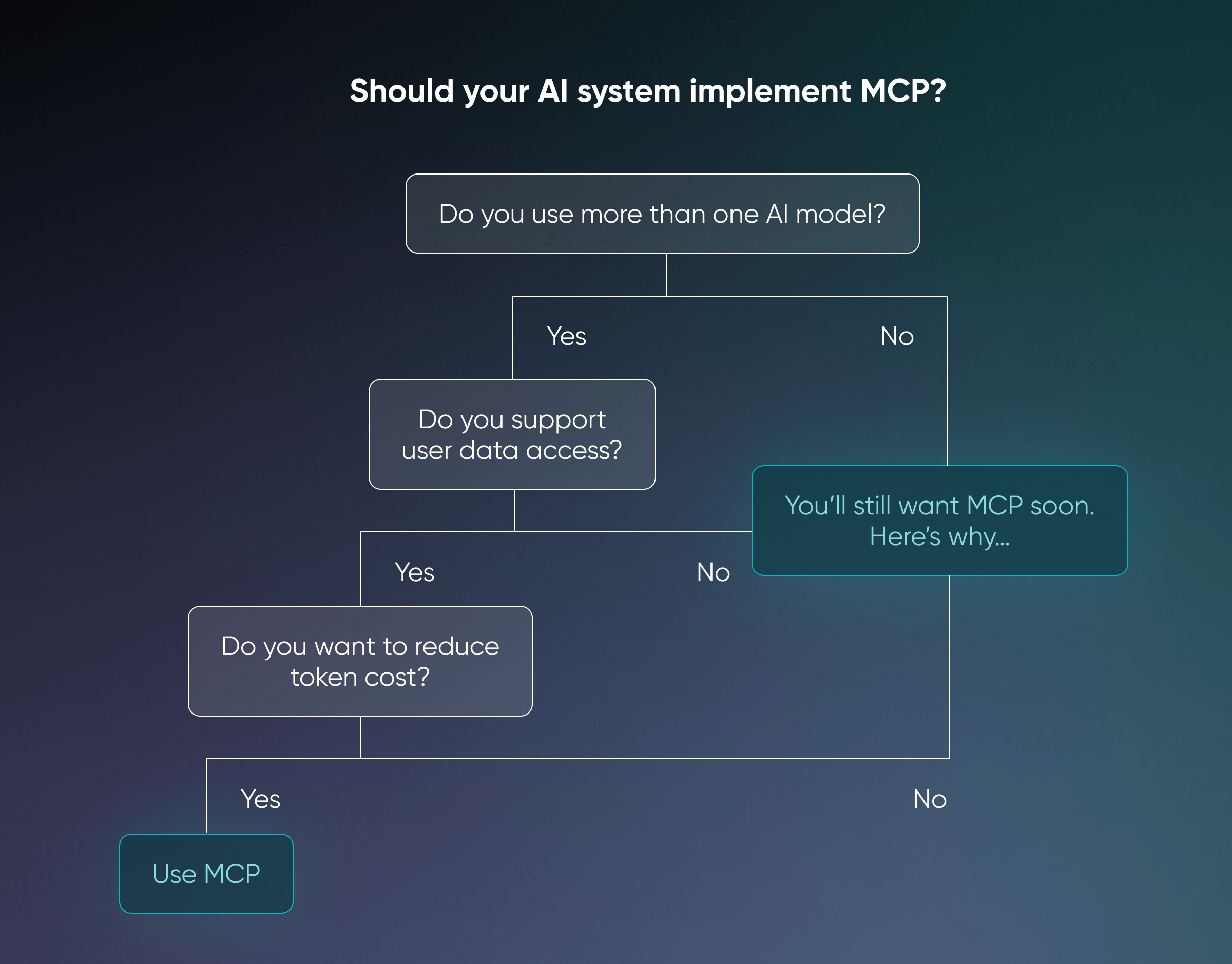
1. Engineering team efficiency
Before MCP
Your developers spend more than half of their AI project time building custom integrations, maintaining multiple API connections, and debugging vendor-specific implementations.
With MCP
One standard implementation connects to all AI models - past, present, and future.
Specific benefits:
- Reduce AI integration time from months to weeks
- Free up senior engineers from integration maintenance to product features
- Eliminate vendor-specific API learning as one protocol works everywhere
- Cut debugging time with standardized error handling
- Accelerate feature shipping for AI-powered capabilities
2. Customer acquisition and retention
Before MCP
You lose deals because customers want different AI models, or you can't demo AI features effectively during sales calls.
With MCP:
You can now be a vendor that offers customer choice and flexibility.
Specific benefits:
- Win more enterprise deals by supporting customer's preferred AI model
- Reduce sales cycle with compelling AI demonstrations
- Increase trial-to-paid conversion through extensive AI capabilities
- Improve customer retention through AI-powered workflow integration
- Expand into new markets by supporting region-specific AI requirements
3. Product development speed
Before MCP
Each new AI feature would require months of planning, custom integration work, and vendor negotiations.
With MCP
You can now add new AI capabilities in days, not months.
Specific benefits:
- Ship AI features faster than competitors, still building custom integrations
- Experiment with multiple AI models without additional engineering work
- Respond to customer requests for specific AI capabilities within weeks
- A/B test different AI providers to optimize performance and cost
- Future-proof your product against AI vendor changes and new market entrants
Real numbers: In the 2025 Stack Overflow Developer Survey, 84% of developers said they use or plan to use AI tools, and 51% of professional developers use them every day.
Trust is the open problem: 46% of developers said they distrust the accuracy of AI output, against 33% who trust it. Among developers who use AI agents, about 70% said agents reduce the time they spend on specific development tasks. Giving AI tools the right context, which is what MCP does, is one of the main levers for accuracy.
4. Revenue growth through premium AI features
Before MCP
Limited AI capabilities would restrict your ability to charge premium pricing or expand customer usage.
With MCP
Comprehensive AI integration enables premium feature tiers and expanded use cases.
Specific benefits:
- Increase average revenue per user through AI feature premiums
- Create new pricing tiers for AI-enhanced plans
- Drive expansion revenue as customers adopt more AI-powered workflows
- Reduce churn through increased product stickiness from AI integrations
- Command market-leading prices due to superior AI capabilities
Real numbers: According to BCG's September 2026 research, nearly half of companies now generate value from AI, and BCG expects agentic AI to account for about 40% of all AI value by 2030.
5. Competitive differentiation
Before MCP
You now have to compete on basic features while struggling to keep up with AI-native startups.
With MCP
You can become an established company with startup-level AI innovation speed.
Specific benefits:
- Outpace AI-native startups with faster feature development and enterprise-grade infrastructure
- Win competitive deals based on AI flexibility and customer choice
- Establish thought leadership in AI integration and industry innovation
- Attract top engineering talent with cutting-edge technology stack
- Build customer switching costs through integrated AI workflows
Real numbers: Block and Apollo were among the early adopters named in Anthropic's MCP announcement. By 2026, ChatGPT, Gemini, Microsoft Copilot, Cursor and Visual Studio Code all act as MCP clients, so a product with an MCP server can be used from each of them.
6. Cost optimization and risk reduction
Before MCP
You have to pay premium prices to AI vendors and face vendor lock-in risks.
With MCP
You can gain negotiating power and cost optimization opportunities.
Specific benefits:
- Negotiate better AI vendor pricing by demonstrating ability to switch providers
- Optimize costs by using different AI models for different use cases
- Reduce vendor lock-in risk and maintain strategic flexibility
- Lower total cost of ownership by eliminating multiple integration maintenance
- Scale AI usage without linear cost increases
Specific MCP benefits by software business type
B2B SaaS platforms (CRM, ERP, marketing tools)
Your challenge: Customers want AI-powered insights and automation, but integration complexity limits what you can offer.
MCP advantage:
- Connect to customer's existing data across all their business systems
- Offer AI-powered analytics that understand full business context
- Enable workflow automation that spans multiple AI capabilities
- Provide personalized AI assistants for each customer's specific needs
Specific revenue impact:
- Increase in contract value through AI premium tiers
- Improvement in customer lifetime value through workflow lock-in
- Faster customer onboarding with AI-assisted setup
Example: a CRM platform exposes its pipeline, contacts and activity data through an MCP server, so a customer's AI assistant can combine it with email and calendar data to prepare account reviews and draft follow-ups.
Developer tools and platforms
Your challenge: Developers expect AI coding assistance, but limited context makes AI suggestions generic and often wrong.
MCP advantage:
- Access full codebase context for accurate AI suggestions
- Connect to development workflows including Git, CI/CD, issue tracking
- Support any AI model developers prefer for coding assistance
- Enable AI-powered debugging with access to logs, metrics, documentation
Specific revenue impact:
- Transform pricing from individual to team plans
- Increase daily active usage through AI workflow integration
- Reduce customer churn through increased productivity value
Example: a code editor connects to GitHub, Jira, Slack and documentation through MCP, so its AI pair programmer can read the issue, the related code and the team discussion before it suggests a change.
Vertical/Industry-specific software
Your challenge: Customers need AI that understands industry-specific data, regulations, and workflows.
MCP advantage:
- Connect to industry-specific systems (EMRs, legal databases, manufacturing systems)
- Support compliance requirements for AI model choice and data handling
- Enable domain-expert AI that understands industry terminology and processes
- Integrate with regulatory and compliance systems for audit trails
Specific revenue impact:
- Create premium pricing for AI-enhanced industry solutions
- Expand market reach by supporting different regions' AI compliance requirements
- Increase customer switching costs through deep workflow integration
Example: legal practice management software connects case law databases, court filing systems and document management through MCP, so an AI assistant can research a matter with the firm's own documents in context.
E-commerce and marketplace platforms
Your challenge: Merchants want AI for personalization, inventory optimization, and customer service, but can't access needed data.
Here is a clear example:
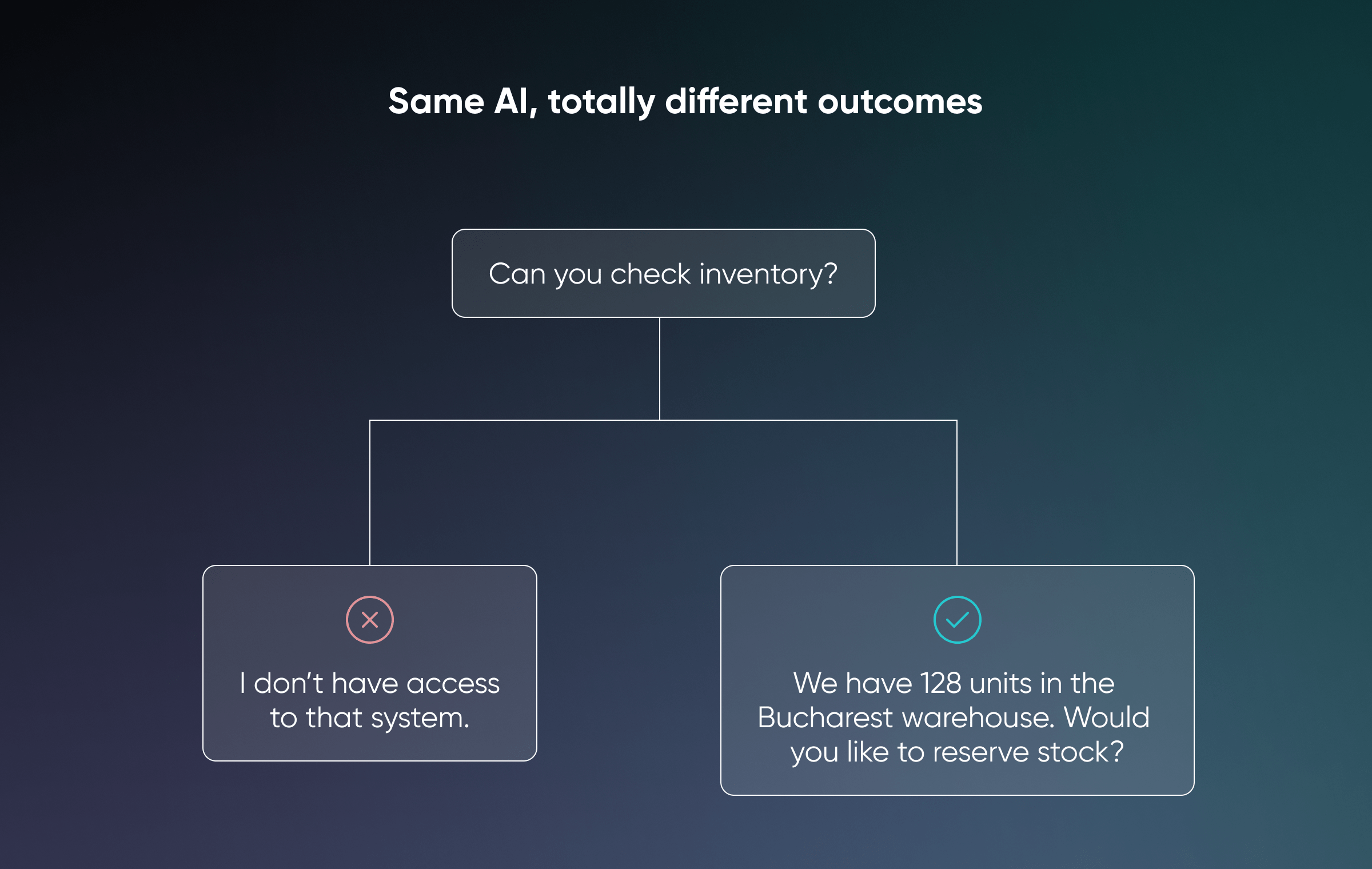
- Unify customer data across touchpoints for personalization
- Connect inventory and supply chain systems for AI-powered optimization
- Enable AI customer service with access to order history, product catalogs, customer preferences
- Support multiple AI models for different merchant needs and preferences
Specific revenue impact:
- Increase in platform fees through AI-powered merchant success
- Improvement in merchant retention through AI-driven revenue growth
- Double platform usage through expanded AI-powered features
Example: an e-commerce platform connects inventory, customer data, marketing tools and analytics through MCP, so a merchant's AI assistant can answer questions such as which products to restock before a campaign.
Communication and collaboration software
Your Challenge: Teams want AI assistance for meetings, project management, and knowledge sharing, but AI lacks context about team dynamics and project history.
MCP advantage:
- Access communication history across channels for context-aware AI
- Connect to project management tools for AI-powered workflow optimization
- Enable meeting AI with access to calendars, documents, previous meetings
- Support knowledge management with AI that understands team expertise and project context
Specific revenue impact:
- Increase in per-seat pricing through AI productivity features
- Reduction in churn through increased team productivity value
- Expand to enterprise market with AI governance and compliance features
Example: a collaboration platform connects calendars, project tools, documents and team profiles through MCP, so its AI assistant can prepare meeting agendas and track project progress.
Implementation success factors for software businesses
Phase 1: Quick wins
Focus: Prove MCP value with internal tools and simple customer features.
Specific actions:
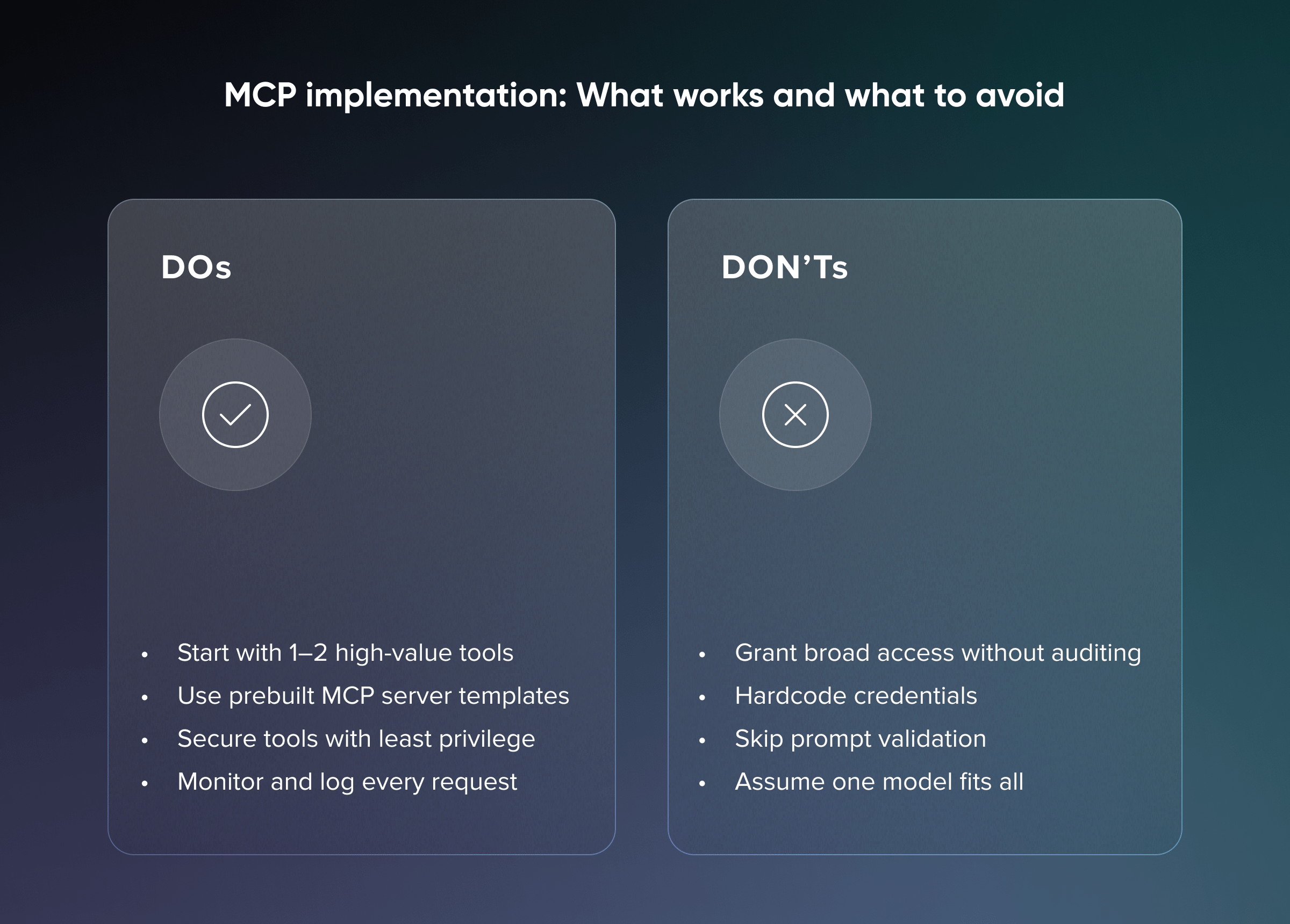
- Connect internal AI tools to company databases and code repositories
- Measure developer productivity improvement
- Implement simple customer MCP feature (e.g., AI that reads customer's uploaded files)
- Gather initial customer feedback and usage analytics
Phase 2: Customer value
Focus: Deploy MCP features that directly impact customer success and willingness to pay.
Specific actions:
- Launch MCP-powered premium tier with price increase
- Enable customer data connections to their existing business tools
- Create AI workflows that solve customers' biggest pain points
- Develop customer success metrics showing AI-driven improvements
Phase 3: Market leadership
Focus: Establish market position as the AI-flexible, customer-choice platform.
Specific actions:
- Support all major AI applications (Claude, ChatGPT, Gemini, Microsoft Copilot)
- Build MCP marketplace for third-party integrations
- Launch enterprise features with AI governance and compliance
- Develop partner ecosystem with AI providers and system integrators
3. Why MCP is essential for modern AI development
The integration crisis before MCP
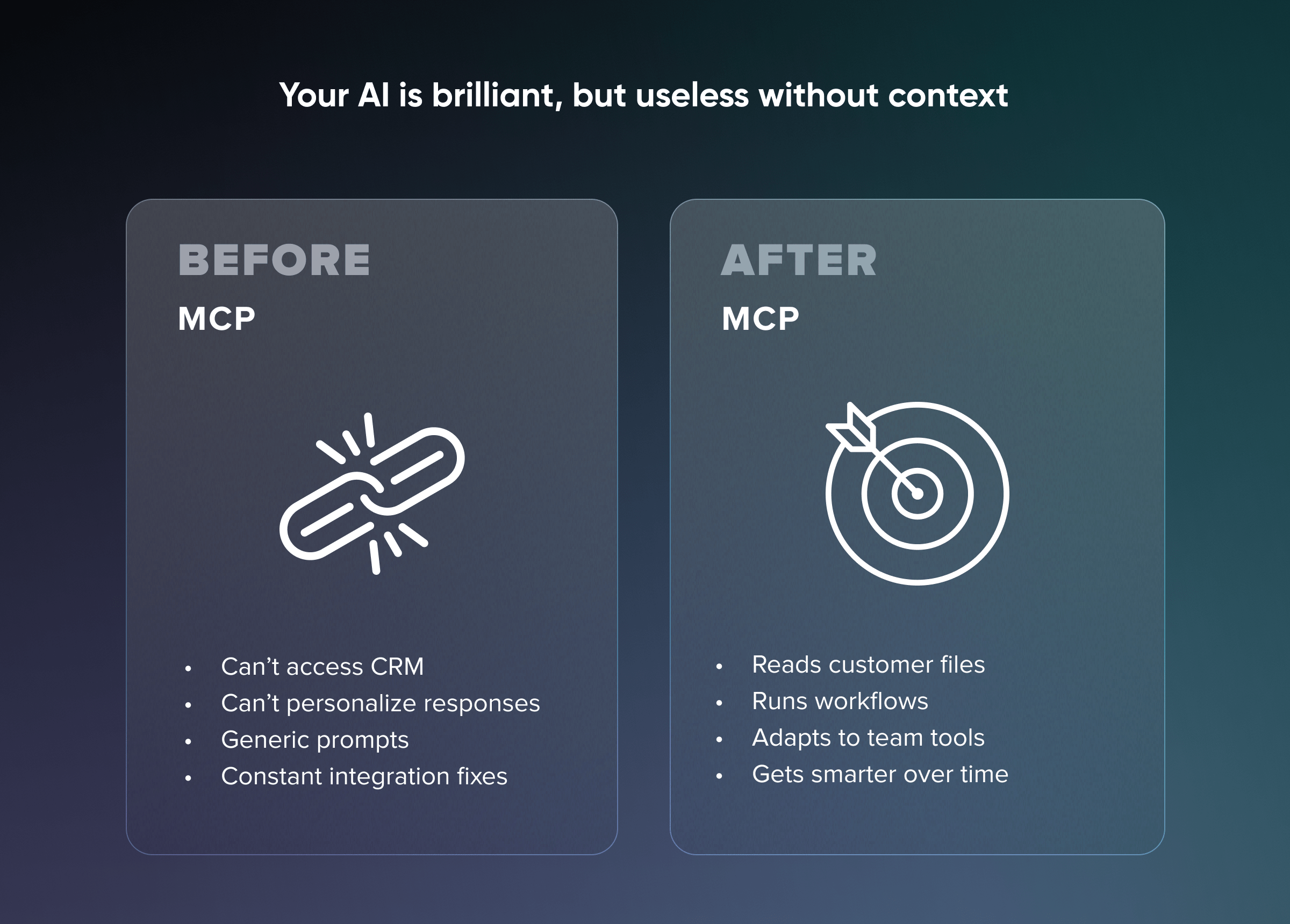
Before MCP, AI integration faced what Anthropic described as the "N×M problem", every AI tool needed separate integrations with every data source, creating exponential complexity:
- Custom development
Each integration required unique code, API understanding, and maintenance
- Fragmented ecosystem
No standardization across AI providers or tool vendors
- Scalability issues
Linear increase in complexity with each new integration
- Maintenance overhead
Updates to any component could break multiple integrations
- Vendor lock-in
Integrations tied to specific AI providers limited flexibility
How does MCP address the key challenges in AI integration?
1. Eliminates integration fragmentation
MCP provides a universal, open standard for connecting AI systems with data sources, replacing fragmented integrations with a single protocol.
This means:
- One integration works with all MCP-compatible AI models
- Standardized patterns reduce development time
- Simplified maintenance across your entire AI stack
- Future-proof architecture that adapts to new AI models
2. Enables true AI context awareness
Modern AI applications need access to:
- Real-time data (databases, APIs, live feeds)
- Historical context (document repositories, version control)
- Interactive capabilities (system commands, workflow automation)
- Business logic (custom rules, approval processes)
3. Accelerates enterprise AI adoption
Early adopters like Block and Apollo integrated MCP into their systems in 2024, and development tool companies including Zed, Replit, Codeium and Sourcegraph built on it. By 2026, MCP support had spread to ChatGPT, Gemini, Microsoft Copilot, Cursor and Visual Studio Code.
Industry adoption and market impact
The rapid adoption of MCP signals a fundamental shift in AI development:
Major AI providers
Following its announcement, the protocol was adopted by major AI providers, including OpenAI, Google DeepMind and Microsoft.
Enterprise integration
In March 2025, OpenAI officially adopted the MCP, following a decision to integrate the standard across its products, including the ChatGPT desktop app, OpenAI's Agents SDK, and the Responses API.
Developer tools
Support in Visual Studio Code, Cursor, Zed and other major development tools
Community growth
More than 10,000 active public MCP servers by December 2025, and close to half a billion monthly downloads of the official SDKs by July 2026. Since December 2025 the protocol is governed by the Agentic AI Foundation under the Linux Foundation (see section 10).
4. How does the Model Context Protocol architecture work?
Core architectural principles
MCP follows a client-server architecture inspired by the Language Server Protocol (LSP), designed for reliability, security, and scalability.
A. MCP hosts: the AI application layer
Applications like Claude, ChatGPT, Visual Studio Code or your own product that want to access data through MCP.
Hosts manage:
- User interactions and permissions
- Multiple client connections
- Security policy enforcement
- Error handling and recovery
B. MCP clients: the protocol interface
Protocol clients that maintain dedicated 1:1 connections with servers.
Each client handles:
- Connection lifecycle management
- Message serialization/deserialization
- Authentication and authorization
- Capability discovery, including cached tool lists
3. MCP servers: the capability providers
Lightweight programs that expose specific capabilities through the standardized Model Context Protocol. Servers can connect to:
- Local data sources: Files, databases, system services
- Remote services: APIs, cloud platforms, external systems
- Custom logic: Business rules, workflows, calculations
Communication protocols and transport layers
MCP uses JSON-RPC 2.0 as its underlying message format, ensuring standardized, reliable communication.
The protocol defines two standard transports:
STDIO Transport (local integrations)
{
  "mcpServers": {
    "local-database": {
      "command": "python",
      "args": ["mcp-database-server.py"],
      "env": {
        "DATABASE_URL": "postgresql://localhost/mydb"
      }
    }
  }
}
Use cases: Local development, file system access, database connections
Benefits: Low latency, simple deployment, no network configuration
Security: Process isolation, local system permissions
Streamable HTTP transport (remote integrations)
{
  "mcpServers": {
    "remote-api": {
      "url": "https://api.example.com/mcp",
      "headers": {
        "Authorization": "Bearer ${API_TOKEN}"
      }
    }
  }
}
Use cases: Cloud services, enterprise APIs, distributed systems
Benefits: Network-based, scalable, centralized management
Security: OAuth 2.1, TLS encryption, centralized auth
Note: Streamable HTTP replaced the older HTTP+SSE transport in the 2025-03-26 specification, and the 2026-07-28 specification formally deprecated HTTP+SSE with a one-year offramp. If you still run an HTTP+SSE server, plan the migration before mid-2027.
MCP server capabilities framework
Every MCP server can expose three types of capabilities:
Resources: data and content access
Resources provide read-only access to data sources without side effects:
@server.list_resources()

async def list_resources() -> List[Resource]:
    return [
        Resource(
            uri="file://documents/report.pdf",
            name="Q4 Financial Report",
            description="Latest quarterly financial analysis",
            mimeType="application/pdf"
        ),
        Resource(
            uri="database://customers/active",
            name="Active Customer List",
            description="Current active customer database",
            mimeType="application/json"
        )
    ]
Examples: File contents, database records, API responses, cached data
Tools: Interactive functions
Tools enable AI models to perform actions and modifications:
@server.list_tools()

async def list_tools() -> List[Tool]:
    return [
        Tool(
            name="send_email",
            description="Send email to specified recipients",
            inputSchema={
                "type": "object",
                "properties": {
                    "to": {"type": "array", "items": {"type": "string"}},
                    "subject": {"type": "string"},
                    "body": {"type": "string"},
                    "priority": {"type": "string", "enum": ["low", "normal", "high"]}
                },
                "required": ["to", "subject", "body"]
            }
        )
    ]
Examples: API calls, system commands, database modifications, file operations
Prompts: reusable templates
Prompts provide standardized instruction templates for consistent AI interactions:
return [

    Prompt(
        name="code_review",
        description="Comprehensive code review template",
        arguments=[
            {
                "name": "pull_request_url",
                "description": "GitHub pull request URL",
                "required": True
            },
            {
                "name": "focus_areas",
                "description": "Specific areas to focus on",
                "required": False
            }
        ]
    )

]
5. Why is MCP more scalable than traditional AI integration methods?
The evolution of AI integration approaches
| Integration method | Built once per | Maintenance | Works across AI applications | Standardization |
|---|---|---|---|---|
| Custom APIs | AI application and data source pair | High | No | None |
| Function calling | Model provider's tool format | Medium | Partly; each provider defines tools its own way | Provider-specific |
| MCP | Data source, as one MCP server | Low | Yes, with any MCP client | Open standard, governed by the Agentic AI Foundation |
6. What are the top security best practices for implementing MCP?
Critical security vulnerabilities in MCP implementations
Security research since 2025 has identified several MCP-specific vulnerabilities that developers must address.
According to a 2025 security analysis by Palo Alto Networks:
"MCP's architecture offers significant advantages in interoperability and efficiency, but it also introduces unique security challenges."
1. Prompt injection attacks
Risk: Malicious inputs can manipulate AI behavior through MCP tool descriptions
Mitigation: Implement input sanitization and context separation
Example: Tool description containing hidden instructions to exfiltrate data
Source: MCP Security Exposed report, Palo Alto Networks 2025
2. Tool poisoning vulnerabilities
Risk: Attackers modify tool metadata to alter AI behavior
Mitigation: Digital signatures for tool definitions, metadata validation
Source: Security analysis by Equixly, March 2025
3. Excessive privilege escalation
Risk: MCP servers granted broader access than necessary
Mitigation: Principle of least privilege, regular permission audits
Advisory: Microsoft's security blog emphasizes that "granting excessive permissions can allow for exfiltration or amending data that the MCP server was not intended to be able to access"
Enterprise security implementation framework
def __init__(self):
self.auth_manager = OAuth2Manager()
self.audit_logger = SecurityAuditLogger()
self.rate_limiter = RateLimiter(requests_per_minute=100)
async def validate_request(self, request):
"""Comprehensive request validation"""
# Input sanitization
sanitized_input = self.sanitize_input(request.data)
# Rate limiting
await self.rate_limiter.check_limit(request.client_id)
# Permission validation
if not await self.auth_manager.validate_permissions(
request.client_id, request.requested_action
):
raise SecurityError("Insufficient permissions")
# Audit logging
await self.audit_logger.log_request(request)
return sanitized_input
Security monitoring and incident response
Key metrics to monitor:
- Failed authentication attempts (threshold: >5/minute)
- Unusual tool execution patterns
- Large data exfiltration attempts
- Cross-server communication anomalies
For comprehensive security guidelines, refer to the official MCP security best practices documentation.
Automated alert configuration:
prompt_injection:
pattern: "system:|ignore previous|new instructions"
severity: high
action: block_and_alert
privilege_escalation:
pattern: "admin|root|escalate"
severity: critical
action: immediate_block
data_exfiltration:
threshold: ">1MB data transfer"
severity: medium
action: rate_limit_and_log
7. How can you scale MCP for enterprise-grade AI systems?
Scaling MCP servers for enterprise workloads
Since the 2026-07-28 specification, MCP servers no longer hold sessions, so any instance can answer any request and you scale them horizontally behind a standard load balancer, like any other web service.
Example service-level targets to agree before launch (illustrative starting points, not measured benchmarks; set yours from your own load tests):
| Deployment Scale | Concurrent Users | Response Time (p95) | Uptime SLA |
|---|---|---|---|
| Small (1–50 users) | 50 | <200ms | 99.5% |
| Medium (51–500 users) | 500 | <500ms | 99.9% |
| Large (501–5000 users) | 5,000 | <1000ms | 99.95% |
| Enterprise (5000+ users) | 50,000+ | <1500ms | 99.99% |
Performance optimization techniques
Database query optimization:
- Connection pooling with 20+ concurrent connections
- Query result caching (Redis/Memcached)
- Database index optimization for MCP-specific queries
- Read replica distribution for analytics workloads
Memory management:
- Response streaming for large datasets
- Memory-mapped file access for document processing
- Garbage collection tuning for long-running servers
- Resource pooling for expensive operations
Network optimization:
- HTTP/2 for transport layer efficiency
- Compression for large response payloads
- CDN integration for static resource delivery
- Regional server deployment for global access
8. What are some real-world examples of MCP in production?
Industry implementation success stories
1. Block (Square) - open-source agents and governance
- What they did
Block was one of the first companies to adopt MCP and built its open-source AI agent, goose, on it - Where it led
In December 2025 Block co-founded the Agentic AI Foundation with Anthropic and OpenAI, contributing goose as one of its founding projects (Anthropic)
"At Block, open source is more than a development model—it's the foundation of our work and a commitment to creating technology that drives meaningful change and serves as a public good for all," said Dhanji R. Prasanna, Chief Technology Officer at Block
2. Replit - developer platform enhancement
- Challenge
Enable AI coding assistants to access project context, git history, deployment data - Solution
Comprehensive MCP ecosystem for development workflows - Status
Among development tools companies working with MCP to enhance their platforms, enabling AI agents to better retrieve relevant information and produce more nuanced code
3. Sourcegraph - code intelligence at scale

- Challenge
Provide AI with semantic understanding of codebases across organizations - Solution
MCP servers for code search, dependency analysis, security scanning - Integration: Sourcegraph Cody implements MCP through OpenCtx for enhanced code intelligence
4. Honeycomb - observability
- What they report
Nearly 20% of Honeycomb's monthly interactive queries now come from AI agents, according to the MCP maintainers
Emerging use cases and market opportunities
According to industry analysis, MCP adoption is expanding rapidly across multiple sectors:
1. Healthcare AI integration
- Patient data aggregation from EHR systems
- Medical research database connectivity
- Compliance-aware data access patterns
- Real-time clinical decision support
2. Financial services innovation:
- Real-time market data integration
- Risk assessment AI with regulatory compliance
- Customer service automation with account access
- Fraud detection with transaction history analysis
3. Manufacturing and IoT:
- Production line data integration
- Predictive maintenance AI connectivity
- Quality control system automation
- Supply chain optimization with real-time data
4. Developer tools ecosystem
As reported by various development platforms, companies including Zed, Replit, Codeium, and Sourcegraph are working with MCP to enhance their platforms.
Code editors and IDEs have adopted support for the protocol, including Zed (which surfaces prompts as slash commands), Cursor (with MCP tools in its Composer environment), and Continue (an open-source AI code assistant).
Where the MCP market is heading in 2027
The adoption numbers point one way: close to half a billion monthly downloads of the official MCP SDKs by July 2026, according to the MCP maintainers, and support across every major AI platform.
In March 2025, OpenAI officially adopted the MCP, following a decision to integrate the standard across its products, including the ChatGPT desktop app, OpenAI's Agents SDK, and the Responses API. Sam Altman described the adoption of MCP as a step toward standardizing AI tool connectivity.
Key market drivers:
1. Security solutions
Growing demand for enterprise-grade MCP security frameworks
2. Enterprise tooling
Advanced monitoring, management, and deployment solutions
3. Industry-specific servers
Vertical-specific MCP implementations for healthcare, finance, manufacturing
4. Performance optimization
Tools and services for scaling MCP deployments
9. How can mastering MCP give your company a competitive edge?
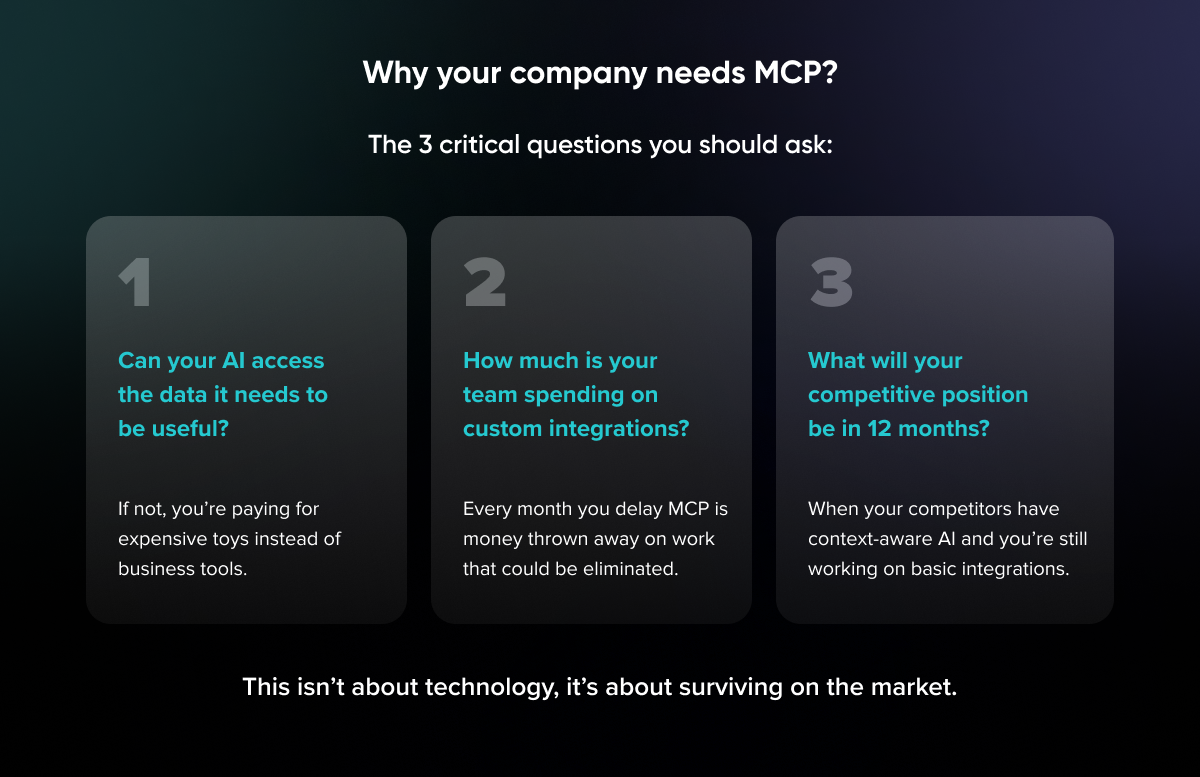
The Model Context Protocol represents more than just another integration standard, it's the foundation for the next generation of AI-powered applications.
Organizations that master MCP implementation today will have significant competitive advantages as AI becomes increasingly central to business operations.
Key takeaways from this guide:
- Technical mastery
You now have the practical knowledge to build production-ready MCP servers with enterprise-grade security and performance - Strategic understanding
MCP's universal compatibility and standardization benefits provide clear ROI for development investments - Security awareness
Understanding and implementing MCP security best practices is crucial for enterprise deployment success - Market positioning
Early adoption of MCP positions your organization at the forefront of AI integration innovation
Your next steps:
1.Start building
Use the code examples in this tutorial to create your first MCP server. Or if you don’t have the knowledge, don’t hesitate to reach out to Linnify, you can do it at requests@linnify.com
2. Join the community
Contribute to the open-source MCP ecosystem and learn from other developers
3. Scale strategically
Plan your MCP implementation roadmap based on business priorities and technical requirements. If you’re not sure how to do it, we’d be glad to assist you.
4. Stay updated: Follow MCP specification updates and security advisories for ongoing optimization.
10. What changed in MCP since 2025?
The protocol changed more between 2025 and 2026 than in its first year. If your team built an MCP server from a 2025 tutorial, these are the changes to check.
| Change | Specification | What it means for your team |
|---|---|---|
| Streamable HTTP replaced the HTTP+SSE transport for remote servers | 2025-03-26; HTTP+SSE formally deprecated on 2026-07-28 with a one-year offramp | Move remote servers to Streamable HTTP before the offramp ends in 2027 |
| An authorization framework based on OAuth 2.1 | 2025-03-26 | Remote servers use standard OAuth flows instead of ad hoc API keys |
| Tool annotations, such as read-only or destructive | 2025-03-26 | Hosts can ask for confirmation before an agent runs a destructive action |
| A stateless core: no initialization handshake and no session ID | 2026-07-28 | Any server instance can answer any request, so you scale with a normal load balancer |
| Routing headers (Mcp-Method, Mcp-Name) on HTTP requests | 2026-07-28 | Gateways can route and rate-limit calls without reading the message body |
| Caching hints (ttlMs, cacheScope) on tool, prompt and resource lists | 2026-07-28 | Clients stop re-fetching tool lists on every call |
| Client ID Metadata Documents replace Dynamic Client Registration, now deprecated | 2026-07-28 | Plan the authorization migration; the old flow still works for now |
| An extensions framework, starting with Tasks, MCP Apps and Enterprise Managed Authorization | 2026-07-28 | Long-running work and enterprise sign-on become standard add-ons instead of custom code |
| Roots, Sampling and Logging deprecated, with at least twelve months of support | 2026-07-28 | Check whether your servers rely on them |
The 2026-07-28 release is not fully backward compatible, so test existing servers against the official SDKs before you upgrade.
Who governs MCP now?
In December 2025, Anthropic donated MCP to the Agentic AI Foundation (AAIF), a fund under the Linux Foundation co-founded by Anthropic, Block and OpenAI, with Google, Microsoft, AWS, Cloudflare and Bloomberg as supporters. No single vendor now controls the standard, which matters if you are choosing it for a product you will run for years.
How widely is MCP used?
- By December 2025 there were more than 10,000 active public MCP servers and 97 million monthly SDK downloads, according to Anthropic.
- ChatGPT, Cursor, Gemini, Microsoft Copilot and Visual Studio Code all act as MCP clients, so a product with an MCP server can be used from each of them.
- By July 2026 the official SDKs were close to half a billion downloads a month, according to the MCP maintainers.
11. What is the A2A (Agent2Agent) protocol?
A2A is an open standard that lets one AI agent find another agent, hand it a task and follow that task until it is done, even when the two agents come from different vendors or frameworks. Google introduced A2A in April 2025 and transferred it to the Linux Foundation in June 2025.
A2A reached version 1.0, its first stable specification, in early 2026. By April 2026 more than 150 organizations supported it, including AWS, Cisco, Google, IBM, Microsoft, Salesforce, SAP and ServiceNow, according to the Linux Foundation. It runs natively in Microsoft's Azure AI Foundry and Copilot Studio and in Amazon Bedrock AgentCore Runtime. In August 2026 A2A joined MCP in the Agentic AI Foundation. Frameworks such as LangGraph, CrewAI, Pydantic AI, AG2 and IBM BeeAI support it.
How does A2A work?
- Discovery. Each agent publishes an Agent Card, usually at /.well-known/agent-card.json, describing its skills, its endpoints and how to authenticate. In version 1.0, Agent Cards can be signed, so a caller can verify who runs the agent.
- Delegation. The calling agent sends a message, and the remote agent opens a task. The remote agent decides how to do the work; the caller does not see its tools or reasoning.
- Tracking. A task moves through states such as submitted, working, input required, completed or failed. The caller follows it by polling, by streaming or through push notifications to a webhook.
- Results. The finished task returns artifacts, such as a document, a structured result or a file.
A2A messages travel over JSON-RPC, gRPC or plain HTTP with JSON, and the specification requires the three to behave the same way.
12. MCP vs A2A: what is the difference?
MCP connects an agent to its tools. A2A connects an agent to other agents. The A2A maintainers describe MCP as the vertical layer and A2A as the horizontal one.
| MCP | A2A | |
|---|---|---|
| Connects | An AI application to tools, data and prompts | One agent to another agent |
| Who decides how the work is done | The calling application's model picks the tool; the server runs exactly that | The remote agent decides how to complete the task |
| Unit of work | A tool call or a resource read | A task with states, messages and artifacts |
| How capabilities are found | The server lists its tools on request | An Agent Card at a well-known address |
| Transports | stdio, Streamable HTTP | JSON-RPC, gRPC, HTTP with JSON |
| Started by | Anthropic, November 2024 | Google, April 2025 |
| Governed by | Agentic AI Foundation, since December 2025 | Agentic AI Foundation, since August 2026 |
The two overlap at the edges. When a remote agent's skill is simple to call, it can be exposed as an MCP tool instead of an A2A task.
When should you use MCP, A2A or both?
- MCP only. Your agent needs your product's data and actions, or your customers want to use your product from ChatGPT, Claude or Copilot. Most B2B SaaS teams start here.
- A2A. Your agent has to delegate work to an agent another team, vendor or customer runs, and you should not need to know how that agent works inside.
- Both. Your product offers an MCP server for its tools and an A2A endpoint so other companies' agents can hand it whole tasks. This is the usual pattern once a product's agents work across company boundaries, as in multi-agent systems built for enterprises.
- Neither. The workflow is fixed and code decides every step. Call the API directly.
13. How to use MCP and A2A together in a multi-tenant SaaS product
In a B2B SaaS product, every customer has its own data, permissions and rules, so both protocols have to respect tenant boundaries. Four practices keep that manageable:
- One MCP server, scoped per tenant. The server checks which customer and which user a call belongs to before it runs any tool, and returns only that tenant's data.
- A gateway in front of it. Authentication, per-tenant rate limits and an audit log sit in one place. The 2026 routing headers let the gateway do this without reading message bodies.
- A2A only where agents cross a company boundary. Publish an Agent Card, require authentication on every task and sign the card so callers can verify it. For push notifications, refuse webhook addresses in private network ranges.
- Log and evaluate both layers. Record every tool call and every task with its inputs and outputs, so you can test the agent's decisions before and after each release.
For the security side in depth, see our MCP security best practices guide. For tenant-level agent design, read AI Agents for SaaS: the complete guide.
14. Relevant resources for MCP
Industry research and reports
- McKinsey, The State of AI in 2025: AI and agent adoption across organizations
- BCG Applied AI Index, September 2026: Where companies generate value from AI
- MIT NANDA, The GenAI Divide, August 2025: Returns on generative AI investments
- RAND Corporation, 2024: Why AI projects fail
- Stack Overflow Developer Survey 2025: Developer use of and trust in AI tools
MCP-specific sources:
- Anthropic MCP Official Announcement: Model Context Protocol introduction and early adopter results
- MCP Official Documentation: Technical specifications and implementation guides
- MCP specification 2026-07-28: Release notes for the stateless specification
- MCP specification 2025-03-26: Changelog: OAuth 2.1 authorization and Streamable HTTP
- Anthropic: Donating MCP and establishing the Agentic AI Foundation
- Linux Foundation: A2A surpasses 150 organizations
- A2A Protocol: A2A joins the Agentic AI Foundation
- Agentic AI Foundation: A2A v1.0 builder's guide
Frequently asked questions about MCP (Model Context Protocol)
1. What is the Model Context Protocol and why is it important for AI in 2027?
The Model Context Protocol (MCP) is a universal standard that connects AI models with real-world data sources, enabling context-aware capabilities. It’s critical for scalable, production-ready AI systems in modern software businesses.
2. How does MCP improve over traditional API integrations?
Unlike traditional APIs that require unique, custom connectors, MCP provides a single, open standard that allows developers to connect any AI model, such as Claude, ChatGPT, or Gemini, to any system with less effort and more flexibility.
3. Is MCP secure enough for enterprise applications?
MCP defines an authorization framework based on OAuth 2.1, runs over TLS for remote servers, and supports tool annotations so hosts can ask before destructive actions. Enterprises can further enhance security with sandboxing, context separation, and prompt validation strategies.
4. What are real-world examples of MCP in action?
Block built its open-source agent goose on MCP, Sourcegraph and Replit use it for code intelligence and developer workflows, and ChatGPT, Gemini, Microsoft Copilot, Cursor and Visual Studio Code all act as MCP clients.
5. How can a development team start implementing MCP?
Start by selecting a use case where AI needs more context, like file access, internal APIs, or real-time data. You can then use existing open-source MCP server templates or build your own following the official MCP documentation.
6. Which tools and platforms support MCP today?
Claude, ChatGPT, Gemini and Microsoft Copilot all support MCP, as do developer tools such as Visual Studio Code, Cursor, Zed and Replit. By December 2025 there were more than 10,000 active public MCP servers.
7. What is the A2A protocol?
A2A, or Agent2Agent, is an open standard that lets one AI agent discover another, hand it a task and track that task to completion, even across vendors and frameworks. Google introduced it in April 2025, and it is now governed by the Linux Foundation's Agentic AI Foundation.
8. What is the difference between MCP and A2A?
MCP connects an agent to tools and data; A2A connects an agent to other agents. With MCP, the calling model chooses the exact tool to run. With A2A, the remote agent decides how to complete the task it was given.
9. Do I need both MCP and A2A?
Most B2B SaaS products need MCP first, so their agents and their customers' AI tools can use the product's data and actions. Add A2A when your agents must work with agents another company runs.
10. What changed in the MCP specification in 2026?
The July 28, 2026 release made the core protocol stateless, added routing headers and caching hints, introduced an extensions framework (including Tasks), and deprecated the old HTTP+SSE transport and Dynamic Client Registration.
11. Who owns MCP and A2A?
Neither is owned by one company. Anthropic donated MCP to the Agentic AI Foundation, part of the Linux Foundation, in December 2025, and A2A joined the same foundation in August 2026.
Contributors
Speakers
Guest
Host
Share


Download
the full guide
Let’s build
your next digital product.
Subscribe to our newsletter
YOU MIGHT ALSO BE INTERESTED IN
RELATED ARTICLES


YOU MIGHT ALSO BE INTERESTED IN
