



How Linnify built AI agents that sort every tenant inquiry
See how we built the AI Digital Inbox for facilioo, a multi-agent system that prepares every tenant inquiry for approval, not by replacing property managers, but by doing the sorting they never have time for.
client
facilioo
MARKET
Germany
INDUSTRY
PropTech
solution
AI Inbox Agent | Multi-Agent System

Linnify built AI workflow automation for our Digital Inbox, extracting key data from tenant requests and mapping it to the right processes with 70 to 90% accuracy. They met every deadline and adapted easily when our priorities changed.

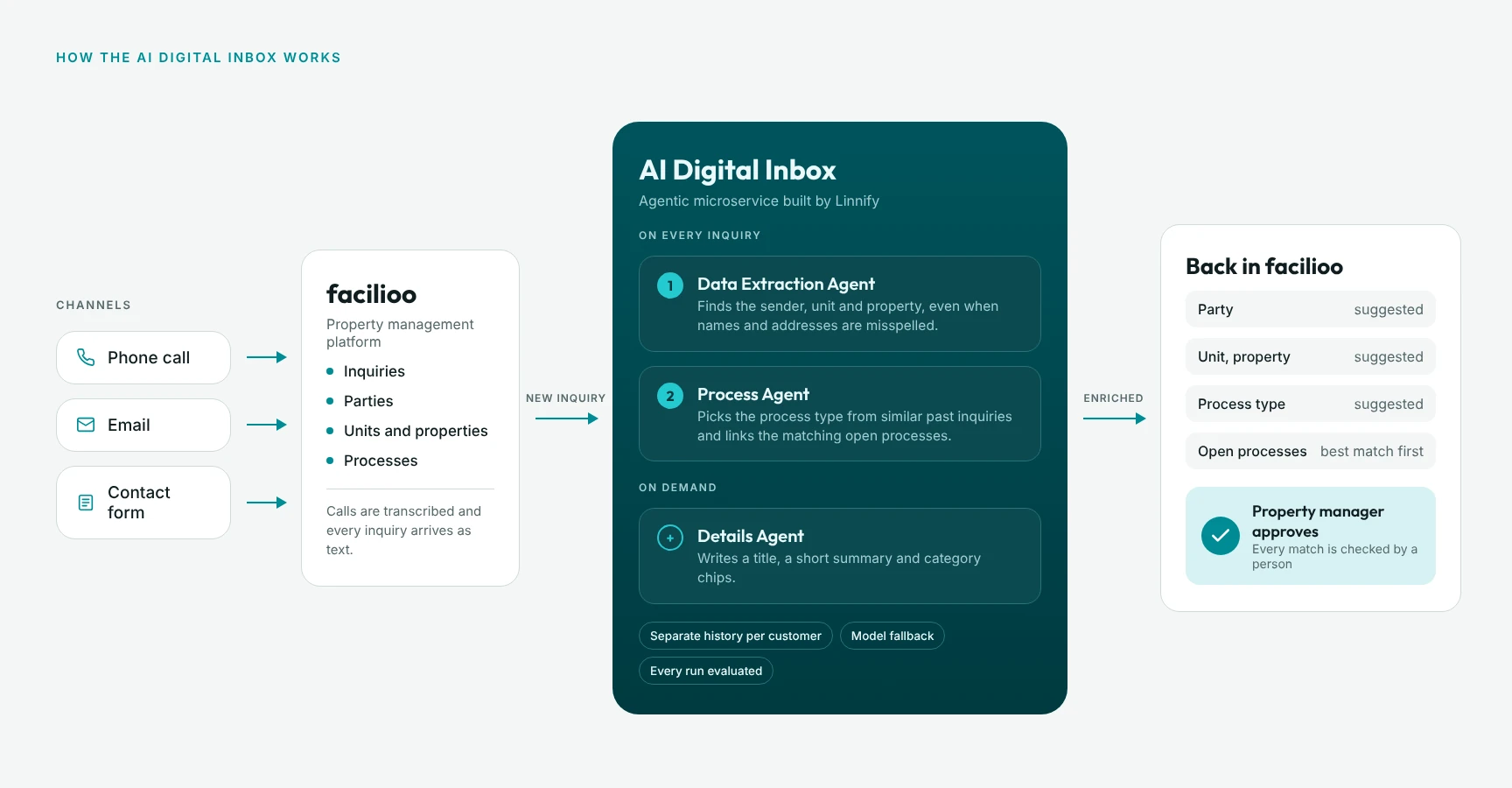
The AI Digital Inbox is a multi-agent service that prepares every facilioo inquiry for a property manager to approve.
facilioo is a Berlin-based CRM and workflow platform for property management professionals. It brings every process around the operation of a building (communication, tasks, documents and maintenance) into one platform, to close the digitalisation gap that has left real estate behind other industries.
Its Digital Inbox is the central hub for incoming communication, and facilioo turns every phone call, email and contact form into text. But text alone does not say who wrote in, about which unit, or what should happen next. As inbound volume grew, property managers carried a heavy manual workload just to work that out.
Linnify built the AI Digital Inbox, an agentic service that recommends the sender, unit, property, process type and matching open processes for each inquiry, so property managers check and approve a prepared suggestion instead of searching and sorting by hand.
We partnered with facilioo from a validated Proof of Value through to production integration, contributing AI architecture, agentic engineering and the validation-driven delivery process behind the agent.

CHALLENGE
Property managers spent their time sorting inquiries, not solving them.
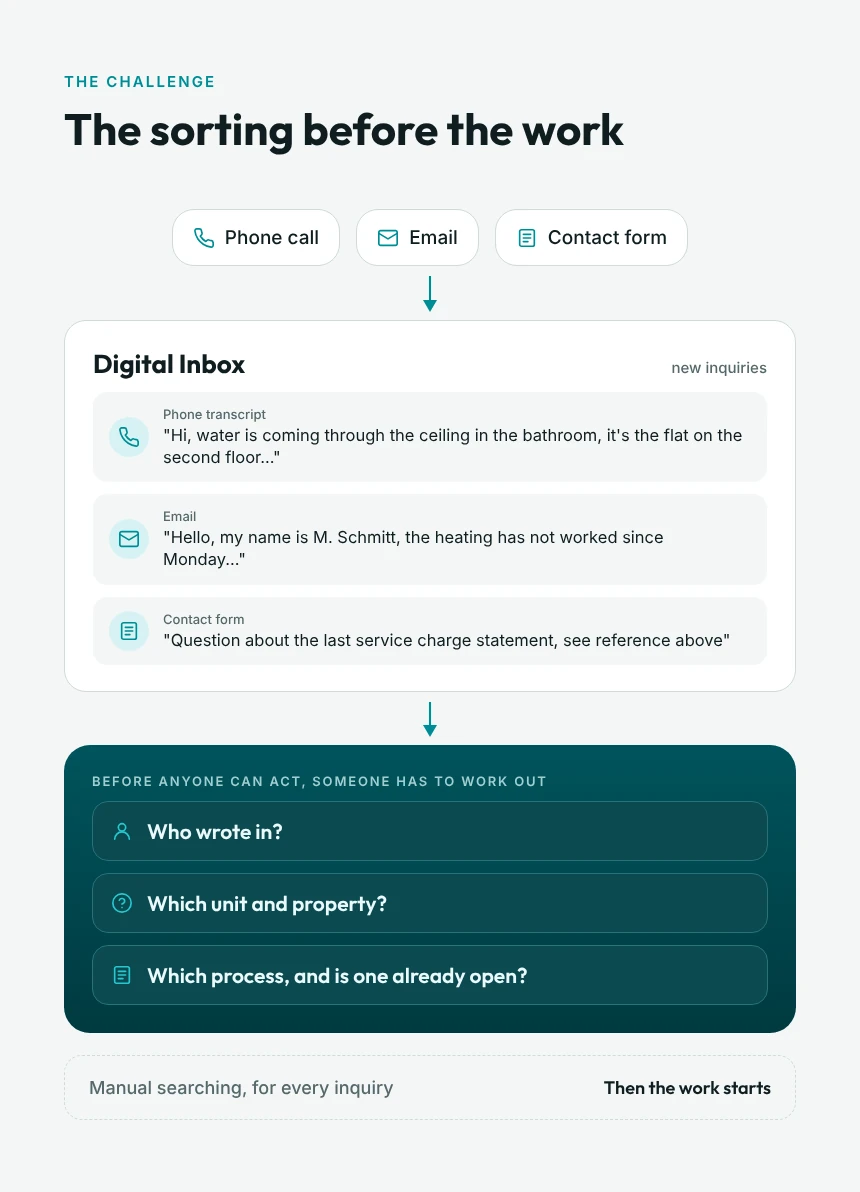
In property management, the hard part is often not resolving a tenant inquiry, but the manual overhead around it: working out who sent it, which unit and property it refers to, which type of process it belongs to and whether there is already an open process for it, before anyone can act.
facilioo already turns every channel into text, from emails and contact forms to transcribed phone calls. The text is there. Making sense of it, across many property management associations, is what had become the constraint: a typical property manager handled around X inbound messages a day.
- Messy details: names and addresses arrive misspelled, inconsistent or incomplete, so finding the right person, unit and property in the master data takes manual searching.
- Many possible processes: every inquiry has to be matched to the right process type and, often, to a process that is already open.
- Every company files differently: each property management company has its own process types and its own way of handling requests, so one fixed set of rules cannot fit them all.
- More messages, more manual work: the time spent sorting grew with message volume and capped how much a team could handle.
As inbound volume keeps climbing, intelligent automation moves from a nice-to-have to an operational necessity. For a platform serving property managers in Germany, it also had to be GDPR-conscious, and the property manager had to stay in control of every decision.
Why current alternatives are not addressing the challenge?
A traditional inbox or rules engine can filter by keyword and apply static routing. It cannot recognize a tenant whose name is misspelled, link a vague description to the right unit, or tell which of a customer's own process types a free-text message belongs to.
Rule-based systems and scripted chatbots break the moment a message does not fit the template, which is most real messages.
facilioo needed AI that could resolve fuzzy details against live master data, compare each inquiry with how that customer has filed similar ones before, and hand the property manager a ready recommendation to approve. That required specialized agents with a human in the loop, not a workflow.
What Linnify built: AI agents for property management inquiries
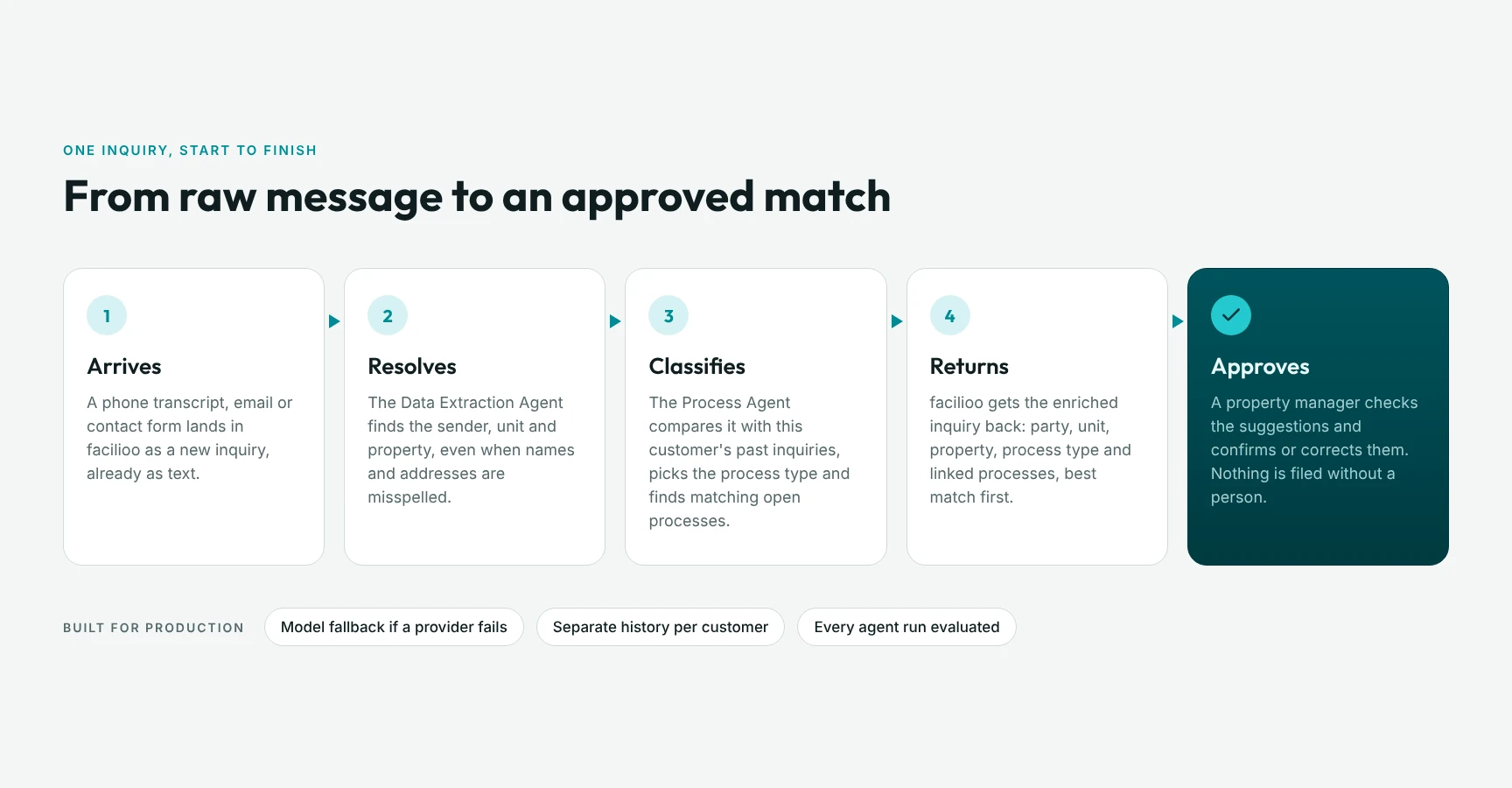
The AI Digital Inbox is an agentic microservice built on LangGraph and connected to facilioo. When a phone transcript, email or contact form lands in facilioo as a new inquiry, the service gets it as text and sends it back enriched: the party, unit, property, process type and the linked open processes, best match first. Three specialized agents share the work, and a property manager reviews and approves every result.
Data Extraction Agent
Finds the sender, unit and property behind each inquiry with live lookups in facilioo and fuzzy matching, so misspelled names and addresses still resolve. Inquiries that arrive already resolved skip this step. Everything it extracts is a recommendation for the property manager to check.
Process Agent
Compares the inquiry with similar past inquiries for each process type, picks the best fit and links the matching open processes, best match first. If the inquiry quotes a process number, it goes straight to that process. Past inquiries are embedded and kept current through facilioo webhooks, so suggestions follow how each customer actually files its requests.
Details Agent
Runs on demand. It writes a title, a short summary and category chips for an inquiry, and rewrites them when a user gives feedback, so property managers can take in a long message at a glance.

We split the AI Digital Inbox into focused agents: one resolves who wrote in and about which unit, one finds the right process, and one writes summaries on demand. Each agent is evaluated on its own, so every change is measured on real scores before release. We also built it to keep running if a model provider fails, and kept each customer’s data separate, so one company’s history never shapes another’s results.
What changed after launch
X% of suggestions approved without changes
Property managers approve X% of the agent's suggested sender, unit, property and process without edits. The work shifts from searching and sorting to checking and approving.
Review in X seconds, not X minutes
Checking a prepared inquiry takes about X seconds, compared with X minutes to sort it by hand. Emails, contact forms and phone transcripts all come back in the same shape, best match first.
70 to 90% mapping accuracy
The agents extract the key data from tenant requests and map them to the right processes with 70 to 90% accuracy, and a property manager still approves every match, so the team keeps full control.
X inquiries handled every month
The agent handles around X inquiries a month for X property management companies. If a call to OpenAI fails, it is retried on Gemini, and each company has its own vector namespace, so one customer's history never shapes another's results.




FREQUENTLY ASKED QUESTIONS
How is the AI Digital Inbox different from a rules-based inbox or a chatbot?
A rules engine filters by keyword and follows a fixed path; the AI Digital Inbox makes recommendations. Its agents resolve the sender, unit and property against facilioo's master data even when names are misspelled, and compare each inquiry with that customer's own past inquiries to suggest the right process type and the matching open processes. A property manager then approves the result.
How do you measure the agents' accuracy?
Each agent has its own evaluator, and every run is traced by environment, so any change to a prompt or model is compared on real scores. The baseline was built with facilioo's domain experts from real historical requests, and only a QA engineer can sign off a release, which then goes through client alpha testing on staging and beta testing with end users before production.
Does the AI replace property managers?
No. The agent prepares and the property manager decides. Every extracted field and every suggested process is a recommendation that a property manager checks and approves.
How is it built, and how does it integrate with existing property management software?
As a standalone AI service that connects to facilioo through its API. facilioo sends each new inquiry and gets the enriched result back, so the existing platform did not need to change. The service switches to a backup model if a provider fails, keeps every customer’s data separate and scores every agent run, which kept disruption low and adoption fast.
Does this approach work for other B2B SaaS products?
Yes. Any SaaS product that receives a high volume of unstructured requests, such as facility management, insurance claims or customer support, can use the same pattern: work out who and what each request is about, compare it with that customer's own history, and hand a person a ready recommendation. The domain layer is the client's own data. The agentic pattern is reusable.


