




How Linnify turned a complex paint catalog into an AI expert advisor
See how we built Gustav, a multi-agent AI system that guides Kober customers, from DIY homeowners to professional contractors, to the right product, color and partner store, not by sending them to a catalog, but by answering like a team of expert consultants.
client
Kober
MARKET
Romania
INDUSTRY
Paint & Varnishes
solution
Conversational AI Assistant | Multi-Agent System

We initially set out to implement the conversational agent as a market differentiator in providing unparalleled customer support through automated solutions, but it ended up delivering far more than we expected. Not only did it guide our clients through complex product specifications, it also revealed where our own materials were unclear or incomplete. That insight enabled us to refine our sales content and communicate more effectively. It has been a game-changer for both our customers and our internal teams.

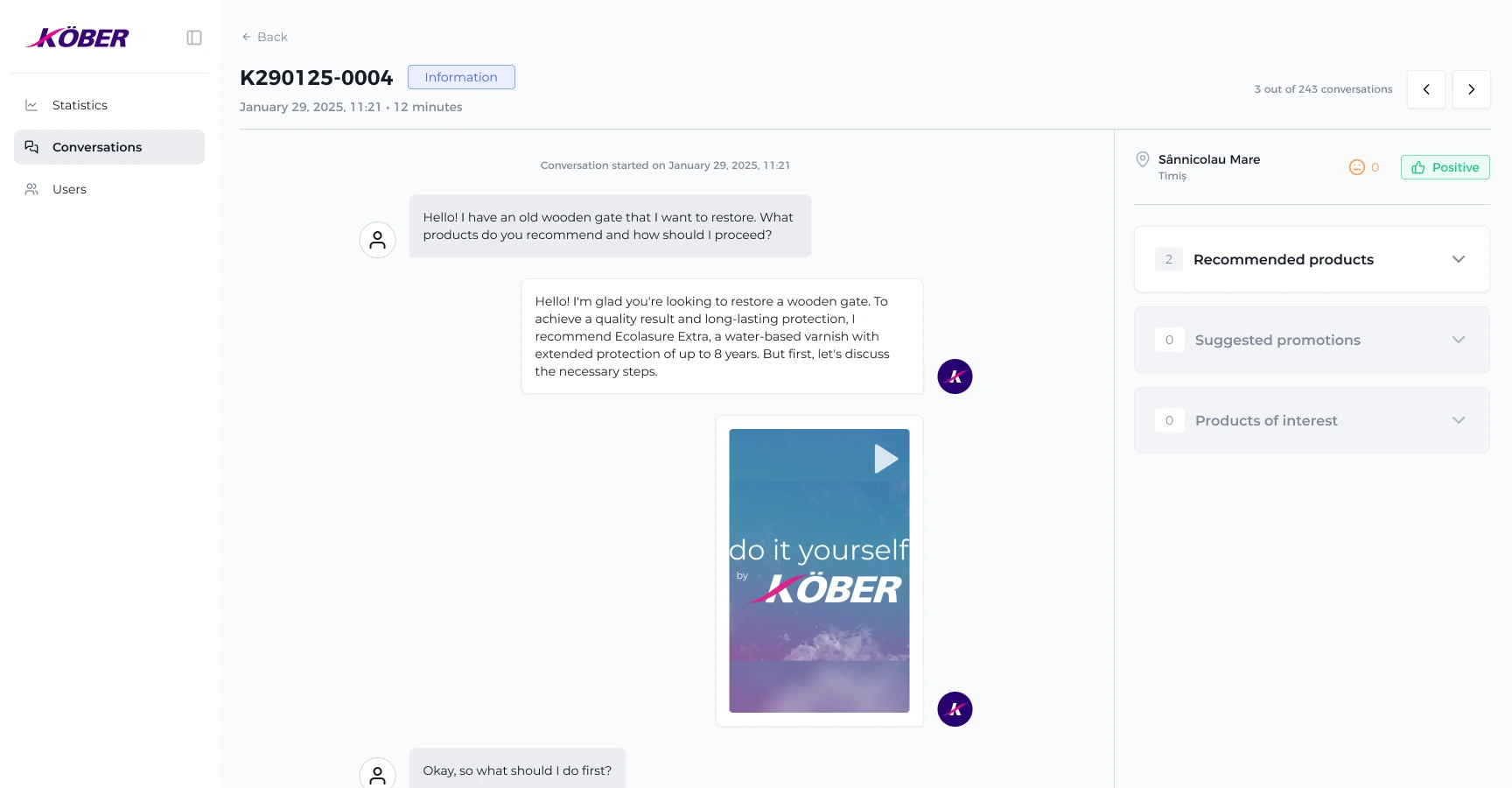
Gustav is a multi-agent AI assistant that guides Kober customers through a complex portfolio of paints, coatings and specialized materials.
Kober is Romania’s leading manufacturer of paints and varnishes. Its range spans decorative paints, industrial coatings and specialized materials, and serves both DIY homeowners and professional contractors.
Every product comes with usage guidance that changes with the surface, the conditions and the intended application. Kober wanted that expertise available to every customer, at any hour, without making them read a technical sheet.
Linnify built Gustav, a conversational AI assistant that replicates the interaction with a real consultant. It gives personalized product recommendations, application instructions and instant access to technical sheets and compliance files, in Kober’s own brand voice.
Linnify acted as Kober’s end-to-end AI partner, contributing AI architecture, UX/UI design, product strategy and delivery. We continue to run Gustav in production on Google Cloud’s Vertex AI, from model orchestration and monitoring to cost and performance optimization. The partnership is ongoing.

CHALLENGE
Customers did not lack product information. They lacked someone to interpret it.
Kober faced a challenge common to manufacturers with large, highly technical ranges. Its customers, from professional contractors to DIY homeowners, struggled to tell similar products apart and to work out which one fit their project.
Each product came with dense technical sheets full of color codes, chemical compositions and precise usage conditions. The right answer depended on the surface, the environment and the finish, so a single product page rarely answered the real question.
- Complex product ranges: customers had to choose from tens of products depending on surface, finish and application conditions.
- Information overload: digital catalogs and product sheets were too dense for non-specialists to use on their own.
- Conversion barriers: without expert support, customers struggled to make confident purchase decisions.
- Support that does not scale: customer service teams spent their time on repetitive questions, manual document retrieval and long one-to-one guidance.
The Romanian market added one more constraint. It mixes professional contractors with individual DIY customers, so the assistant had to feel simple for a first-time buyer and still give a contractor full technical depth, in a tone that matched Kober’s brand.
Why current alternatives are not addressing the challenge?
Static catalogs hold the right information, but customers have to find it, read it and interpret it themselves.
Off-the-shelf chatbots were not designed for this level of complexity. Most could only give generic answers or redirect users to catalog pages. They could not interpret nuanced questions, recommend products for unusual surfaces or environmental conditions, or walk a customer through the correct application steps.
Kober needed AI that could reason over its own documentation the way an expert consultant does: understand the project, ask the right follow-up question and ground every answer in Kober’s technical data. That required specialized agents, not a single chatbot.

What Linnify built: a network of specialized AI agents
Rather than one general-purpose chatbot, Gustav is built on five specialized agents that work together behind a single chat interface. Each owns one area of expertise and is grounded in Kober’s technical documentation and compliance records.
Color Selection Agent
Explores Kober’s palette and suggests shades by preference, project type or trend. As Kober’s core differentiator, it runs on Anthropic’s Claude Haiku 4.5, which interprets each request and picks the right tools to find a matching color.
Recommendation Agent
Matches products to the customer’s needs and context, such as surface, project type and conditions, and explains why each product fits.
Technical Specialist Agent
Advises on application, surface compatibility and correct usage, with step-by-step instructions. It retrieves technical sheets, compliance files and video tutorials on request.
Partner Stores Agent
Points customers to the nearest authorized Kober partner for pricing and availability, so every conversation ends with a clear next step to buy.
Complaints Agent
Detects dissatisfaction during the conversation and routes the customer to Kober’s support team.

We treat every agent in Gustav as its own component, with its own evaluation suite for technical accuracy, recommendation precision, domain restriction, complaint routing and knowledge-base access. That is what made the system easy to improve. When the evals showed the color agent was the bottleneck, we swapped its model on Vertex AI without touching the orchestration or the other agents, and errors on that flow dropped to zero.
What changed after launch
Zero errors on the core color agent
Color selection is Kober’s core differentiator. On its original model the agent failed on more than half of live conversations; since moving to Claude Haiku 4.5 it has recorded zero customer-reported errors in production.
Over 97% accuracy across agents
Evaluation metrics for technical accuracy, recommendation precision, domain restriction, complaint routing and knowledge-base access each average over 97%.
Expert guidance for every customer
DIY homeowners and professional contractors get expert-level answers in real time, without parsing technical sheets. Simpler product selection and application support improve conversion potential and take repetitive questions off the support team.
Customer insight on demand
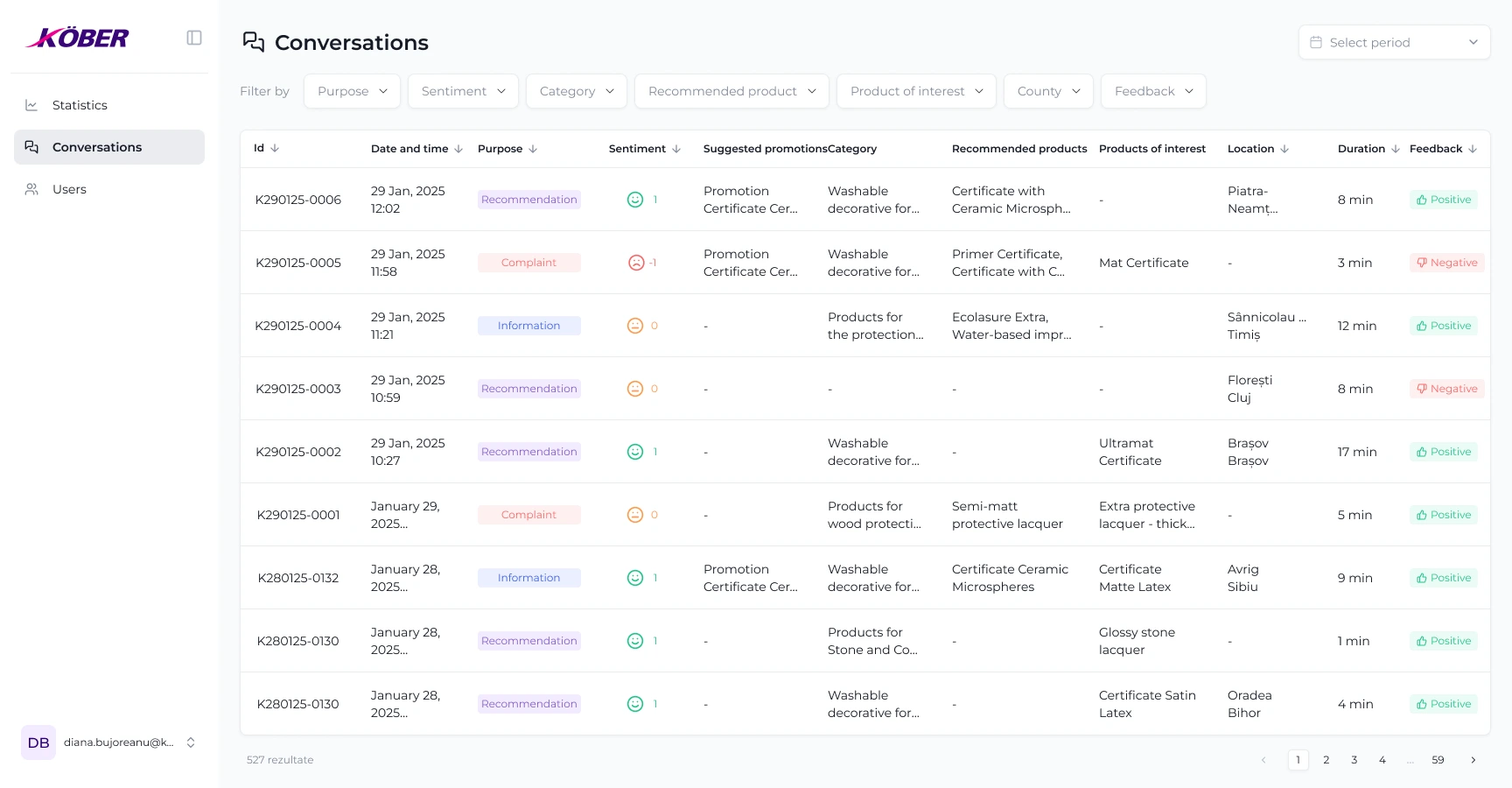
The admin dashboard turns every conversation into insight on customer behavior and product interest. It also showed Kober where its own product materials were unclear, so the team could refine its sales content.



FREQUENTLY ASKED QUESTIONS
What makes Gustav different from a standard chatbot?
A standard chatbot uses one general-purpose model to match questions to answers. Gustav splits the work across five specialized agents for colors, recommendations, technical advice, partner stores and complaints. Each answer comes from the agent with the deepest knowledge of that topic, grounded in Kober’s own documentation.
How accurate is Gustav, and how do you measure it?
Each agent has its own evaluation suite. Technical accuracy, recommendation precision, domain restriction, complaint routing and knowledge-base access each average over 97%. In production, the Color Selection Agent has recorded zero customer-reported errors since its model migration.
How does Gustav stay up to date with the product catalog?
Gustav syncs automatically with Kober’s website CMS. Promotions update daily, products, technical sheets and videos every three days, and colors weekly, so the assistant always reflects the current range without retraining.
How long does it take to build a system like this?
Gustav went from internal beta in April 2025 to production with real customers in July 2025. Linnify has kept improving it since, based on real conversations and per-agent evaluations.
Does this architecture work for other industries?
Yes. Any company that sells products with complex technical specifications, such as building materials, industrial equipment or chemicals, can use the same multi-agent pattern on top of its own documentation. The industry layer is the knowledge base. The agentic infrastructure is reusable.


