

.svg)

.svg)

How to get an AI system through enterprise compliance review


.png)
AI systems that work in testing fail at compliance review more often than they fail technically.
The system produces correct outputs. The model performs. The demo went well. And then legal, security, or governance review flags problems that trace back to decisions made in the first week of the project and that cannot be fixed without a significant rebuild.
This is the most predictable failure mode in enterprise AI deployment.
It is also almost entirely avoidable.
Compliance review does not fail AI systems because the requirements are unreasonable. It fails them because those requirements were not treated as design constraints from the beginning.
This guide covers what enterprise compliance review actually examines, what the EU AI Act and GDPR require for AI systems, how US-regulated enterprises approach the same problem without a federal framework, and how to build AI that passes compliance review the first time not the third.
Why AI systems fail compliance review
Compliance review is not primarily a legal problem. It is an architectural one.
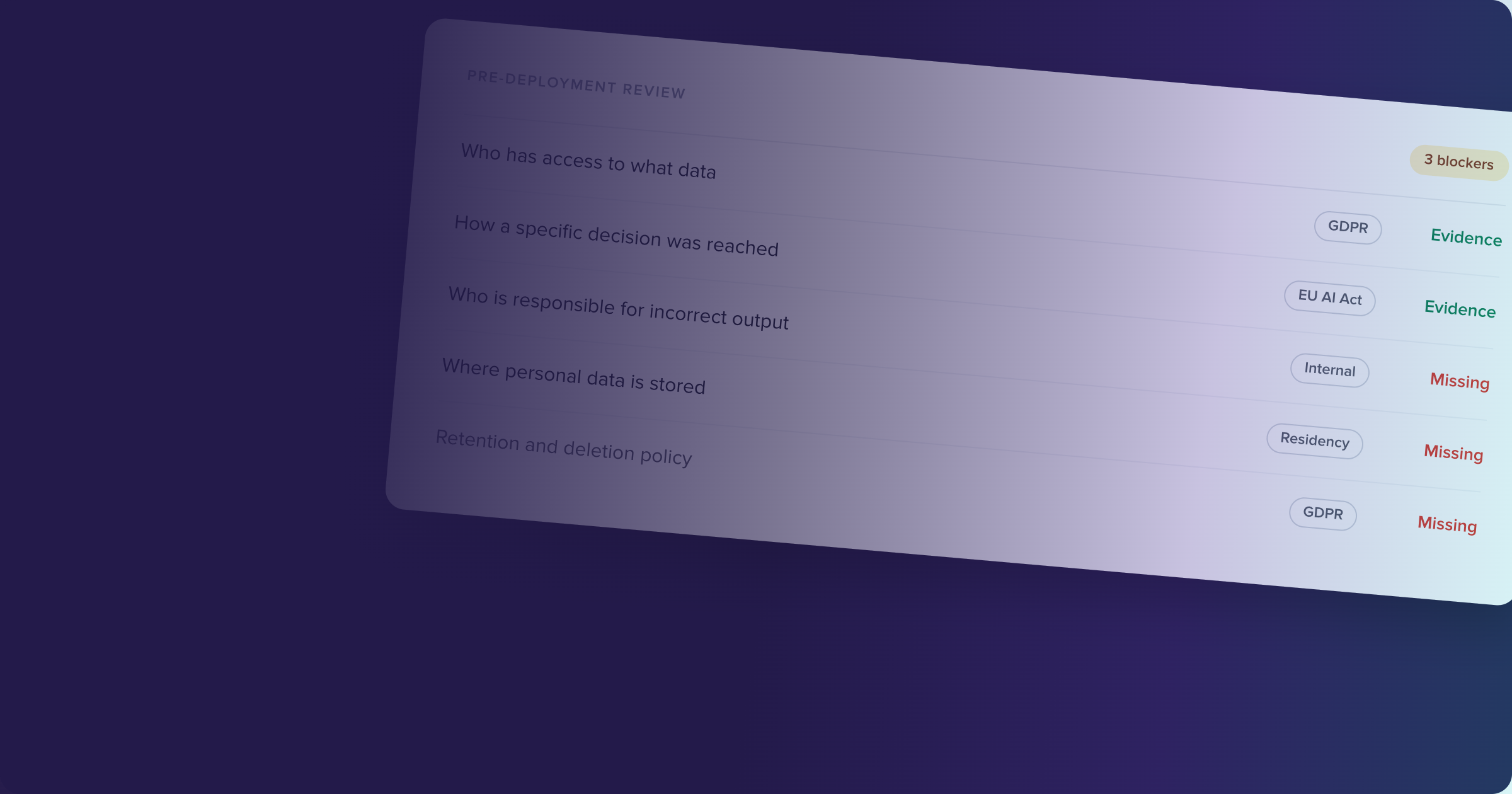
When a legal, security, or governance team reviews an AI system before production deployment, they are asking a set of questions that the system either was or was not designed to answer.
“Can you show us who has access to what data?”
“Can you demonstrate how the system reached a specific decision?”
“What happens when the system produces incorrect output, and who is responsible?”
“How is personal data handled across each territory where the system operates?”
A system built without these questions in mind cannot answer them adequately, regardless of how much documentation is produced after the fact.
Audit trails that do not exist cannot be reconstructed. Access controls that were not designed in cannot be retrofitted cleanly. Data that was processed without residency controls cannot be retroactively compliant.
The teams that consistently get AI through compliance review do not have better lawyers or more lenient governance processes. They have AI systems that were built from the start to answer the questions compliance will ask.
The 3 layers of compliance
Enterprise AI compliance review examines three distinct layers.
Most AI systems are built to satisfy the first layer and are largely unprepared for the second and third. Getting through the review requires all three.
Layer 1: Access control and role management
Every person and system that can interact with the AI read its outputs, supply it with data, trigger its decisions, or modify its behaviour needs a defined, documented role.
Compliance review will ask who can access what, under what conditions, and what happens when access permissions change.
This means role-based access controls implemented across every interface the system exposes: the user-facing layer, any APIs the system calls or exposes, the data pipelines feeding the system, and the administrative layer used for configuration and monitoring.
It means access logging, a record of who accessed what, when, and what action they took. And it means a documented off-boarding process: what happens when a team member leaves, or when a vendor loses their credentials.
Access control is rarely the layer that surprises teams.
What surprises teams is the documentation requirement: not just that controls exist, but that they can be demonstrated, tested, and evidenced.
A security audit will not accept a verbal assurance that access is restricted. It will ask to see the controls in operation.
Layer 2: Logging and auditability
A production-ready AI system must be able to explain itself.
That means a complete record of every agent decision: the inputs the system received, the processing steps that occurred, the output produced, and any human review that was applied before the output was acted upon.
Compliance teams need this record for two reasons.
First, to investigate when something goes wrong: when an incorrect output is produced, when a decision is disputed, or when a user or customer raises a concern.
Second, to demonstrate ongoing compliance to regulators who may audit the organisation either routinely or in response to a specific incident.
The standard that most enterprise compliance frameworks set is not "we have logs somewhere."
It is "we can produce a complete, timestamped, tamper-evident record of any specific decision within a defined time window."
For AI systems operating in regulated environments, such as finance, healthcare, insurance, and manufacturing that window is typically defined by sector-specific regulation.
Auditability cannot be added to a system that was not designed to produce it.
The logging architecture, the data retention policies, and the query interfaces that allow compliance teams to pull records all need to be designed as part of the system not appended to it during the compliance review process.
Layer 3: Governance checkpoints and sign-off
Before an AI system reaches production, enterprise governance frameworks require that specific stakeholders have reviewed and approved specific aspects of the system.
Legal reviews the data handling approach. Security reviews the access controls and logging. The Data Protection Officer (or equivalent) reviews GDPR and data residency compliance. The relevant business owner signs off on the intended use and the human oversight model.
This layer fails most often not because stakeholders refuse to sign off, but because they are brought into the process too late. When governance stakeholders first encounter an AI system at the pre-production review stage, they frequently see design decisions for the first time that they would have flagged in week two of the project.
The rework required is not a matter of additional testing it is often a redesign of core architectural components.
The solution is to treat governance checkpoints as milestones in the build process, not as gates before launch. Legal should see the data handling design before the pipeline is built. Security should review the access model before roles are implemented.
The DPO (Data Protection Officer) should be consulted on data residency before the infrastructure is provisioned. Bringing these stakeholders in at the right point in the project costs a fraction of bringing them in at the wrong one.
What GDPR and the EU AI Act actually require
For organisations operating in the EU or building AI systems that will process data about EU residents, two regulatory frameworks define the compliance floor.
They are separate instruments with different scopes, and both apply simultaneously to most enterprise AI deployments.
GDPR requirements for AI systems
GDPR applies to any AI system that processes personal data about individuals in the EU, regardless of where the organisation building or deploying the system is based. The relevant obligations for AI systems centre on four requirements.
First, a lawful basis for processing must be identified and documented for every category of personal data the system processes.
AI systems that process data without a clearly defined lawful basis legitimate interest, consent, contractual necessity, or another basis under Article 6 fail this requirement at the design stage.
Second, a Data Protection Impact Assessment (DPIA) is required for processing operations that are likely to result in high risk to individuals which the European Data Protection Board guidance indicates includes most automated decision-making systems. The DPIA must be completed before processing begins, not after.
Third, data minimisation: the system should process only the personal data that is necessary for the stated purpose.
AI systems trained on broad datasets or processing more data than the immediate use case requires create GDPR exposure that is difficult to address after the model is in production.
Fourth, data subject rights must be technically implementable: the right of access, the right to erasure, and the right to object to automated decision-making under Article 22.
An AI system that cannot action a data subject’s erasure request because the data is embedded in model weights, or because there is no mechanism to retrieve individual records is not GDPR-compliant, regardless of how well it performs technically.
EU AI Act: high-risk classification and what it means
The EU AI Act introduces a risk-based classification framework for AI systems. The compliance obligations depend on which category a system falls into.
For teams building AI in high-risk categories, the Act requires, among other things, that human oversight mechanisms be designed into the system architecture, not added afterwards.
This aligns directly with Linnify’s ARC framework, which treats human-in-the-loop (HITL) as an architectural decision rather than a compliance feature.
Systems built with HITL designed in pass this requirement. Systems that add oversight later often cannot satisfy the documentation requirements the Act demands.
US enterprise compliance: sector-specific frameworks in the absence of federal law
As of 2026, the United States does not have a federal AI regulation equivalent to the EU AI Act.
Enterprise AI compliance in the US is governed instead by a combination of existing sector-specific regulations (HIPAA for healthcare, GLBA and fair lending laws for financial services, FERPA for education, CCPA and its successors for consumer data in California), evolving federal agency guidance from NIST, the FTC, and the EEOC, and contractual obligations imposed by enterprise customers through data processing agreements.
For US-based organisations, the practical compliance requirement is to map every AI use case against the applicable sector frameworks and document the legal basis for each data processing activity.
The NIST AI Risk Management Framework provides a voluntary but widely adopted structure for this mapping.
Financial services organisations face the most prescriptive requirements, with federal regulators having issued explicit model risk management guidance that applies to AI systems making or influencing credit, fraud, or underwriting decisions.
US-based teams building AI for European customers or for multinational enterprises with EU operations need to satisfy both frameworks simultaneously.
The EU requirements are typically more demanding, but they do not conflict with US sector-specific obligations. A system built to EU AI Act and GDPR standards will satisfy US sector requirements in all but the most specific regulatory contexts.
Data residency: the issue that surfaces late and costs the most
Data residency is consistently the compliance issue that catches enterprise AI projects by surprise.
Not because it is obscure, but because it is invisible during the build phase and very visible during compliance review.
The question is simple: where does the data go, at every stage of the AI pipeline?
Where is it stored?
Where is it processed?
Where are model weights and embeddings held?
Where do API calls route?
Where are logs retained?
For most enterprise AI systems built on cloud APIs, the honest answer to several of these questions is: wherever the vendor’s infrastructure is located.
GDPR prohibits the transfer of personal data to countries outside the EU/EEA unless adequate protections are in place.
The list of countries with an EU adequacy decision is limited, and the United States is not on it without additional contractual mechanisms.
AI systems that route data to US-based cloud APIs or LLM providers without appropriate standard contractual clauses or binding corporate rules are not compliant by default.
When the AI system’s processing layer, data pipelines, and model infrastructure run within the organisation’s own cloud environment in a defined region, data residency compliance is a configuration decision, not a renegotiation with a third-party provider.
The organisation owns the infrastructure, controls where data is processed, and can evidence residency compliance without depending on vendor certifications that may change.

Data ownership is non-negotiable. Agentic AI partners need to build every agentic system inside the client’s own infrastructure, not on theirs. The client needs to own the pipeline, the data, and harness the agent (tools, context, memory, skills, etc.). That is not a preference; it is an architectural principle. And that’s how we build at Linnify.
Compliance-first AI: what this looks like in practice
The difference between AI that passes compliance review and AI that fails it is not the quality of the legal team. It is when compliance requirements enter the design process.
In our proprietary ARC framework, we apply three layers of compliance hardening before any production release:
- access control and role management (Layer 1),
- logging and auditability (Layer 2),
- and governance checkpoints and sign-off (Layer 3). These are not post-build additions.
They are design constraints that shape every architectural decision from Phase 2 onwards.
By the time an ARC-structured project reaches Phase 4, the compliance stakeholders have already reviewed the data handling approach, the access model has been documented and tested, the audit trail architecture has been built into the system, and the DPO or equivalent has been consulted on residency and DPIA requirements.
This phase is where these elements are validated against the deployment environment, not where they are introduced for the first time.
The practical outcome is a compliance review process that takes weeks, not months, because the system was designed to pass it.
The documentation exists. The controls are tested. The governance sign-offs are in process before the review begins. The reviewers are not encountering the system for the first time; they have been part of the design process at the appropriate points.
This is what compliance-first AI deployment looks like in practice. Not a separate compliance workstream running alongside the build. A single build process in which compliance requirements are treated as architectural constraints from the first week.
Frequently asked questions (FAQ)
References & further reading
• Gartner. (2024, July 29). Gartner Predicts 30% of Generative AI Projects Will Be Abandoned After Proof of Concept By End of 2025. gartner.com/en/newsroom/press-releases/2024-07-29
• European Parliament and Council. (2024). Regulation (EU) 2024/1689 EU Artificial Intelligence Act. eur-lex.europa.eu
• European Data Protection Board. (2022). Guidelines 05/2022 on the use of facial recognition technology in the area of law enforcement. edpb.europa.eu
• NIST. (2023). Artificial Intelligence Risk Management Framework (AI RMF 1.0). nist.gov/system/files/documents/2023/01/26/NIST.AI.100-1.pdf
• Deloitte. (2026). State of AI in the Enterprise The Untapped Edge. deloitte.com/state-of-ai-2026
• Linnify. (2026). What Production-Ready Agentic AI Actually Means. linnify.com/ai-insights/what-production-ready-agentic-ai-really-means
• Linnify. (2026). How to Move Agentic AI from Pilot to Production. linnify.com/ai-insights/how-to-move-agentic-ai-from-pilot-to-production




.png)
