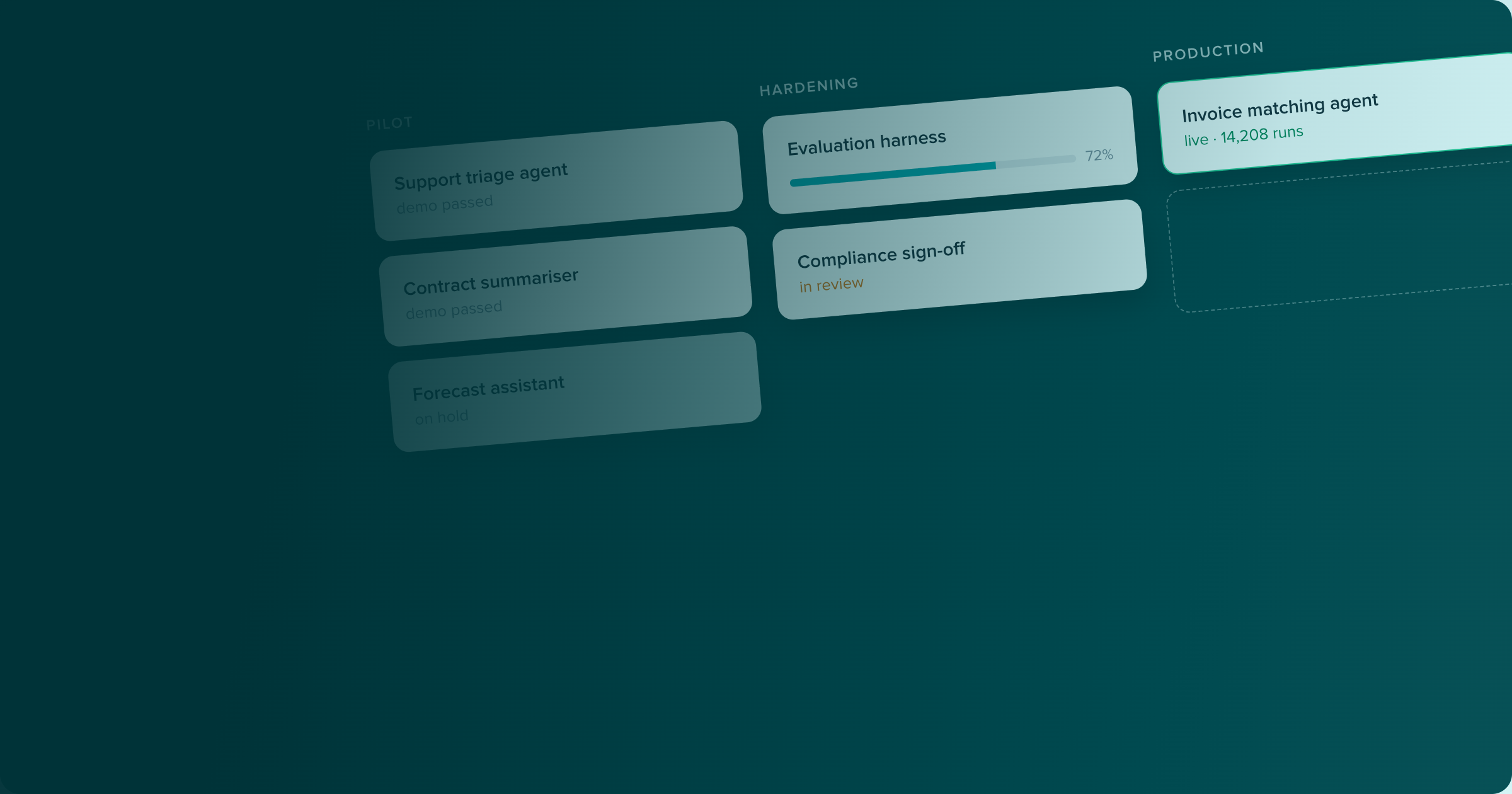
So bringen Sie Agentic AI vom Pilotprojekt zur Produktion
Agentische KI

So bringen Sie Agentic AI vom Pilotprojekt zur Produktion

Register

Immerse yourself in a world of inspiration and innovation – be part of the action at our upcoming event

April 16, 2026

10

10

 min read

Key Takeaways

So bringen Sie Agentic AI vom Pilotprojekt zur Produktion

What you will learn Most companies running AI experiments never make it to production. This article explains why and what a practical, step-by-step path to deployment actually looks like. You will find: the four structural reasons AI pilots stall, a five-phase delivery approach used in real enterprise deployments, a plain-language checklist for what production-ready actually means, and answers to the most common questions CTOs and CPOs ask when moving AI from pilot to live.

Die meisten KI-Projekte geraten ins Stocken, bevor sie überhaupt live gehen. Die Demo sieht toll aus. Der Pilot läuft reibungslos in einer kontrollierten Umgebung.

Aber irgendwo zwischen dem Machbarkeitsnachweis und einem System, auf das echte Benutzer täglich angewiesen sind, geht etwas kaputt, und es ist selten die KI selbst.

In diesem Leitfaden werden die praktischen Schritte für den Übergang von einem KI-Experiment zu einem Produktionssystem beschrieben, das einen echten Geschäftswert bietet, konform bleibt und im Laufe der Zeit zuverlässig läuft.

Wo relevant, beziehen wir uns auf den strukturierten Fünf-Phasen-Ansatz, den wir bei Linnify verwenden, um agentische KI für die Produktion bereitzustellen. Die hier aufgeführten Prinzipien gelten jedoch allgemein, unabhängig davon, wie Sie Ihr Team oder Ihre Technologie organisiert haben.

Warum schaffen es die meisten KI-Piloten nie zur Produktion?

Die Lücke zwischen einer funktionierenden Demo und einem bereitgestellten System ist derzeit die entscheidende Herausforderung der KI in Unternehmen. Die meisten Unternehmen führen Experimente durch, aber nur sehr wenige haben sie in Systeme umgewandelt, die zuverlässig in großem Maßstab funktionieren.

30%

of AI projects built on generative AI will be abandoned after the proof-of-concept stage by the end of 2025

— Gartner, July 2024

Und diese Zahl unterschätzt wahrscheinlich die tatsächliche Zahl. Sie zählt nur explizite Abbrüche, nicht die Projekte, die auf unbestimmte Zeit im Pilotmodus weiterlaufen und Budget verbrauchen, ohne Ergebnisse zu liefern.

88% vs 39%

Most companies use AI, but less than half see real business impact.

88% of companies are using AI in at least one function, yet only 39% see meaningful impact on their bottom line.

McKinsey's 2025 State of AI

95 / 1,837

Almost no companies have AI agents truly in production at scale.

Out of 1,837 organisations surveyed, just 95 had AI agents live in production at scale. The rest were stuck at the evaluation or experimentation stage.

Cleanlab's 2025 AI Agents in Production survey

Die Schlussfolgerung ist unbequem: Die meisten Unternehmen verwenden KI, aber der größte Teil dieser KI funktioniert nicht wirklich als Geschäftssystem.

Was führt eigentlich dazu, dass KI-Piloten scheitern?

Bei dem Scheitern geht es fast nie um das KI-Modell selbst. Es ist strukturell, und sobald Sie das Muster gesehen haben, können Sie es entsprechend entwerfen. Hier sind die vier häufigsten Fehlerpunkte und was Sie anders machen können:

Failure point What usually happens What to do instead
Starting with the wrong use case
The team picks what sounds exciting, often a complex, high-visibility use case rather than what is most likely to succeed and scale. Score your AI opportunities by ROI potential, data availability, process repeatability, and compliance risk before committing to a direction.
👥 Building without expert input
Engineers define what the AI should do, without deeply involving the people who actually do the work. The result is a system that is technically functional but operationally useless. Before writing a single line of code, work directly with domain experts to define what the AI needs to know, decide, and hand off to a human.
No clear definition of “ready”
Success criteria are vague, the pilot “works” but nobody has defined what working means in production. There is no objective threshold for when to ship. Set measurable performance targets before you start building: accuracy against a test set, cost per run, and response time. These become your go-live criteria.
Skipping the engineering discipline
AI is treated as a product experiment, not a software system. No staging environments, no version control, no plan for what happens when something goes wrong. Apply the same software development practices you use for any production system: environments, version control, release cycles, and a clear rollback plan.

Das DORA-Bericht zum Stand der KI-gestützten Softwareentwicklung 2025 bestätigt, was dieses Muster impliziert: Teams, die bei der KI-Entwicklung die richtigen Software-Engineering-Praktiken anwenden, erzielen wesentlich bessere Produktionsergebnisse als Teams, die sie als separate Kategorie behandeln.

Wie sieht ein strukturierter Weg von der Pilotphase zur Produktion aus?

Die Übertragung von KI in die Produktion ist kein einmaliges Ereignis, sondern ein Prozess, der mit derselben Struktur wie jede Softwarebereitstellung verwaltet werden muss.

Bei Linnify haben wir eine fünfstufige Methode namens ARC (Agentic Release Control) entwickelt, die Softwareentwicklungsdisziplin auf den Einsatz von KI anwendet, wobei in jeder Phase menschliche Aufsicht eingebaut ist. Die zugrunde liegende Logik gilt jedoch unabhängig davon, welches spezifische Framework Sie verwenden.

1

Phase 1: Assess

Goal: Find the right use case to build first

Key output: Prioritised opportunity list, requirements document

2

Phase 2: Ingest

Goal: Capture what the human expert actually knows

Key output: Agent requirements, human oversight workflow

3

Phase 3: Validate

Goal: Confirm the AI can perform to the expected flow of action

Key output: Feasibility validation, performance baseline

4

Phase 4: Deploy

Goal: Ship it as a proper software system with validated production metrics

Key output: Production system, governance and security controls

5

Phase 5: Optimize

Goal: Keep improving it with real data and user feedback

Key output: Monitoring, feedback loops, new agent roadmap

Phase 1: Wo solltest du anfangen?

Der größte Fehler, den Teams machen, ist, mit der aufregendsten Idee zu beginnen und nicht mit der praktikabelsten.

Der erste Schritt ist eine strukturierte Priorisierung, bei der jede KI-Chance anhand von fünf Dimensionen bewertet wird:

  1. wie wiederholbar der Prozess ist
  2. ob die zugrunde liegenden Daten existieren
  3. wie klar ist der ROI
  4. wie das Compliance-Risiko aussieht
  5. wie sehr die Arbeit menschliche Kreativität im Vergleich zur Ausführung erfordert.

Dies ist die Red Ocean-Analyse, eine Bewertungsmethode, die darauf abzielt, die Chancen aufzudecken, die am wahrscheinlichsten für einen Erfolg in der Produktion sind, und nicht nur die, die sich gut entwickeln.

Unternehmen, die dies im Voraus tun, liefern durchweg schneller als Unternehmen, die es überspringen. Unternehmen, die mit dem auffälligsten Anwendungsfall beginnen, befinden sich in der Regel sechs Monate später noch in der Pilotphase.

Das Ergebnis ist eine Auswahlliste realer Anwendungsfälle, die entwickelt werden könnten, ein klares Anforderungsdokument für den ersten Build und ein Entscheidungsprotokoll, das das Team auf dem Laufenden hält.

Phase 1
Assess

Start with the highest-value opportunity, not the most exciting one

Score every AI use case against ROI potential, data availability, process repeatability, and compliance risk. Pick the one most likely to succeed in production.

Key output: Prioritised use case list, Red Ocean Analysis scores, Business Requirements document

Phase 2: Wie stellen Sie sicher, dass die KI den Job tatsächlich erledigt?

Dies ist der am meisten unterschätzte Schritt in einem KI-Projekt.

Bevor Sie etwas bauen, müssen Sie sich mit den Leuten zusammensetzen, die gerade die Arbeit erledigen, und genau verstehen, wie sie die Arbeit machen, welche Entscheidungen sie treffen, mit welchen Randfällen sie umgehen und welche Dinge nicht schief gehen können.

In dieser Phase der „Erfassung von Fachwissen“ wird menschliches Wissen in eine strukturierte Spezifikation umgesetzt, auf der das Entwicklungsteam aufbauen kann.

Es definiert auch, wo ein Mensch auf dem Laufenden bleiben muss: Welche Entscheidungen müssen von einem Menschen überprüft werden, was passiert, wenn die KI unsicher ist, und wer letztendlich für jeden Output verantwortlich ist.

Es ist nicht nur eine gute Praxis, in dieser Phase menschliche Aufsicht in den Entwurf einzubeziehen, anstatt sie später hinzuzufügen. Dies ist zunehmend eine gesetzliche Anforderung.

Das Artikel 14 des EU-KI-Gesetzes legt spezifische Anforderungen an die menschliche Überwachung von KI-Systemen mit hohem Risiko fest, und Organisationen, die dies von Anfang an einplanen, sind in einer deutlich besseren Position als Unternehmen, die versuchen, es nachzurüsten.

Das Ergebnis ist ein detailliertes Dokument, das die funktionalen und technischen Spezifikationen enthält, auf denen alles andere basiert. Teams, die diesen Schritt überspringen, erhalten oft eine KI, die zwar technisch beeindruckend ist, aber nicht wirklich zur Funktionsweise des Unternehmens passt.

Phase 2
Ingest

Capture what the expert knows before you write any code

Work directly with domain experts to define what the AI needs to know, what decisions it can make, where human review is required, and what "correct" looks like in practice.

Key output: Agent Requirements Document (ARD), human oversight workflow definition, architecture diagram

Phase 3: Woher weißt du, wann die KI bereit ist, live zu gehen?

Hier wird der Prototyp zu einem realen System, das anhand von tatsächlichen Daten erstellt, anhand realer Szenarien getestet und anhand der in Phase 2 festgelegten Leistungsziele bewertet wird.

Das entscheidende Ergebnis ist eine formale Machbarkeitsüberprüfung: eine dokumentierte Bewertung, ob die KI die für die Produktion erforderlichen Genauigkeits-, Kosten- und Geschwindigkeitsgrenzwerte erfüllt. Ohne diesen Schritt ist „bereit für die Produktion“ nur ein Gefühl.

Damit haben Sie eine objektive Grundlage für die Go-Live-Entscheidung.

Research by ZenML across 1,200+ production AI deployments found that evaluation and monitoring are the most commonly skipped practices in AI development.

Their absence is the leading predictor of production failure.

Phase 3
Validate

Confirm the AI performs to the standard you actually need

Build and test the AI against real data. Establish measurable accuracy, cost, and speed baselines. Only move to production once the AI meets the targets defined in Phase 2.

Key output: Feasibility validation report, performance baseline, production roadmap

Phase 4: Wie setzt man KI wie ein echtes Softwaresystem ein?

Der Einsatz von KI in der Produktion ohne angemessene technische Kontrollen entspricht dem Versand von Software ohne Staging-Umgebung. Die Frage ist nicht, ob etwas kaputt geht, sondern wann.

In dieser Phase werden Standardverfahren zur Softwareentwicklung auf das KI-System angewendet: separate Entwicklungs-, Staging- und Produktionsumgebungen, versionierte Modelle mit Änderungsverfolgung, ein Freigabeprozess mit Genehmigungsschritten und ein klarer Plan, was zu tun ist, wenn nach dem Start etwas schief geht.

Noch wichtiger ist, dass Sicherheits- und Compliance-Kontrollen hier integriert sind und nicht nachträglich hinzugefügt werden.

Zugriffsmanagement, Auditprotokollierung, Kontrollpunkte und Aufsichtsmechanismen sind von Anfang an Teil der Produktionsarchitektur.

Das Ergebnis ist nicht nur ein eingesetztes KI-System, es ist ein Teil der eigenen Infrastruktur, die das Unternehmen vollständig kontrolliert, ohne auf einen bestimmten Anbieter angewiesen zu sein.

2.3M
customer conversations
11 → 2 min
resolution time

Klarna's AI assistant , which handled 2.3 million customer conversations and cut resolution times from 11 minutes to under 2 minutes, succeeded because it was treated as a production software system from the beginning, not as an experiment that happened to go well.

Phase 4
Deploy

Ship the AI with the same rigour you would apply to any software release

Deploy using proper development, staging, and production environments. Include version control, release approvals, a rollback plan, and full security and compliance controls. The organisation owns the resulting infrastructure.

Key output: Live production system, monitoring baseline, governance, and security controls

Phase 5: Was passiert, nachdem du live gegangen bist?

Die Live-Schaltung ist nicht das Ende, sondern der Beginn eines neuen Betriebsrhythmus.

Sobald die KI in Produktion ist, stehen Ihnen echte Daten zur Verfügung, aus denen Sie lernen können: das tatsächliche Nutzerverhalten, Randfälle, die beim Testen nicht aufgetreten sind, und Leistungsschwankungen im Laufe der Zeit.

In Phase 5 werden die Feedback-Schleifen, die Überwachungswarnungen und die regelmäßigen Überprüfungszyklen eingerichtet, damit das System stets gut funktioniert.

Es legt auch klare Leistungsvereinbarungen darüber fest, was das KI-System voraussichtlich tun wird, wie schnell Probleme gelöst werden und wer für das Ergebnis verantwortlich ist. Stellen Sie sich diese als Leistungsvereinbarungen vor, die jedoch speziell für KI geschrieben wurden.

Der zusätzliche Vorteil ist struktureller Natur: Die Infrastruktur, die für den Einsatz des ersten KI-Systems gebaut wurde, macht den Aufbau jedes nachfolgenden Systems schneller und billiger. Unternehmen, die eine vollständige erste Bereitstellung abschließen, fangen beim zweiten Mal nicht bei Null an.

Phase 5
Optimize

Set up the systems to keep improving after launch

Run regular performance reviews, monitor for drift and errors, and collect user feedback. Each improvement cycle makes the system more reliable. The infrastructure also becomes the foundation for every new AI capability you build.

Key output: Monitoring and alerting setup, feedback loops, performance agreements, roadmap for next AI capability

Was bedeutet eigentlich „produktionsbereit“ für KI?

Der Ausdruck wird locker verwendet. In der Praxis hat es eine bestimmte Bedeutung und geht weit über „das Modell gibt eine vernünftige Antwort“ hinaus.

Hier ist eine Checkliste in einfacher Sprache:

Production-ready AI checklist

  • Security: Access controls are in place. Only authorised users can interact with or configure the AI system.
  • Reliability: The system performs consistently across the full range of inputs it will receive in real use, not just the test cases.
  • Auditability: Every output can be traced back through the decision process. A human can review and correct any result.
  • Monitoring: Performance is tracked in real time. If the system starts behaving unexpectedly, an alert fires before it becomes a problem.
  • Governance: There is a clear owner for every AI output, a defined escalation path for edge cases, and agreed standards for what good looks like.

Ein KI-System, das alle fünf dieser Standards erfüllt, wird nicht nur technisch eingesetzt, sondern auch operativ integriert. Das ist der Unterschied zwischen einem Pilotprojekt, das zufällig die Konformitätsprüfung überstanden hat, und einem System, das als Teil des Unternehmens zuverlässig läuft.

Was sind die nicht verhandelbaren Dinge, bevor wir live gehen?

Bei jedem Einsatz gibt es drei Anforderungen, die KI, die es in die Produktion schafft, konsequent von KI, die es nicht schafft, trennen. Keine davon ist technisch spannend, und genau aus diesem Grund investieren die meisten Teams zu wenig in sie.


Non-negotiable Why it matters What it looks like in practice
Human oversight is built into the design AI systems fail in unexpected ways. Having a clear human responsible for reviewing and correcting output is what makes the system trustworthy, and increasingly, it is a regulatory requirement. Define approval workflows, escalation paths, and accountability for every output before the system goes live. The EU AI Act (Article 14) requires this for high-risk systems.
Formal evaluation before deployment Without defined performance thresholds, you have no objective basis for calling the system ready. 'It seems to work' is not a production standard. Test against a validation set. Measure accuracy, cost per run, and response time. Document the results. Only ship when you hit the targets set at the start.
The organisation owns the infrastructure AI built on vendor platforms creates lock-in, data exposure risk, and loss of competitive advantage. The system your organisation builds and controls is a strategic asset. Use version control, maintain your own environments, and ensure you hold the data, the models, and the intellectual property not the vendor.

Häufig gestellte Fragen (FAQ)

ARC is Linnify's five-phase framework for building and deploying AI to production, covering everything from initial prioritisation through to live monitoring and ongoing improvement. It applies software development discipline to AI delivery and treats the resulting infrastructure as a company-owned asset, not a vendor dependency. The five phases are: Assess, Ingest, Validate, Deploy, and Optimize.
The most common failure points are: picking the wrong use case to start with, building without sufficient input from domain experts, having no measurable definition of what 'ready' means, and treating AI development without the engineering discipline applied to other software systems. Gartner (2024) found 30% of generative AI projects abandoned after proof-of-concept, Capgemini (2025) found only 15% of enterprises have reached production at scale.
It means that at every step where an AI output has significant consequences, there is a clearly defined human responsible for reviewing and approving it. This is not a workaround for AI that does not work well enough—it is a design principle that makes the system auditable, correctable, and trustworthy. It is also increasingly required by law: the EU AI Act's Article 14 mandates human oversight for high-risk AI applications.
For a well-scoped use case with available data, the validation phase typically takes four to six weeks. Full production deployment, including proper engineering controls and compliance sign-off, typically runs eight to twelve weeks from the initial assessment. Each subsequent AI capability is faster to build because the underlying infrastructure already exists.

Tags

Immerse yourself in a world of inspiration and innovation – be part of the action at our upcoming event

Download
the full guide

Lorem ipsum dolor sit amet, consectetur adipiscing elit. Suspendisse varius enim in eros elementum tristique. Duis cursus, mi quis viverra ornare, eros dolor interdum nulla, ut commodo diam libero vitae erat. Aenean faucibus nibh et justo cursus id rutrum lorem imperdiet. Nunc ut sem vitae risus tristique posuere.

Let’s build
your next digital product.

Subscribe to our newsletter

Drag

Privacy Settings