


Agentic AI Governance: How to Classify Agents by Risk

Most companies already have some form of AI governance: a policy, an approval board, maybe a model inventory. Then the first agents arrive, and the existing process either blocks everything or waves everything through, because it was built to review models, not software that acts.
Agentic AI governance is the set of roles, rules and controls that decide which AI agents an organization may build and run, what each one is allowed to do, and how it is monitored, with oversight proportional to the risk each agent carries. The key word is proportional. A meeting-notes assistant and an agent that approves refunds should not go through the same review.
This guide gives you a practical way to make that distinction: agent risk classes. It covers the factors that make an agent risky, a four-class model, the controls for each class, and how to run it day to day without slowing every team down.
Why model governance is not enough for AI agents
Model governance asks whether a model is accurate, fair and documented. Agent governance has to ask more, because agents take actions. Regulators and standards bodies are converging on the same point. In January 2026, Singapore's IMDA published the first government framework written specifically for agentic AI, which centers on an agent's action space (the tools and systems it can reach), its autonomy, and whether its actions can be reversed. The World Economic Forum's "AI Agents in Action" framework from November 2025 makes similar recommendations, and the OWASP Top 10 for Agentic Applications lists the security risks that follow from getting it wrong.
In the US, banking supervisors went the other way: the April 2026 model risk guidance SR 26-2 explicitly leaves generative and agentic AI out of scope, which means banks have to design their own agent governance. We cover the legal side of that gap in enterprise AI governance is now a legal liability.
The 6 factors that decide how risky an AI agent is
Score every agent on six factors before it is built. Each one is a question you can answer in a design review.
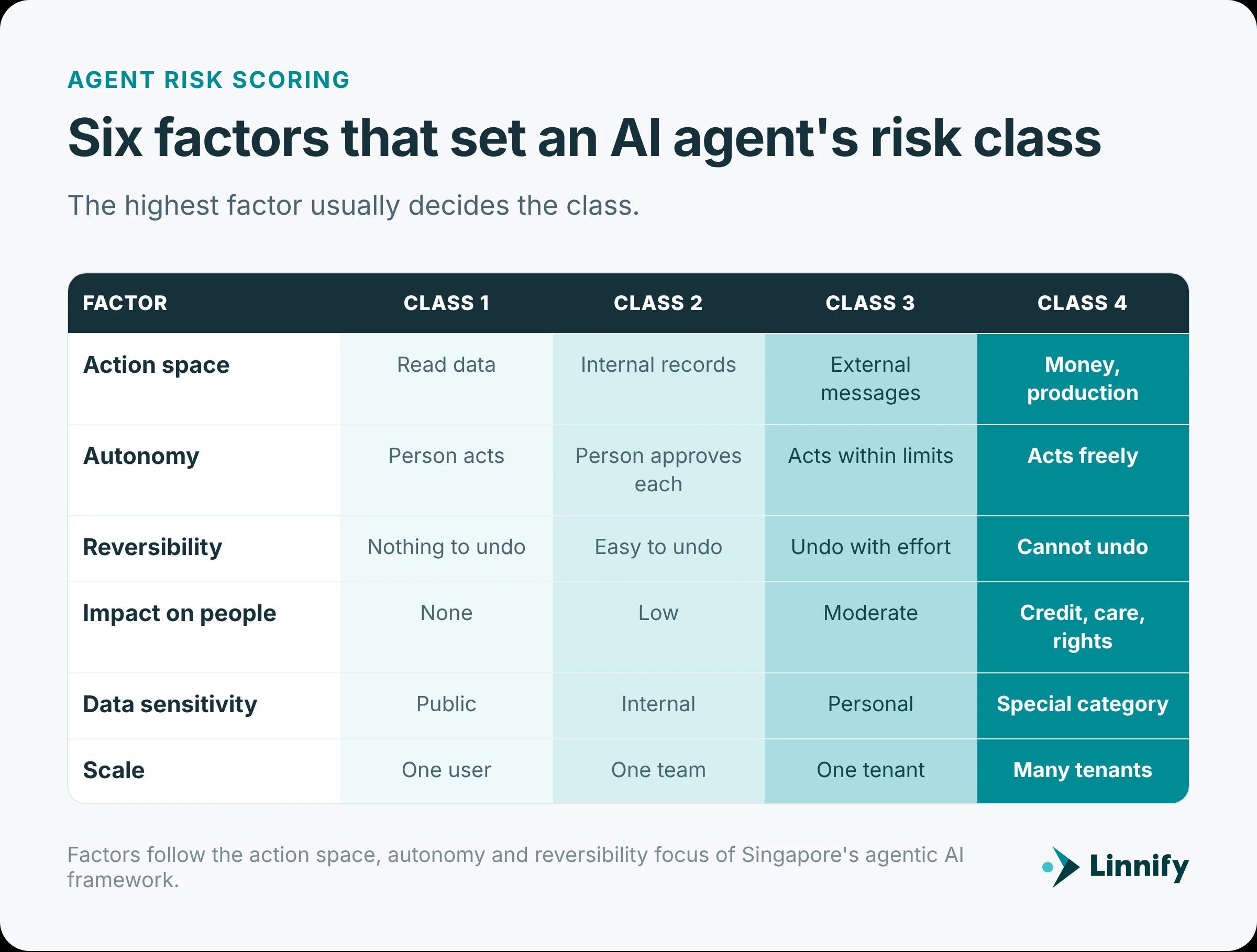
- Action space: what can the agent touch? Read-only data, internal records, external messages, money, or production systems.
- Autonomy: does a person approve each action, a sample of actions, or none?
- Reversibility: can a wrong action be undone easily, with effort, or not at all?
- Impact on people: could the agent's output affect someone's access to credit, care, a job, or another significant decision?
- Data sensitivity: public data, internal data, personal data, or special categories such as health data.
- Scale: how many actions, customers or tenants does one mistake reach before someone notices?
A four-class model for agent risk
The six factors roll up into four classes. The highest factor usually decides the class: an agent that touches payments is at least class 3, however simple it is.
Agents can move between classes. Most of the agents we build start in class 2, prove their accuracy against a baseline, and move to class 3 for the cases where the evidence supports it. That path is safer, and it also builds the trust that adoption depends on.
Controls for each risk class
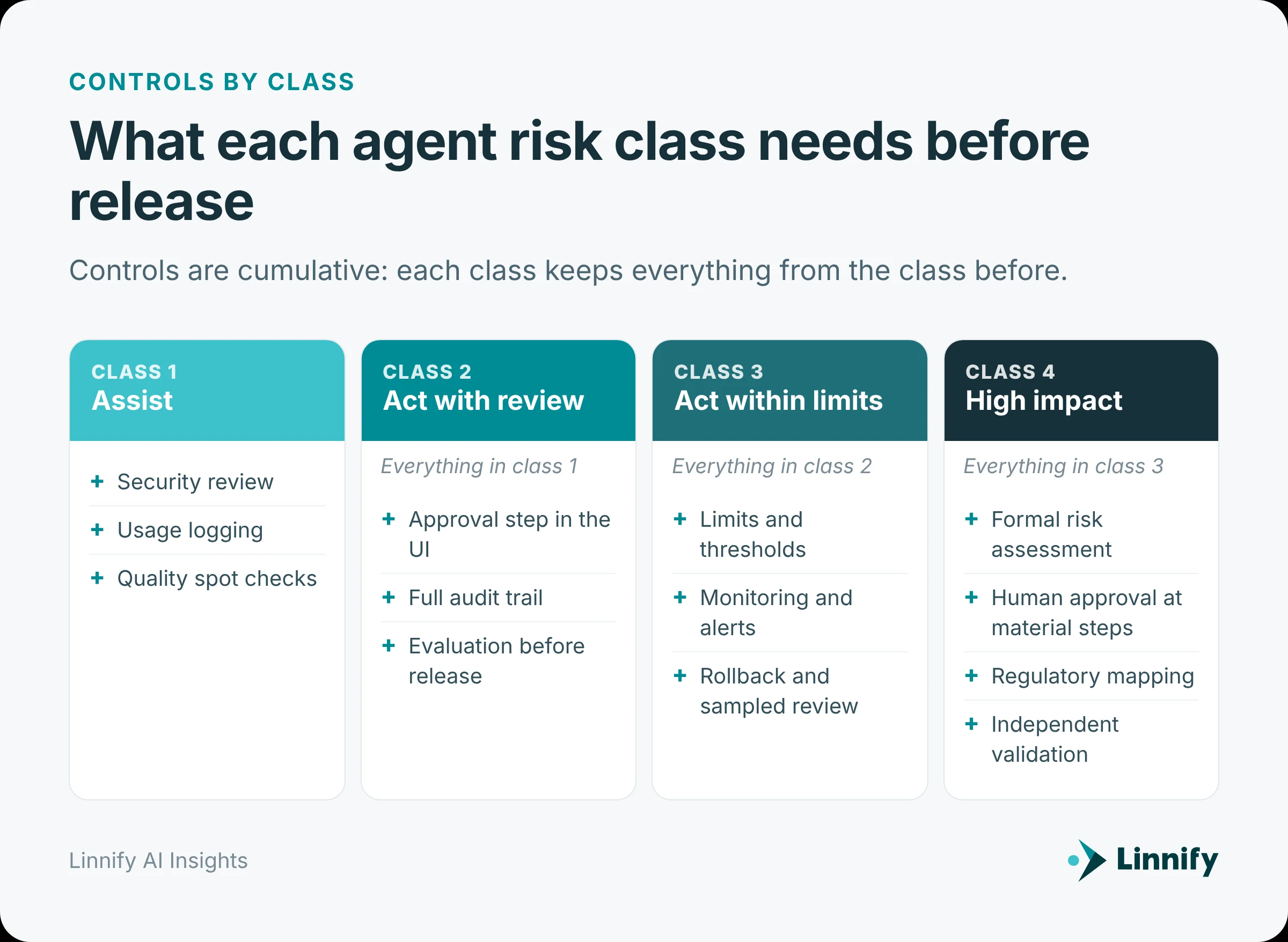
Controls are cumulative: each class keeps the controls of the class below and adds its own. The technical side of these controls, from per-agent identity to tool risk tiers, is covered in how to design permissions for AI agents. The regulatory side for healthcare and finance is in agentic AI compliance in healthcare and finance.
How to run agentic AI governance in practice
1. Keep an agent registry
Every agent gets an entry before it is built: owner, purpose, risk class, tools, data sources, models and versions, approval points, evaluation results and review date. The registry is what lets you answer a regulator, an auditor or your own board in minutes.
2. Put gates in the lifecycle, sized to the class
- Design review: classify the agent and agree on controls before development.
- Pre-release evaluation: test against a baseline your domain experts accept.
- Gradual rollout: limited users or volume first, wider release on evidence.
- Monitoring: quality, cost, incidents and denied actions, with alerts.
- Periodic re-review: yearly for class 1, quarterly or on every material change for class 4.
3. Name the roles
Each agent needs a business owner who is accountable for its output, a technical owner who runs it, and a reviewer from risk, compliance or security for classes 3 and 4. A domain expert, the person whose work the agent supports, should sign off its evaluation criteria.
How agent risk classes fit with existing frameworks
How we apply agent risk classes at Linnify
In our ARC (Agentic Release Control) framework, risk and compliance exposure is scored in the very first phase, alongside value, so that the riskiest ideas are either redesigned or deliberately chosen with the right controls. The agent requirements we write in the Ingest phase record decision boundaries and approval points, and the Deploy phase ships access control, logging and governance sign-offs with the release. Our principle is simple: a named person is always accountable for what an agent does, and production-grade controls are there from day one.
For what those controls look like in a live system, read what production-ready agentic AI really means.
Agentic AI governance in one line
Classify every agent by what it can touch, how freely it acts, how reversible its actions are and who it affects, then scale the controls to the class. Governance built that way lets low-risk agents ship quickly and gives high-impact agents the scrutiny they need.
References and further reading
• Davis Wright Tremaine. (2026, January). New governance frameworks offer a roadmap for managing risks unique to agentic AI (Singapore IMDA and WEF). dwt.com
• OWASP GenAI Security Project. (2025, December). OWASP Top 10 for Agentic Applications, reported by TechRepublic. techrepublic.com
• NIST. (2023). Artificial Intelligence Risk Management Framework (AI RMF 1.0). nist.gov
• ISO. ISO/IEC 42001:2023 Artificial intelligence management system. iso.org
• Federal Reserve, OCC, FDIC. (2026, April 17). SR 26-2, summarized by Cutover. cutover.com


