


How to Design Permissions for AI Agents in a SaaS Product

The moment an AI agent can act inside your product, it needs an answer to a question your permission system was never designed to ask: what is this agent allowed to do, for this user, in this customer's account, right now?
AI agent authorization is the set of rules and checks that decide what an agent may do, on whose behalf, with which data and in which tenant, at the moment it acts. It sits on top of your existing user permissions, but it is not the same thing. An agent chains actions, reads untrusted content and can be talked into things a user would never do.
Security leaders have noticed. In our own search data, the questions buyers type into AI assistants increasingly read like this: agents now hold permissions, reach sensitive systems and take real actions, so how do we keep them least-privileged and visible? This guide answers that for B2B SaaS teams. It covers the design rules, the access models and the mistakes we fix most often, and it builds on our complete guide to AI agents for SaaS.
Why AI agent permissions are different from user permissions
In a classic SaaS product, a permission check is simple: this user, this role, this resource. Agents break that model in three ways.
- Agents act on someone's behalf. When an agent updates a record, the system needs to know both who the agent is and which user it is working for. Without that, every action looks like it came from a generic service account.
- Agents chain actions. One request can trigger ten tool calls across several systems. A permission that is harmless for one call can be dangerous in combination.
- Agents read untrusted content. An email, a PDF or a web page can contain instructions. If the agent has broad access, a hidden instruction can turn it into what security engineers call a confused deputy: a trusted program tricked into misusing its own authority.
That is why the OWASP Top 10 for Agentic Applications, published in December 2025, puts tool misuse (ASI02) and identity and privilege abuse (ASI03) near the very top of its list.
The four questions every agent permission check must answer
Every time an agent calls a tool, your system should be able to answer four questions before the call runs.
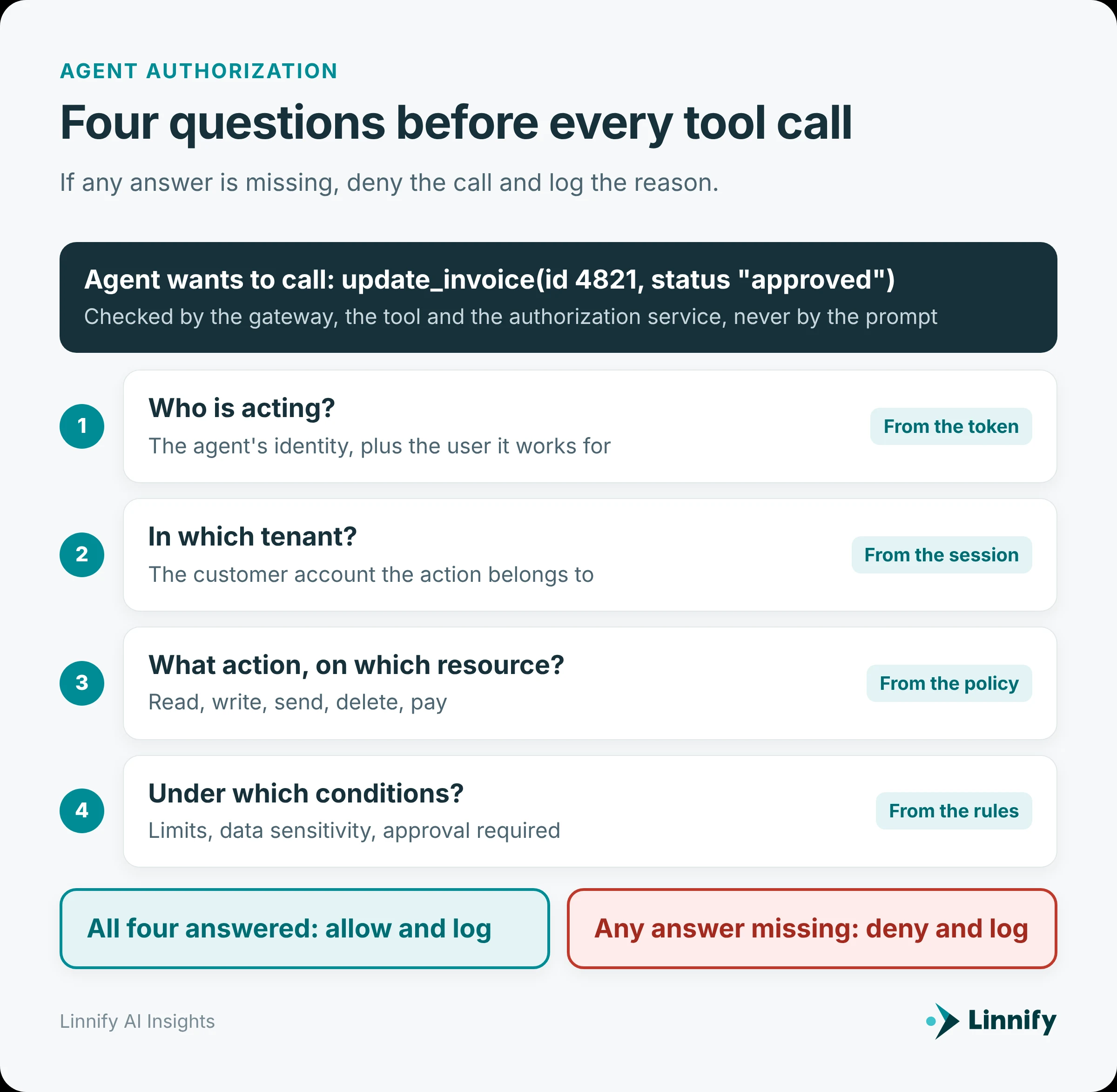
- Who is acting? The agent's own identity, plus the user it is acting for.
- In which tenant? The customer account the action belongs to, taken from the authenticated session, never from the prompt.
- What action on which resource? Read this invoice, update that contact, send this email.
- Under which conditions? Limits, time windows, data sensitivity, and whether a person has to approve first.
If any of the four answers is missing, the safe default is to deny the call and log why.
7 rules for designing AI agent permissions
1. Give every agent its own identity
Treat each agent as a non-human identity with its own credentials, owner and lifecycle. Never let agents share an admin API key. A distinct identity is what makes every later control possible: scoping, monitoring, revocation and an audit trail that says which agent did what.
2. Act on behalf of a user, with the intersection of rights
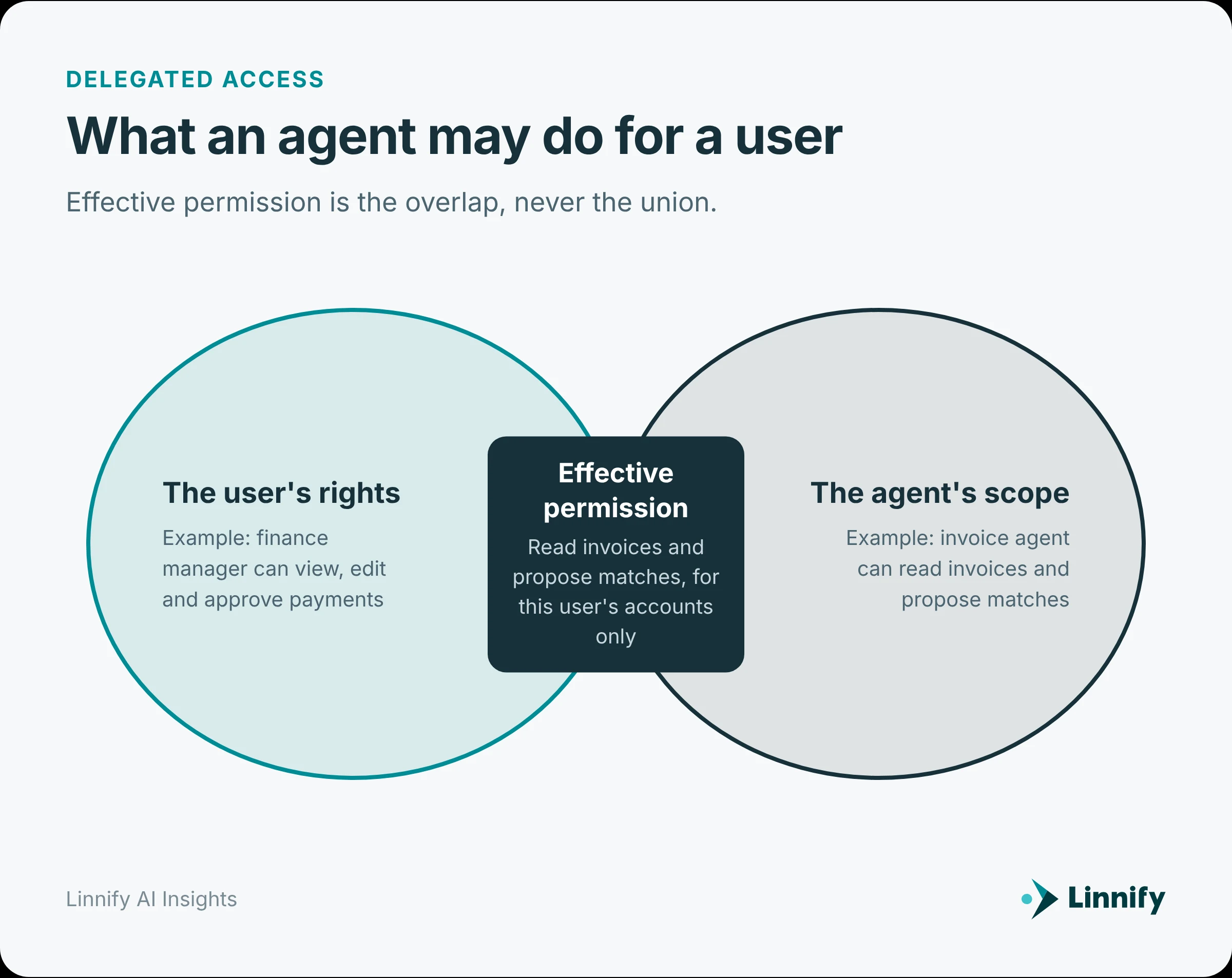
When an agent works for a user, its effective permission should be the intersection of what that user may do and what the agent is designed to do. A finance manager may approve payments; an invoice-matching agent working for her should still only be able to read invoices and propose matches.
3. Use short-lived, narrowly scoped tokens
Issue tokens per task or per session, scoped to the tools and the tenant involved, and let them expire in minutes, not months. Standard OAuth flows support this: token exchange (RFC 8693) lets a service swap a user's token for a narrower one the agent can use. The Model Context Protocol builds its authorization on OAuth 2.1 and treats each MCP server as a protected resource, so agents and tools can follow the same pattern.
4. Enforce tenant isolation inside the tool
The tenant must come from the authenticated context, never from text the model produced. Every tool call is filtered by that tenant at the data layer. If a prompt says "look up the invoices for customer B" while the session belongs to customer A, the tool simply cannot see customer B.
5. Choose the right access model for resources
Most SaaS products end up combining them: roles for the broad strokes, relationships for record-level access, and attributes for the conditions that matter to agents. Relationship-based systems such as Google's Zanzibar design and its open-source descendant OpenFGA are a good fit when agents need to respect fine-grained sharing.
6. Sort tools into risk tiers
Not every tool deserves the same treatment. We classify each one before it is exposed to an agent.
7. Log every decision, allowed or denied
Record the agent identity, the user, the tenant, the tool, the parameters, the decision and the reason. Denied calls matter as much as allowed ones: a spike in denials is often the first sign of a prompt injection attempt or a badly designed tool.
Where to enforce permissions: in code, not in the prompt
A system prompt is not a permission system. Instructions such as "never access other customers' data" help the model behave, but they can be overridden by clever input. Enforcement has to live in code the model cannot rewrite: the API gateway, the tool implementation and the data layer.
In practice that means three layers. The gateway authenticates the agent and the user and attaches the tenant. The tool checks the action against the authorization service. The data layer filters every query by tenant and scope. The model only ever sees the results it was allowed to see.
The AI agent permission mistakes we fix most often
How we design agent permissions at Linnify
In our ARC (Agentic Release Control) framework, permissions are designed before the agent is built. In the Ingest phase we write down each agent's tools, decision boundaries and approval points with the product owner and the domain expert. In the Deploy phase we implement access control, role management and logging as part of the release, not as a patch afterwards. Because the agent runs in our client's own infrastructure, their security team can review every control with the tools they already use.
If your agents work with regulated data, our guide to agentic AI compliance in healthcare and finance shows how these controls map to HIPAA, GDPR, DORA and the EU AI Act. For the protocol layer, see our MCP security best practices guide.
AI agent authorization: the short version
Give each agent its own identity, let it act only within the overlap of its own scope and its user's rights, keep tenants apart in code, and put a person in front of anything external, destructive or financial. Agents built that way can be given more autonomy over time, because every action they take is visible and bounded.
References and further reading
• OWASP GenAI Security Project. (2025, December). OWASP Top 10 for Agentic Applications, reported by TechRepublic. techrepublic.com
• IETF. (2020). RFC 8693: OAuth 2.0 Token Exchange. rfc-editor.org
• Pang, R. et al. (2019). Zanzibar: Google's Consistent, Global Authorization System. USENIX ATC. usenix.org
• OpenFGA. Fine-grained authorization, open source. openfga.dev
• Linnify. (2026). MCP security best practices: complete enterprise implementation guide. linnify.com


