


How the Agent Loop Works: Memory, Tools and Planning Explained

Every AI agent, from a coding assistant to an accounts payable agent, runs on the same basic engine: a loop.
The agent loop, also called the agentic loop, is the cycle an AI agent repeats to reach a goal. It reads its context, plans the next step, calls a tool, observes the result, and then decides whether to keep going or stop. The model supplies the reasoning. The loop supplies everything else: memory, tools, limits and checks.
That is why two teams using the same model can ship agents with completely different reliability. The difference is almost never the model. It is how the loop is designed.
This guide explains how the agent loop works, stage by stage, with the three parts that matter most in production: memory, tools and planning. It is written for CTOs and engineering leads who need to understand what they are building or buying, and it builds on our complete guide to AI agents for SaaS.
What is an agentic loop?
An agentic loop is a repeating cycle in which a language model chooses an action, a program executes it, and the result is fed back to the model until a stop condition is met.
Compare it with the two things it is often confused with:
- A chatbot answers once. Input goes in, text comes out, and nothing happens in the world.
- A workflow runs fixed steps that a developer wrote in advance. It can call a model, but code decides what happens next.
- An agent decides its own next step, based on what it has seen so far. The loop keeps running until the goal is reached, a limit is hit, or a person steps in.
The idea was formalized in the 2022 ReAct paper (reasoning and acting), which showed that models perform better when they alternate between thinking about a problem and taking actions to gather information. Almost every agent framework today, from the Claude Agent SDK to LangGraph, is a variation on that pattern. Anthropic describes its own loop in four words: gather context, take action, verify work, then repeat.
In 2026 the discipline even got a name. The Claude Code team calls it loop engineering: designing the cycle an agent repeats, rather than prompting it one turn at a time.
How the agent loop works: the 5 stages
Whatever framework you use, a production agent loop moves through five stages on every turn.
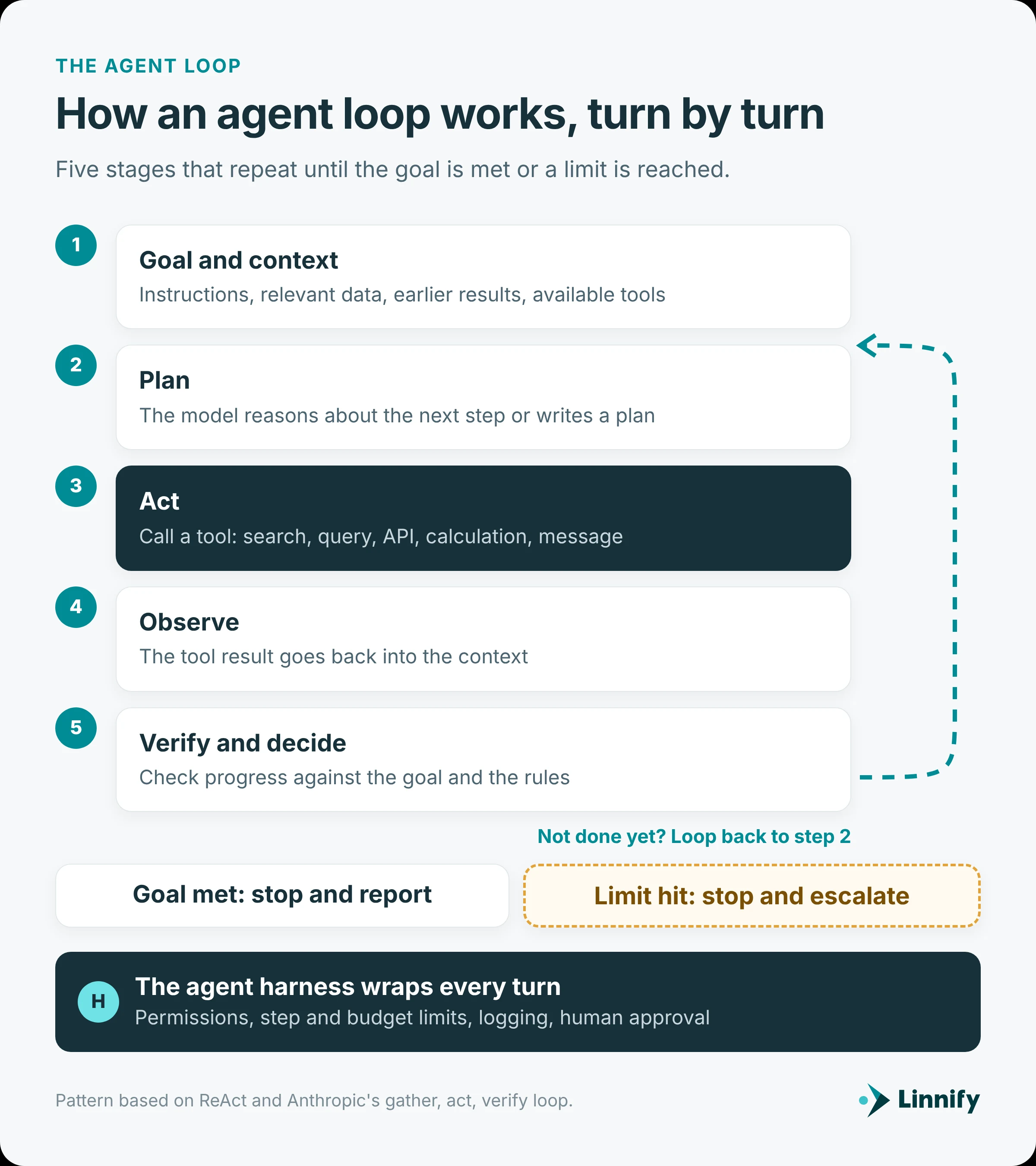
- Goal and context. The loop starts with a goal ("reconcile these 40 bank transactions") and assembles the context the model needs: instructions, relevant data, results of earlier steps and the list of available tools.
- Plan. The model reasons about what to do next. Sometimes that is a single step; sometimes it is a written plan it will follow over several turns.
- Act. The model calls a tool: a search, a database query, an API call, a calculation or a message. The program around the model, often called the agent harness, runs the call and enforces permissions.
- Observe. The tool result goes back into the context. This is where the agent learns whether its action worked.
- Verify and decide. The agent checks its progress against the goal and the rules. If the goal is met, or a limit is reached, it stops. Otherwise the loop runs again.
A simple task may take two turns. A complex one may take fifty. What keeps both reliable is the same thing: every turn is bounded, logged and checked.
Memory: how an AI agent remembers
Short answer: an agent remembers through its context window, plus whatever you store outside it and load back in at the right moment.
The model itself has no memory between calls. Everything it "knows" during a turn is in the context window. Agent memory is the design of what goes into that window, and what stays out. Researchers usually describe four kinds, following the CoALA framework for language agents.
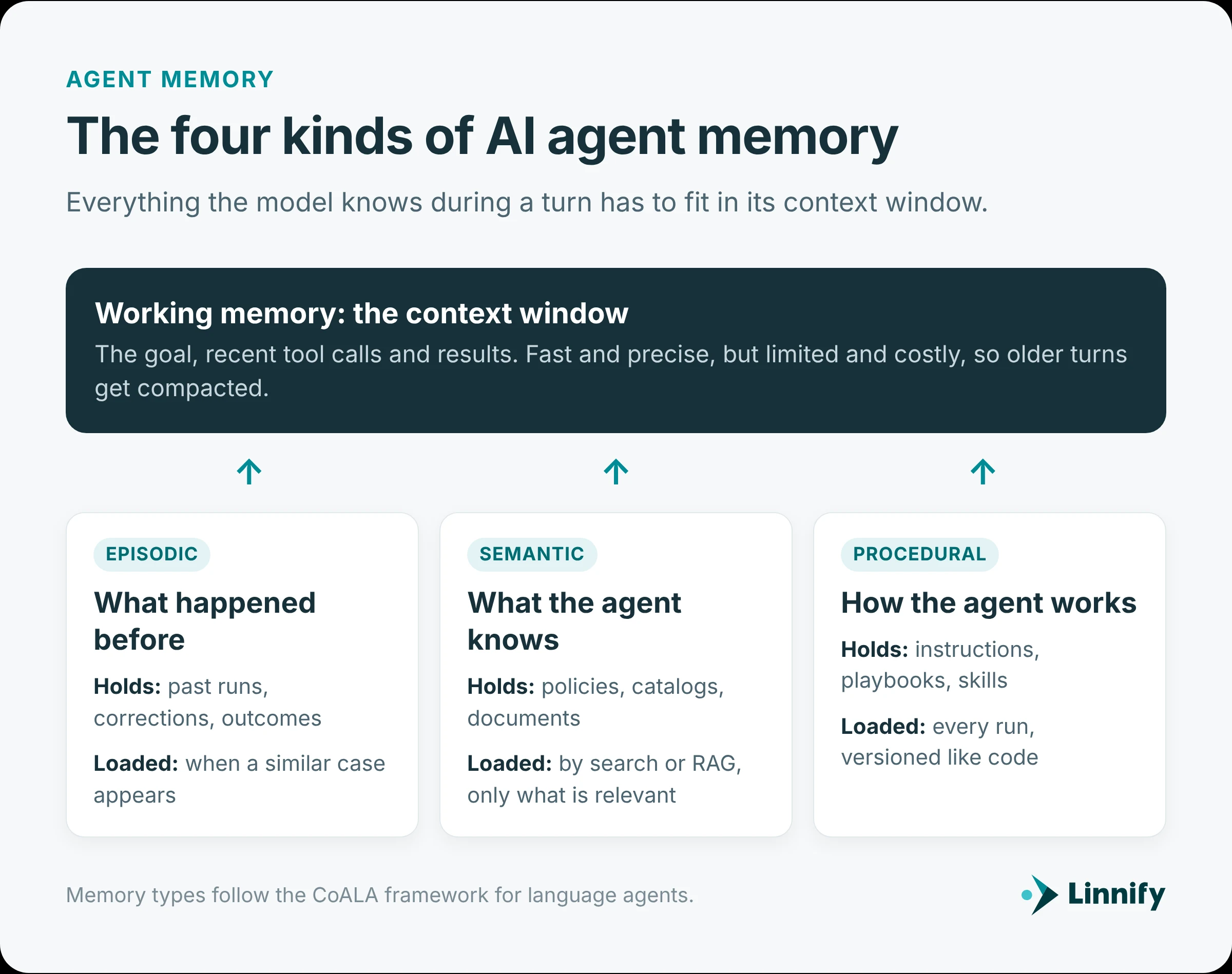
Working memory: the context window
Working memory is the current conversation: the goal, recent tool calls and their results. It is fast and precise, but limited and expensive. Long-running agents fill it quickly, which is why frameworks such as the Claude Agent SDK compact older turns into summaries when the limit gets close.
Episodic memory: what happened before
Episodic memory stores past runs: what the agent tried, what worked and what a reviewer corrected. Loaded selectively, it lets an agent avoid repeating mistakes. In regulated settings it doubles as part of the audit trail.
Semantic memory: what the agent knows
Semantic memory is domain knowledge: product catalogs, policies, contracts, documentation. It is usually retrieved on demand, through search or retrieval-augmented generation (RAG), so only the relevant pieces enter the context.
Procedural memory: how the agent works
Procedural memory is the agent's instructions, playbooks and skills: how to handle an invoice, when to escalate, what format to answer in. It changes less often than the other three and should be versioned like code.
Choosing what enters the context window, when, and in what form is what the industry now calls context engineering. In our experience it has more effect on agent quality than switching models.
Tools: how an AI agent acts
Short answer: tools are the functions an agent is allowed to call. They are its hands, and their design decides both what the agent can do and what it can break.
A model calls a tool by producing a structured request (the tool name and its parameters). The harness runs it and returns the result. Today most tools are exposed through the Model Context Protocol (MCP), so the same tool works across Claude, ChatGPT, Gemini and Copilot.
Four rules make tools work well inside a loop:
- Make tools narrow. "Get open invoices for supplier X" beats "run any SQL query". Narrow tools are easier for the model to choose correctly and harder to misuse.
- Describe them like an API for a new colleague. The model only knows what the name, description and parameter types tell it.
- Return only what the agent needs. A tool that returns 5,000 rows floods working memory. Summarize, paginate or filter in the tool.
- Separate reading from changing. Tools that change data, send messages or move money get extra checks, and often a human approval step.
Tool permissions are where agent design meets security. Our MCP security best practices guide covers how to scope them per user and per tenant.
Planning: how an AI agent decides what to do next
Short answer: planning is how the agent breaks a goal into steps. The right pattern depends on how predictable the task is and how expensive a mistake would be.
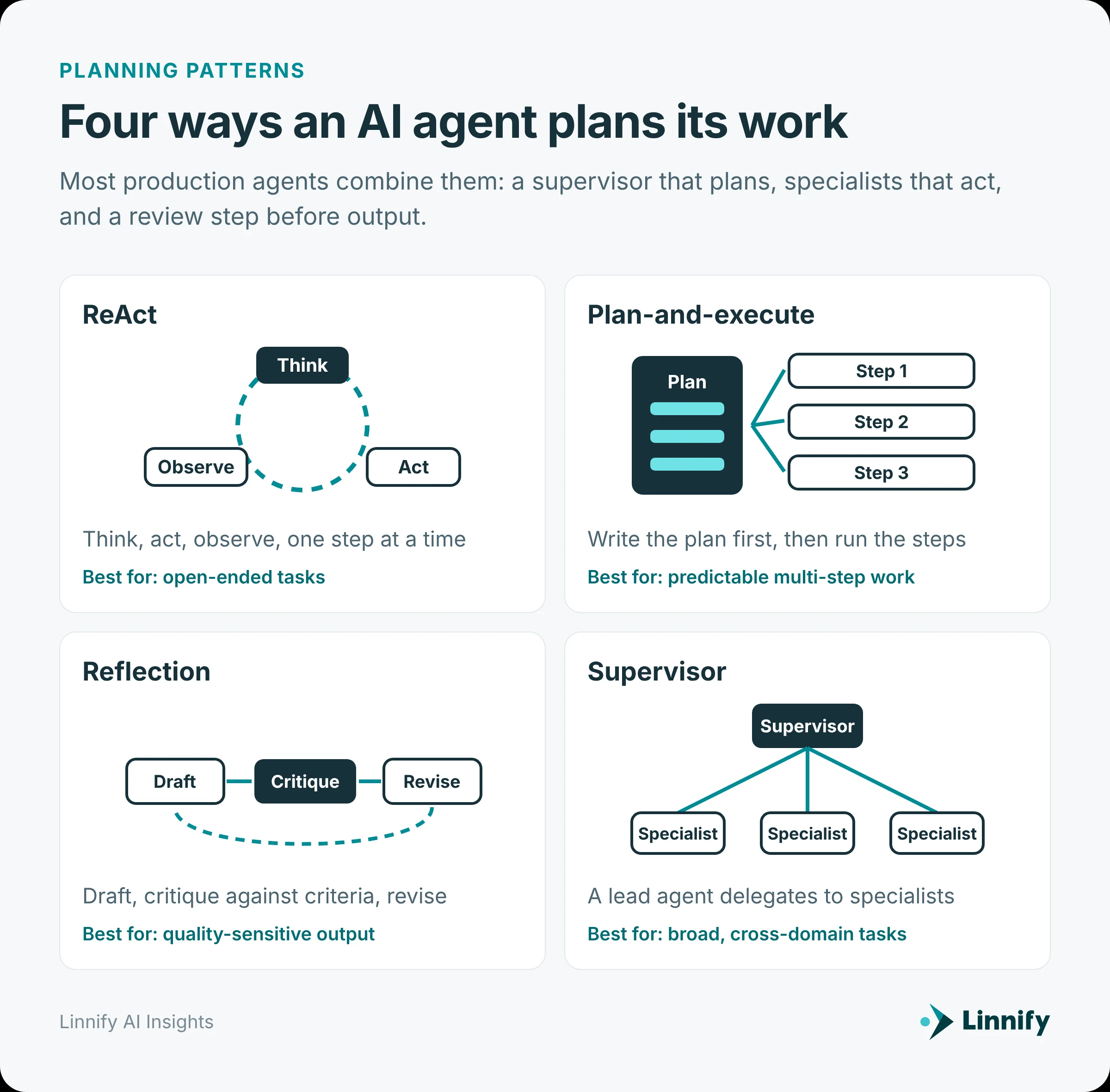
Most production agents combine patterns: a supervisor that plans, specialists that use ReAct, and a reflection step before anything reaches a customer. We explain when a single agent is enough and when to split the work in how we design multi-agent AI systems for enterprises.
Stop conditions and verification: keeping the loop under control
A loop without a stop condition is a cost incident waiting to happen. Every production agent needs explicit answers to two questions: when does it stop, and how does it know it is done?
Stop conditions
- Goal met: a measurable success criterion, checked by code or by a separate evaluator model.
- Turn or step limit: a hard cap on how many times the loop can run.
- Budget limit: a ceiling on tokens, cost or time per task.
- Human checkpoint: the loop pauses for approval before a material action.
- Error threshold: repeated tool failures stop the run and escalate instead of retrying forever.
Verification
Anthropic's guidance for agent builders names three ways to verify work: rules-based checks (validation, tests, schema checks), visual checks (screenshots or renders compared with the expected result) and a model acting as judge for fuzzier criteria. Rules come first because they are cheap and deterministic. A model judge is useful, but it is slower and less reliable, so it should not be the only check.
Why agent loops fail in production
Most agent failures we are asked to fix come from the loop, not from the model.
How we design agent loops at Linnify
We treat the loop as the product. In our ARC (Agentic Release Control) framework, the loop is specified before a line of code is written: in the Ingest phase we document the agent's goal, its tools, its decision boundaries and where a person approves, together with the domain expert whose work the agent supports. In the Validate phase we measure the loop against a baseline that expert agrees on, including cost per run and failure modes.
That discipline is what let us take multi-agent systems such as Gustav, Kober's AI expert advisor, and GentrAIner's work simulation agents from prototype to production. If you want to go deeper on what production-grade means for loops like these, read what production-ready agentic AI really means.
The agent loop in one sentence
The agent loop is simple to describe and hard to run well: give the model a clear goal, the right memory, narrow tools and a hard stop, and check its work every turn. Teams that design those five things on purpose ship agents that hold up in production. Teams that leave them to the framework's defaults usually end up debugging the same failures.
References and further reading
• Yao, S. et al. (2022). ReAct: Synergizing Reasoning and Acting in Language Models. arxiv.org
• Sumers, T. et al. (2023). Cognitive Architectures for Language Agents (CoALA). arxiv.org
• Anthropic. (2025, September 29). Building agents with the Claude Agent SDK. claude.com
• Anthropic, Claude Code team. (2026, June 30). Loop engineering: getting started with loops. claude.com
• MIT NANDA. (2025, August). The GenAI Divide, reported by The Register. theregister.com
• Linnify. (2026). How we design multi-agent AI systems for enterprises. linnify.com


