


Technical Due Diligence Checklist for a Development Partner

What you will learn
Choosing a software development partner is one of the few technology decisions that is expensive to reverse. Six months in, switching means lost time, lost context and code someone else has to learn.
A technical due diligence of a development partner is a structured review of how a vendor builds, secures, staffs and hands over software, done before you sign. Unlike the due diligence investors run on a company they buy, its goal is not to value a business. It is to predict whether this team will ship what you need, safely, and leave you in control of it.
The stakes are higher for AI work. MIT's 2025 study of enterprise generative AI found that buying from specialized vendors and building partnerships succeeded about 67% of the time, while internal builds succeeded about a third as often. A partner can be the difference between a pilot and production, but only the right one.
This checklist is built from the questions our own prospects ask us, from CTOs at US scale-ups to procurement teams at German enterprises. Use it as-is, or adapt it into your RFP.
success rate for AI projects bought from specialized vendors or built with partners, about twice the rate of internal builds.
The technical due diligence checklist: 8 areas to review
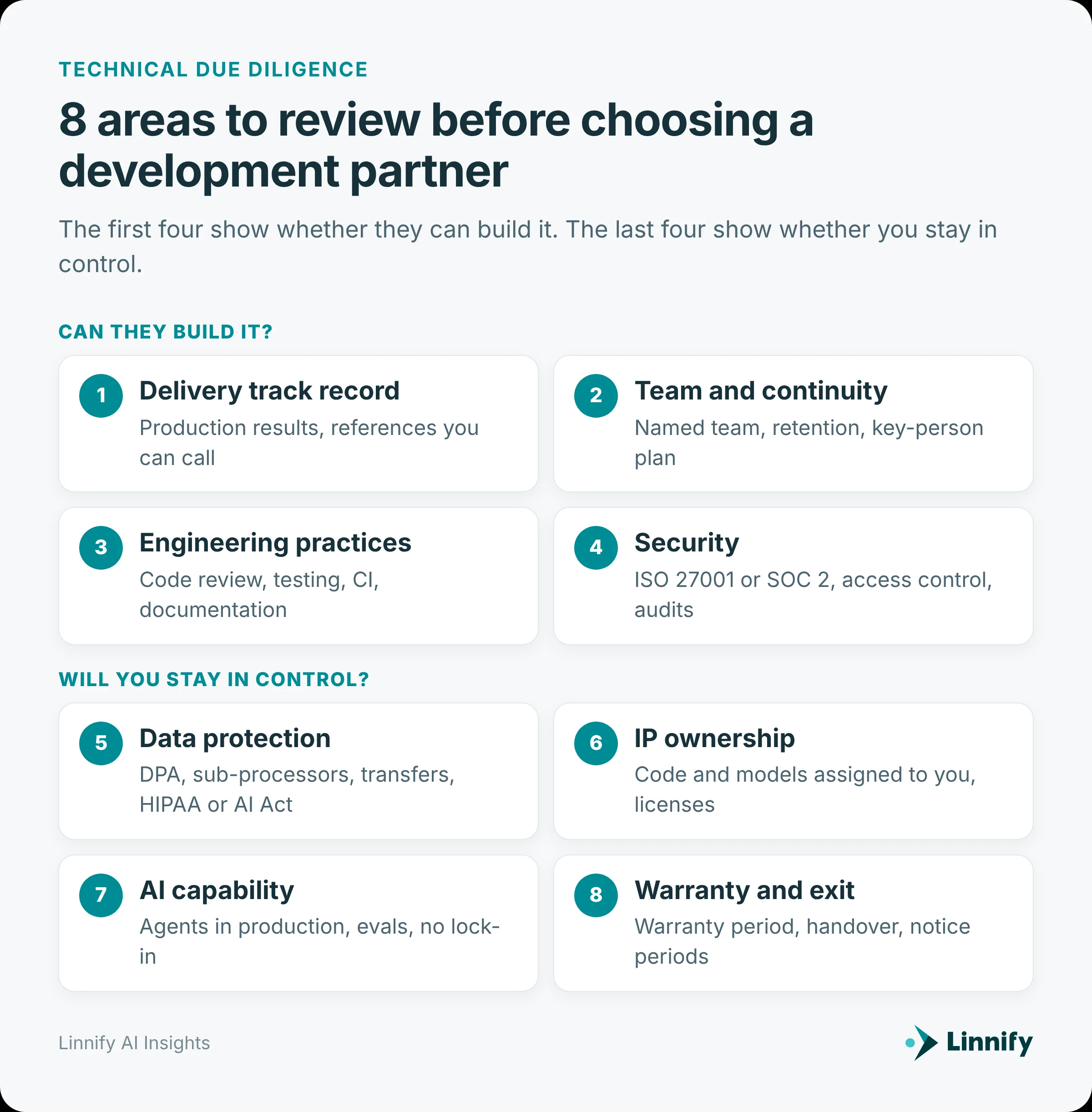
A complete review of a development partner covers eight areas. The first four tell you whether they can build it. The last four tell you whether you stay in control.
1. Delivery track record
Demos are easy. Production systems with real users, real data and real incidents are not.
Ask:
- Which projects like ours have you taken to production, and what happened after launch?
- What measurable results did those projects deliver, and can the client confirm them?
- Which projects did not go well, and what did you change afterwards?
Evidence to request: two or three case studies with metrics, and reference calls with clients you choose from their list, ideally one whose project ended.
2. Team and continuity
You are hiring a team, not a logo. Ask who will actually work on your product, and how long they will stay.
Ask:
- Who exactly will be on the team, and can we interview them before signing?
- What is your engineer retention rate, and what happens if a key person leaves?
- How many hours of overlap will we have with our time zone, and who is our day-to-day contact?
Evidence to request: CVs of the proposed team, a named tech lead, a written replacement and knowledge-transfer policy.
3. Engineering practices
Good partners can show how they work, not just tell you.
Ask:
- How do you handle code review, testing and continuous integration?
- How do you document architecture decisions and hand them over?
- What does your definition of done include?
Evidence to request: a sample (anonymized) pull request, an architecture decision record, a test coverage report and a description of the environments they use (development, staging, production).
4. Security and certifications
A partner gets access to your code, your cloud and often your customers' data. Their security becomes yours.
Ask:
- Which security certifications do you hold, and what is their scope?
- How do you manage access to client systems, and how quickly is access removed when someone leaves?
- Have you had a security incident in the last three years, and how did you handle it?
Evidence to request: certificates such as ISO 27001 or a SOC 2 report with their scope, the information security policy, and the results of the last penetration test or audit.
5. Data protection and compliance
If personal data is involved, the partner is a data processor, and the paperwork has to match reality.
Ask:
- Will you sign our data processing agreement, and which sub-processors will touch our data?
- Where is data stored and processed, and how are international transfers covered?
- What experience do you have with the rules that apply to us, such as GDPR, HIPAA or the EU AI Act?
Evidence to request: a signed DPA, a sub-processor list, transfer mechanisms such as Standard Contractual Clauses, and, for health data in the US, a business associate agreement.
6. IP ownership and contracts
The most common surprise in vendor relationships is discovering who owns what only when you try to leave.
Ask:
- Do we own all code, designs and models built for us, and from when?
- Which of your own components or libraries will be in our product, and under what license?
- What is your policy on open-source licenses?
Evidence to request: a contract that assigns IP to you (usually on payment), a list of pre-existing components with a perpetual license for you to use them, and an open-source policy.
7. AI and agentic capability
For AI projects, ask what happens after the demo. Most of the work is in evaluation, monitoring and integration.
Ask:
- Which agents have you put into production, and how do you measure their quality over time?
- How do you keep the solution independent of a single model provider?
- Where will our data, prompts and agent infrastructure live, and who owns them?
Evidence to request: an evaluation report from a past project, a description of the monitoring and human review setup, and an architecture where the agent runs in your environment. We cover the wider question in build vs buy vs partner for agentic AI.
8. Commercials, warranty and exit
Plan the end of the relationship at the start, when everyone is still motivated to be fair.
Ask:
- What pricing model do you propose, and what is fixed versus variable?
- What warranty do you give on delivered work, and for how long?
- If we end the contract, what do we receive and how long does the handover take?
Evidence to request: a written warranty clause, a handover and exit plan with a timeline, and notice periods that give you time to switch.
Red flags that should end the evaluation
| Red flag | Why it matters |
|---|---|
| You cannot meet the team before signing | The people who sell are rarely the people who build |
| Only demos, no production references | Production is where most AI projects fail |
| IP transfers only at the end of the contract, or never | You may not own what you paid for if you leave early |
| No certification and no clear security policy | Their weakest control becomes your exposure |
| Agent infrastructure hosted only on their platform | Your data and workflows become hard to move |
| No answer to "what if your tech lead leaves?" | Key-person risk will land on your roadmap |
How to run the review in two weeks
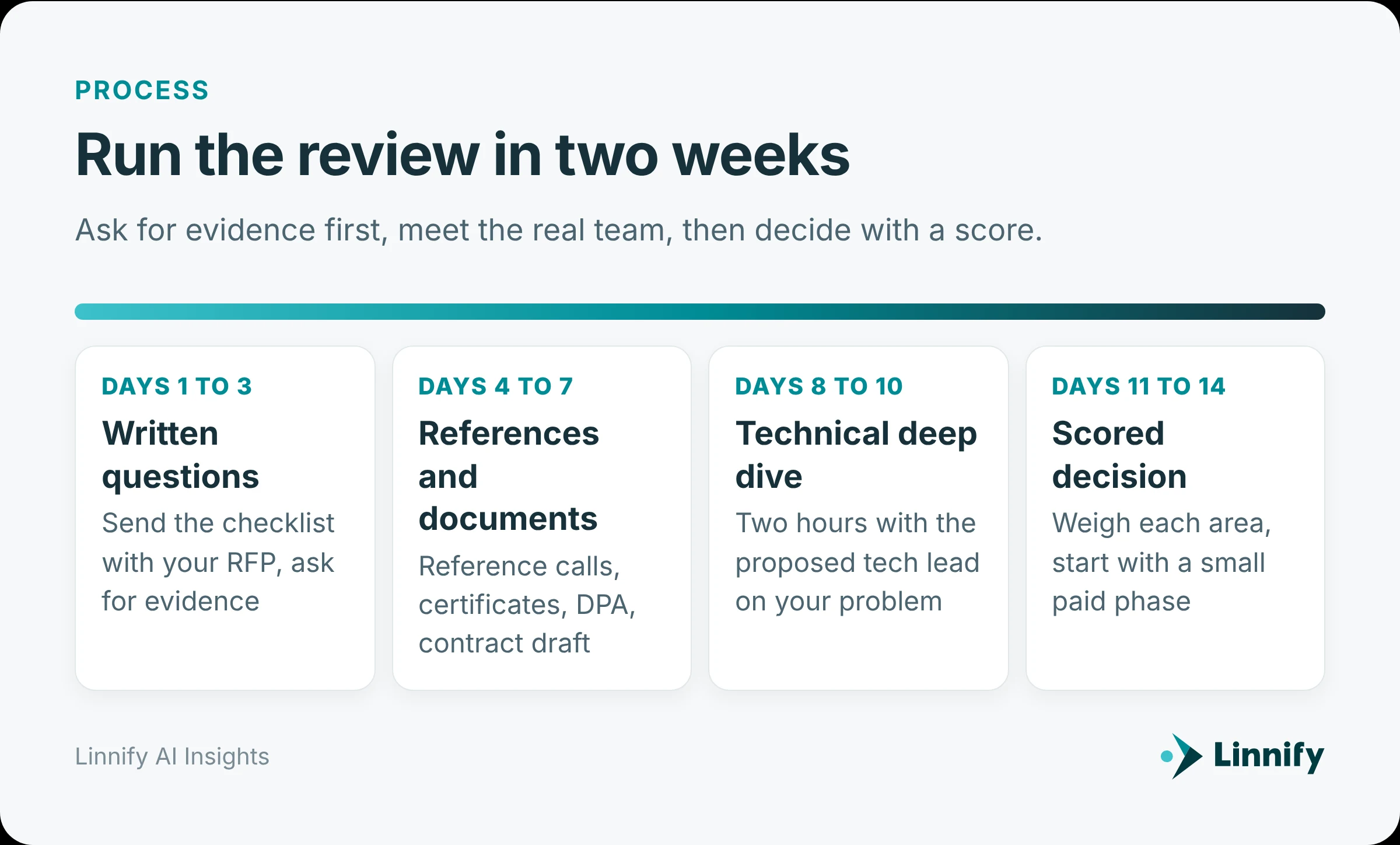
- Days 1 to 3: written questions. Send the checklist above as part of your RFP and ask for the evidence, not just answers.
- Days 4 to 7: references and documents. Call two or three references, read the certificates, DPA and contract draft.
- Days 8 to 10: technical deep dive. A two-hour session with the proposed tech lead on your actual problem: architecture, risks, a first plan.
- Days 11 to 14: scored decision. Score each area, weigh it by what matters most to you, and agree on a small paid first phase before a long commitment.
A short paid discovery or proof of concept is the best due diligence of all. It shows you how the team thinks, communicates and handles a real constraint, at a fraction of the cost of finding out later.
How Linnify answers this checklist
We get these questions every week, so here are our own answers, in short:
- Track record: founded in 2016, more than 100 digital products launched, and agents in production for clients such as Kober and a Munich-based accounting platform. Linnify appears on the FT1000 list of Europe's fastest-growing companies for 2025 and 2026.
- Security: ISO 27001 certified, alongside ISO 9001 and ISO 14001.
- AI capability: a Select Partner in Anthropic's Claude Partner Network, with partnerships with OpenAI and Google Cloud. Every Linnify engineer holds a Claude certification.
- Ownership: through our ARC (Agentic Release Control) framework, agents and their infrastructure are built in your environment, so you own the code, the data and the agent operating system that results.
If you are comparing partners for agentic AI work, our list of the best agentic AI development companies for B2B SaaS and our analysis of why agentic AI success depends on the right partner are good next reads.
Choosing a software development partner: the bottom line
A good technical due diligence asks for evidence, meets the real team and settles ownership and exit before the work starts. Two weeks of structured review costs far less than six months with the wrong partner, and the partners worth hiring will welcome the questions.
Running a vendor review for an AI project?
Send us your checklist. We will answer every question with evidence, and introduce you to the team who would build your product.
Talk to Linnify →Frequently asked questions
What is technical due diligence of a development partner?
It is a structured review of how a software vendor builds, secures, staffs and hands over software, done before you sign. It covers track record, team, engineering practices, security, data protection, IP ownership, AI capability and exit terms.
What should a technical due diligence checklist include?
Eight areas: delivery track record, team and continuity, engineering practices, security and certifications, data protection and compliance, IP ownership and contracts, AI and agentic capability, and commercials, warranty and exit. For each, ask for evidence, not only answers.
How long does due diligence on a software development partner take?
About two weeks is enough for most projects: written questions, reference calls and document review, a technical deep dive with the proposed team, and a scored decision, ideally followed by a small paid first phase.
Who should own the code built by a development partner?
You should. The contract should assign all code, designs and models built for you, usually on payment, and give you a perpetual license to any pre-existing components the partner includes.
What should I check when choosing an AI development partner?
Ask for agents they have put into production, how they evaluate and monitor quality, how they avoid lock-in to one model provider, and where your data and agent infrastructure will live. Prefer partners who build in your environment.
References and further reading
• Fortune. (2025, August 18). MIT report: 95% of generative AI pilots at companies are failing. finance.yahoo.com
• Linnify. (2026). Build vs buy vs partner for agentic AI: which one is for me? linnify.com
• Linnify. (2025). Crossing the GenAI divide: why your agentic AI success depends on the right partner. linnify.com
• Linnify. ISO 27001 certification for secure digital products. linnify.com


