

.svg)

.svg)

AI Agents for SaaS: The complete guide to building and shipping them in 2027


.png)
Your SaaS product now has an agentic layer, and it serves customers who all work differently.
One customer's data model is nothing like the next. Their approval rules, their tone, their edge cases, their compliance obligations: all different. So your team keeps building custom agent infrastructure around each account, and every new agent feature quietly turns into an infrastructure project. The product customers actually pay for waits while your engineers wire up observability, guardrails, identity, and evaluation for the tenth time.
There is a name for what that feels like: personalization debt (the hidden cost and performance decay that builds up when companies rely on blunt, automated personalization or scale messaging without genuine human context).
This guide is about paying it down. It covers what AI agents for SaaS actually are, why shipping them into multi-tenant production is a different problem from building a clever demo, and the disciplined way to build, deploy, and scale them so they stay reliable, secure, and compliant. It is written for the experts who have to make that work in 2027, not in a keynote.
What are AI agents for SaaS?
An AI agent is a software system that uses a large language model to plan and take actions toward a goal, calling tools and data sources across multiple steps rather than returning a single response.
In a SaaS context, an AI agent for SaaS is an agent embedded in a multi-tenant product, where it must perform its task reliably across many customers whose data, workflows, and policies differ.
That last clause is the whole challenge, so it is worth separating three things people often blur together.
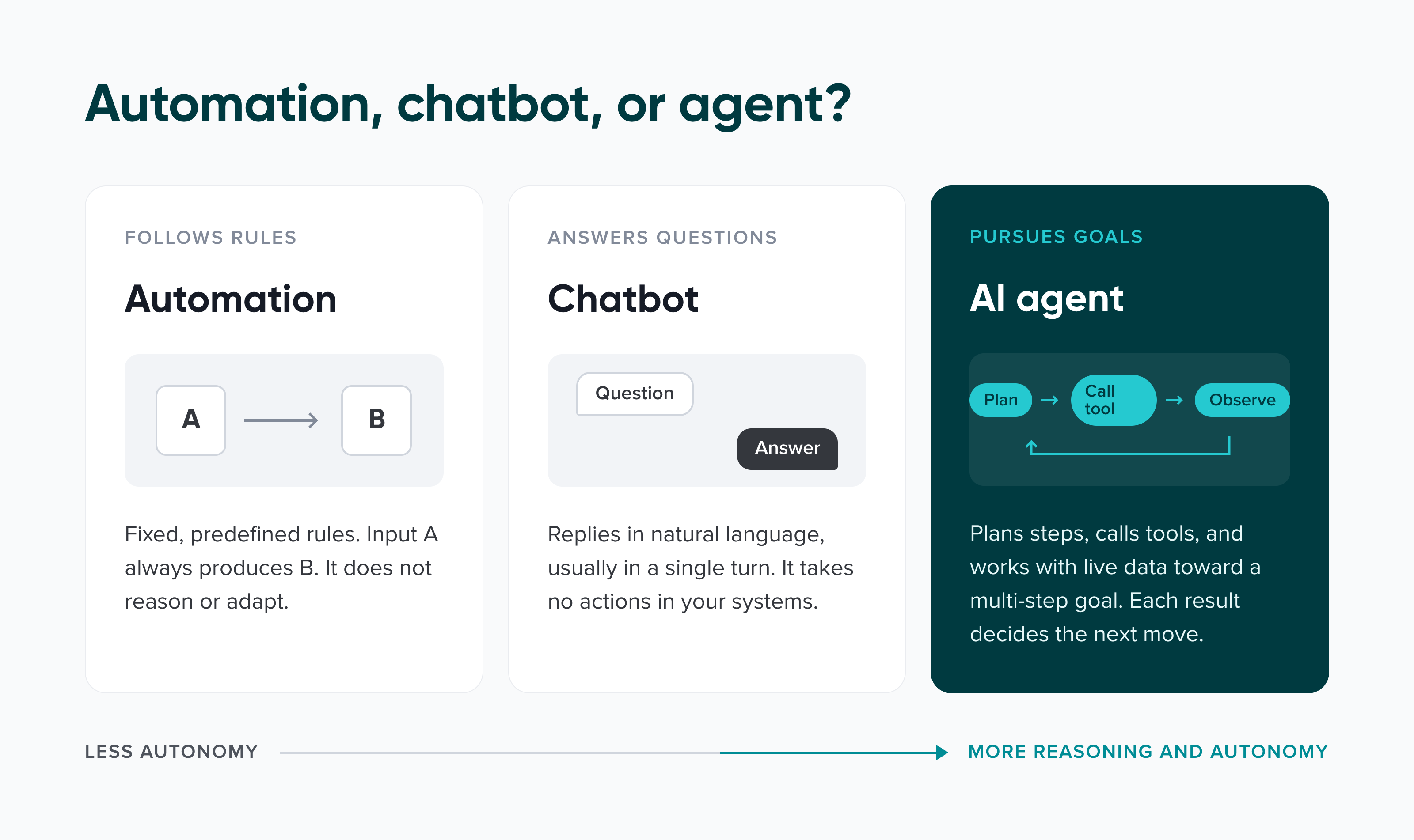
- Automation follows fixed, predefined rules. Given input A, it always does B. It does not reason and it does not adapt.
- A chatbot answers questions in natural language, usually in a single turn, without taking actions in your systems.
- An AI agent plans a sequence of steps, chooses and calls tools, works with live data, and pursues a goal that may take many actions to complete. It decides what to do next based on what happened in the previous step.
Agentic AI is the broader field: the design of systems where AI agents plan, act, and adapt with a degree of autonomy, under human oversight. If you want the foundational explainer, our piece on what agentic AI is and why it matters covers the ground. This guide assumes you are past the definition and are trying to ship.
Why shipping AI agents in SaaS is harder than the demo
A single-tenant demo hides every problem that multi-tenant production will surface. The demo runs on clean data, one set of rules, and a forgiving audience. Production runs on many customers' messy data, many policy regimes, and users who lose trust the first time the agent does something wrong in front of their own clients.
Three things make SaaS agents distinctly hard:
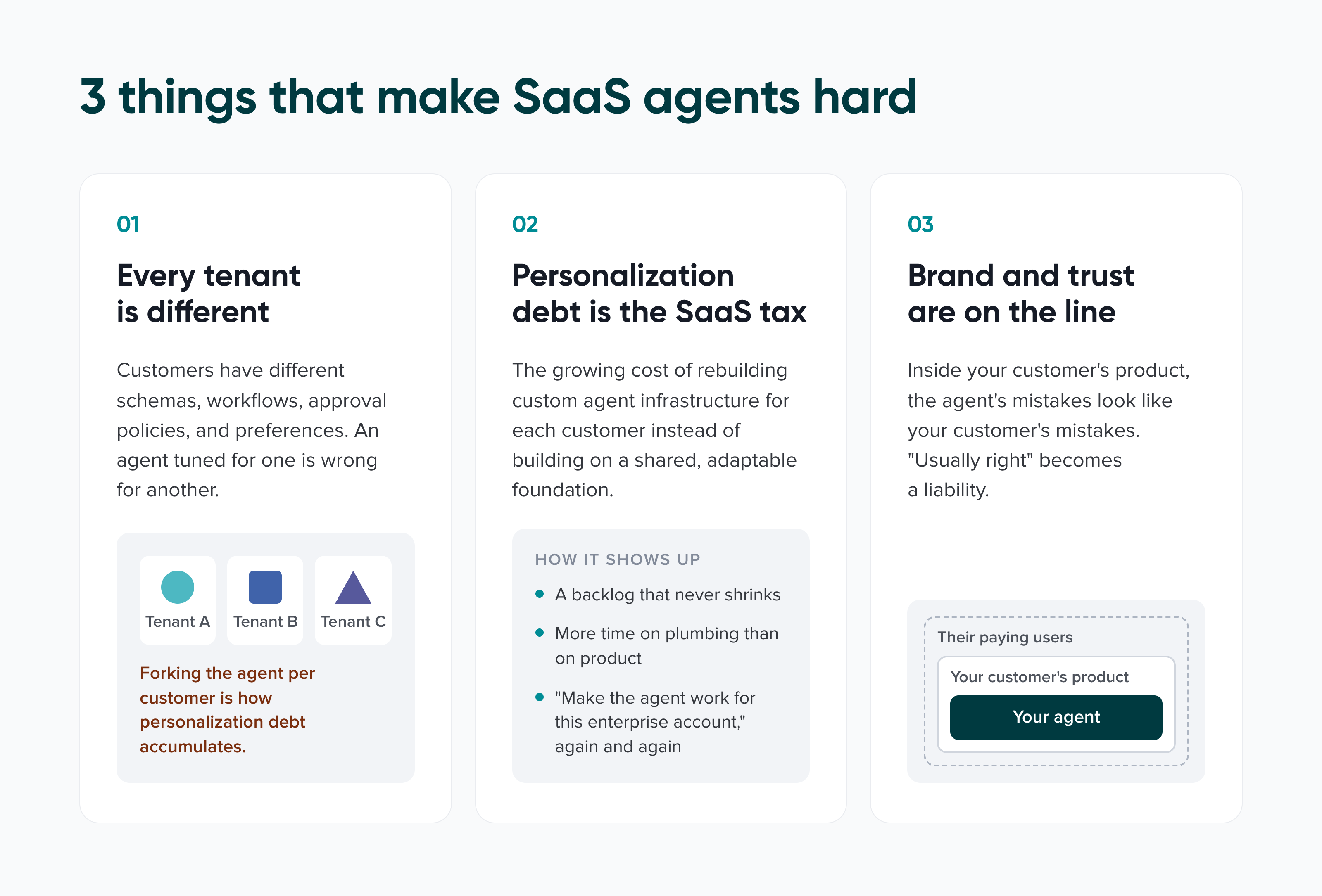
- Every tenant is different, and the agent has to reflect that.
Your customers have materially different data schemas, workflows, approval policies, and preferences. An agent tuned for one is wrong for another. The naive fix is to fork the agent per customer, which is exactly how personalization debt accumulates.
- Personalization debt is the SaaS-specific tax on agentic features.
Personalization debt is the growing engineering cost of rebuilding custom agent infrastructure around each customer instead of building on a shared, adaptable foundation. It shows up as a backlog that never shrinks, a team that spends more time on plumbing than on product, and a roadmap where "make the agent work for this enterprise account" appears again and again.
- Brand and trust are on the line at the tenant's edge.
When your agent acts inside your customer's product experience, its mistakes look like your customer's mistakes to their users. That raises the reliability bar above what most internal tools ever face. An agent that is "usually right" is a liability when it is wrong in front of someone else's paying customer.
The way out is not to personalize less. It is to build a shared agentic foundation that adapts per tenant by design, so a new customer means configuration and training rather than a new infrastructure project.
The anatomy of a production-grade AI agent for SaaS
A production-grade AI agent is one that meets a defined bar for security, reliability, auditability, and monitoring from day one, not one that merely produces good outputs in testing. Reaching that bar means treating the agent as a system with distinct layers, each of which is its own engineering concern. This is the map for the rest of the guide, and each layer links to a deeper page.
Miss any one of these layers and the agent will fail somewhere between the demo and the tenth customer. The rest of this guide walks the path that builds all of them in the right order.
How to build and ship AI agents: a disciplined lifecycle
The reason most AI agent projects stall in pilot is that they are treated as experiments instead of software. Agentic development mirrors software development: it has a lifecycle, and skipping stages does not save time, it moves the cost to production where it is far more expensive.
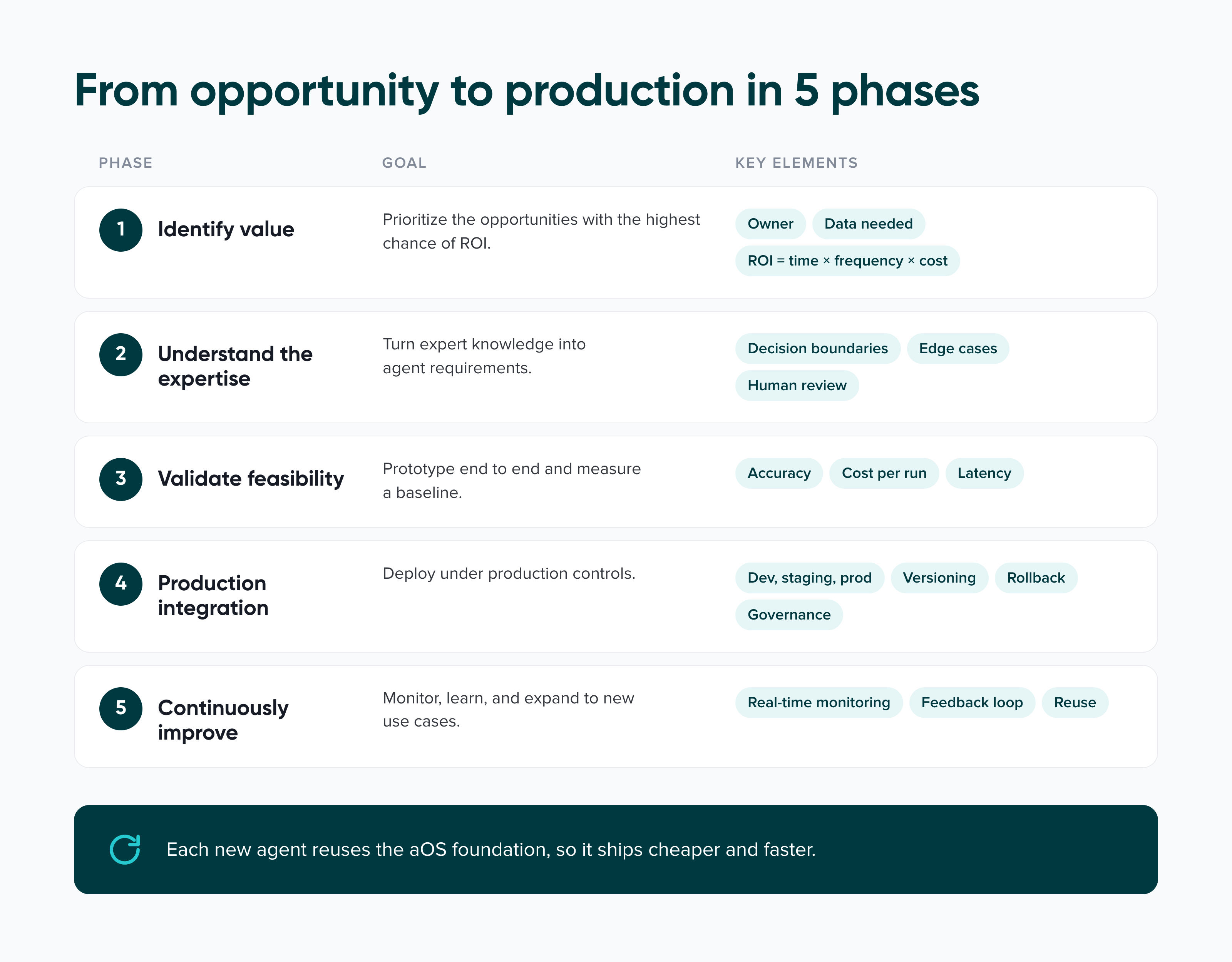
Linnify runs this as a named framework, ARC (Agentic Release Control). ARC (Agentic Release Control) is Linnify's framework for building scalable, production-grade agentic infrastructure, combining software development discipline with human-led governance so companies retain full ownership of their AI systems.
The infrastructure a company builds as a result is its aOS (Agent Operating System): the proprietary, versioned, governed foundation that every future agent is built on. You do not need to adopt Linnify's framework to use the shape of it, so here are the five phases in plain terms.
Or shorter:
If you want this mapped onto your own product, Linnify's step-by-step guide to implementing agentic AI is the practical companion.
Making agents reliable, secure, and observable in production
Reliability, security, and observability are not features you add at the end. They are the properties that decide whether an agent survives contact with real customers, and they have to be designed in from Phase 2.
Reliability starts with evaluation
You cannot ship what you cannot measure. Agent evaluation is the process of measuring an agent's accuracy, cost, latency, and failure modes against a defined baseline before it reaches production, and continuously after.
Demos lie because they run on happy-path inputs; evaluation is how you find the unhappy paths before your customers do. The public cost of skipping this is real the Deloitte AI report scandal is a case study in what unevaluated AI output costs a brand. The methodology lives in how to evaluate AI agents before production.
Observability is the difference between trust and guesswork
Agent observability is the practice of monitoring an AI agent's internal steps, tool calls, cost, latency, and output quality in production so failures are visible and diagnosable.
Traditional application monitoring is not enough for agents, because an agent is non-deterministic and multi-step: you need to see the reasoning trace, not just the final response. What to watch: step-by-step traces, tool-call success rates, latency, cost per run, output drift, and how often guardrails fire or the agent escalates to a human.
LLM observability is the adjacent discipline focused on the model layer itself (tokens, cost, drift, and hallucination signals). Both are covered in agent observability in production and LLM observability.
Security means the agent has its own identity and its own limits
An AI agent should have its own identity and least-privilege permissions on every tool it can call, never a borrowed human credential.
As agents gain the ability to take actions through tools and MCP servers, the attack surface grows, so identity, authorization, and tool-level permissions become first-order security concerns. Guardrails sit alongside identity: input validation, output filtering, confidence scoring, and approval thresholds that stop the agent before it takes a costly action.
Underneath all three sits a single principle: human-in-the-loop is part of the scalable architecture, not a training-wheels phase you remove later. A domain expert stays responsible for reviewing, validating, and escalating agent output. Every production failure worth studying traces back to removing the human too early.
Governance and compliance: building agents you can defend
Governance is what lets you move fast without shipping something you cannot defend to a security team, a regulator, or a customer's data protection officer.
Agentic AI governance is the set of controls (identity, permissions, policy enforcement, audit trails, and human oversight) that make an autonomous agent's behavior accountable.
For a SaaS company selling into enterprise or regulated buyers, governance is not overhead, it is a precondition of the sale. The full treatment is in agentic AI governance for CTOs.
Two compliance regimes now shape how agents get built in Europe, and both reach beyond Europe's borders.
The EU AI Act, and what "high-risk" means for your agent
The EU AI Act classifies AI systems by risk, and high-risk systems carry the heaviest obligations.
A high-risk AI system under the Act is one used in a sensitive domain listed in Annex III (or as a safety component of a regulated product), where failure could materially affect people's rights, safety, or opportunities. Annex III lists eight domains, and education and vocational training is one of them. That category explicitly covers AI that determines access to schools, allocates students to programs, assesses exam performance, monitors students during exams, or evaluates learning achievement in ways that affect future opportunities.
If your SaaS product evaluates learners or flags them, you are very likely building a high-risk system.
High-risk classification brings concrete engineering requirements:
- iterative risk management across the system's lifecycle
- data governance ensuring training data is relevant and representative
- technical documentation
- automatic event logging
- effective human oversight, followed by a conformity assessment before the system goes to market.
These map almost one-to-one onto disciplined agent engineering: logging and auditability, human-in-the-loop, and evaluation baselines are compliance controls as much as quality controls.
The timeline matters and it recently changed.
General application of the Act and its transparency duties took effect in August 2026. The obligations for Annex III high-risk systems, originally set for August 2026, were postponed to December 2027 by the 2026 Digital Omnibus.
That gives teams building high-risk agents real runway, but it is runway to build correctly, not a reason to wait, because retrofitting logging, oversight, and data governance into a live agent is far more expensive than designing them in.
Penalties for high-risk non-compliance run up to 15 million euros or 3 percent of global turnover.
GDPR and data protection when the agent handles personal data
If your agent processes personal data of people in the EU, GDPR applies, and for a multi-tenant SaaS product that usually means EU-based hosting, a signed Data Processing Agreement, and a maintained list of sub-processors that your customers' data protection officers can review.
When a portion of the end users are minors, the bar is higher still. Data protection is not a legal afterthought bolted on at launch; it constrains architecture from the first diagram (where data lives, how tenants are isolated, what the agent is allowed to retain).
Build vs buy, and choosing a partner
At some point the question becomes: do we build this agentic infrastructure ourselves, buy a platform, or bring in a partner? The honest answer depends on whether agents are core to your product.
If the agent is or is becoming a core capability of your SaaS product, the infrastructure it runs on is a strategic asset you should own, not rent.
Buying a closed platform is fast, but it constrains you to a vendor's environment and hands them the layer your product increasingly depends on.
Building it right means treating your agentic infrastructure as a proprietary asset, versioned and governed like software, that belongs to your company. That is the premise behind aOS: the Agent Operating System a company builds and owns, so each new agent compounds on a foundation it controls. The full argument is in build vs buy: should you build your own agentic infrastructure?.
"Build it yourself" rarely means "alone," though. Most SaaS teams that ship agents well keep product direction, architecture ownership, and domain expertise in-house and bring in execution power: senior engineers who have shipped multi-tenant products, designers who work inside a design system rather than around it, and AI people who have taken models into production rather than into a demo.
That is a forward-deployed partnership, and it works only under real conditions: a shared backlog, direct access to the partner's engineers rather than an account manager, IP that is assigned to you on payment, and hard guarantees on data protection, team continuity, and clean handover.
Choosing that partner is its own decision, and it is where a lot of agentic projects go wrong.
A production-readiness checklist for AI agents
Before you ship an agent to real tenants, it should clear this bar. Treat any "no" as a blocker, not a nice-to-have.
- Value is validated. You can state the ROI and the owner for this agent, not just the use case.
- Expertise is captured. The agent's decision boundaries, edge cases, and failure scenarios are documented, not implied.
- A baseline exists. You have measured accuracy, cost per run, and latency against a defined target, on realistic data.
- It is observable. Step traces, tool-call success, cost, latency, and drift are monitored in production.
- It has identity and limits. The agent has its own identity, least-privilege tool permissions, and guardrails with approval thresholds.
- A human is responsible. Review, approval, and escalation paths are defined and staffed.
- It is governed. Audit trails, access control, and policy enforcement are in place.
- It is compliant. You know whether it is high-risk under the EU AI Act, and GDPR obligations are met by design.
- It adapts per tenant without a rewrite. Onboarding a new customer is configuration and training, not a new infrastructure project.
- It can be handed over. Documentation is good enough that another team could continue without a rewrite.
Save this for yourself:
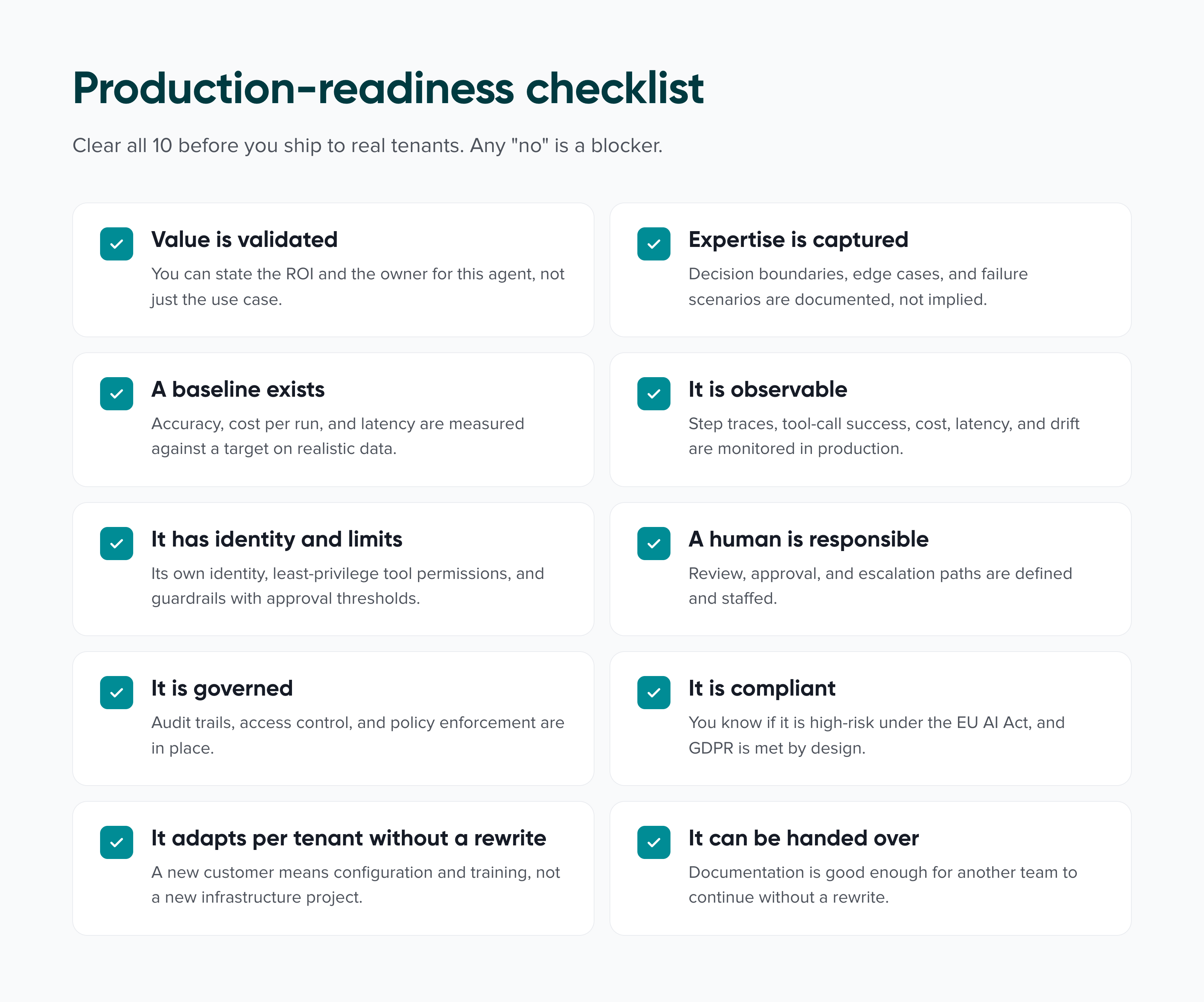
If your team keeps failing item 9, you have personalization debt, and it will only compound. That is the specific problem a shared, owned agentic foundation is built to solve.
Conclusion and next step
None of this is about chasing the newest model. It is about the far less glamorous work that decides whether your agents earn your customers' trust: evaluation, observability, governance, and an infrastructure foundation you actually own. Get that right and personalization debt stops being the thing that eats your roadmap. If you would like a second set of experienced eyes on your agentic architecture before you scale it, that is exactly where we like to start.




.png)
