

.svg)

.svg)


Build vs. Buy vs. Partner for Agentic AI: which one is for me?


It usually starts as a budget question and turns into a career question.
Do you build your own agentic AI, buy a packaged product, or bring in a partner?
Pick wrong and you either burn a year of engineering time on infrastructure that never ships, or you lock your company into a vendor whose roadmap is not yours. Either way, you are the one who has to explain it to the board.
The pressure is real because the window is short. Gartner expects 40% of enterprise applications to embed task-specific AI agents by the end of 2026, up from less than 5% in 2025 (Gartner).
At the same time, Gartner predicts more than 40% of agentic AI projects will be cancelled by the end of 2027 over cost, unclear value, and weak controls (Gartner, June 2025). The build, buy, or partner choice is the first place that risk is won or lost.
This guide breaks down all three paths on the dimensions that actually matter, gives you a decision framework you can run this week, and is honest about when each option is the right call.
Build vs. buy vs. partner: the three paths defined
Build means your team develops the agentic system in-house, owning the architecture, data pipelines, models, and governance end-to-end. You get maximum control and no licensing fees, but you carry the full cost of talent, time, and maintenance.
Buy means you buy an off-the-shelf agentic product and configure it. You get speed and a known price, but you inherit the vendor's roadmap, data boundaries, and limits, and you take on switching costs over time.
Partner means you work with a tech partner that brings a proven methodology and engineering capacity, builds the system with you, and hands you an asset your company owns. It blends the control of build with much of the speed of buy.
Build agentic AI: when it wins, and what it really costs
Building wins when the agentic workflow is core to your differentiation, your data is highly sensitive, and you have the rare in-house talent to design, ship, and maintain production AI. If agents are going to be your product, you probably should not rent them.
The catch is cost and time. A custom multi-agent system carries a five- to six-figure fixed cost before the first cheap token saves you anything, and the build is only the start. The ongoing burden is talent and maintenance. Frontier models update on a near-monthly cadence, and someone has to keep your system current, monitored, and compliant.
The bigger risk is the one that sinks most internal builds: readiness. MIT's 2025 NANDA study found that 95% of enterprise generative AI pilots delivered no measurable P&L impact, with the root cause being weak integration into real workflows rather than weak models (MIT NANDA, via National CIO Review). Ungoverned, low-quality data is the single most common reason pilots never reach production.
Building does not remove that barrier. It puts it squarely on your team. We cover what a stalled build actually costs in the real cost of a failed AI pilot.
Buy agentic AI: speed now, lock-in later
Buying is the fastest path to a working agent, and for commodity use cases like generic support deflection, it is often the right one. You get a known price and a maintained product. The trade is control, and the bill arrives later as lock-in.
The visible costs, the subscription and per-token fees, are the smallest part of your real exposure. The hidden costs show up only once you want to leave.
Partner for agentic AI: the hybrid that leaves you owning the asset
The partner model exists because building AI Agents demands scarce expertise and off-the-shelf solutions rarely fit complex, regulated, or differentiated processes.
A good partner brings a proven methodology and senior engineering capacity, moves faster than an internal team starting from zero, and, critically, builds infrastructure that your company owns rather than rents.
This is the model Linnify is built around: ARC (Agentic Release Control) is Linnify's framework for building scalable, production-grade agentic infrastructure, combining software development discipline with human-led governance so companies retain full ownership of their AI systems. The output is your aOS (Agent Operating System), the proprietary agentic infrastructure you own and keep.
Partnering well gives you the best of both worlds: the speed and lower risk of working with people who have shipped this before, plus the control, data ownership, and lack of lock-in that buying cannot offer.
The differentiator is whether the partner leaves you with a dependency on them or with an asset you control. ARC is explicitly designed for the second outcome.
Build vs. buy vs. partner, compared
No single column wins every row, which is the point. The right choice depends on the workload in front of you.

A decision framework you can run this week
Before you pick a path, score the specific workflow, not agentic AI in the abstract. Linnify does this in Phase 1 of ARC, which rates each opportunity on process repeatability, frequency, the balance of execution versus creativity, data availability, ROI clarity, and compliance risk.
The same lens gives you a fast build, buy, or partner answer.
Ask five questions:
- Is this workflow core to our differentiation? If yes, lean build or partner. If it is a commodity, buy.
- How sensitive is the data? High sensitivity or heavy regulation pushes you toward build or partner, where you keep full data ownership.
- How fast do we need value? A hard near-term deadline favors buy or partner over a from-scratch build.
- Do we have the talent to ship and maintain production AI? Honest answer. If not, a build will stall, and partner closes the gap.
- What is our tolerance for lock-in? Low tolerance rules out a pure buy for anything strategic.
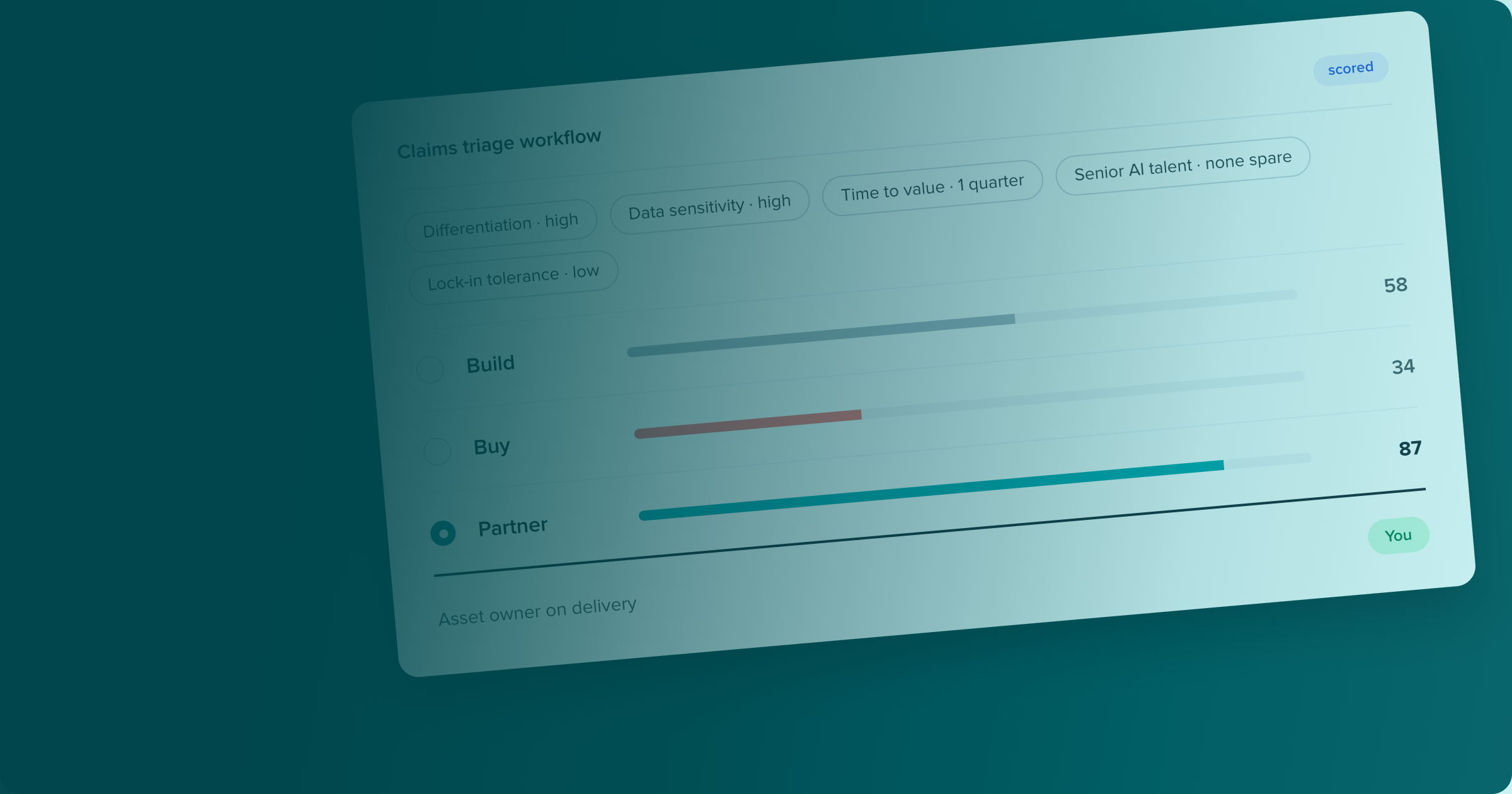
If your answers cluster around differentiation, data sensitivity, and low lock-in tolerance, but you lack spare senior AI talent, the partner model is usually the rational choice. That is the exact profile of most scale-ups. For the broader journey from first agent to production, start with our guide on moving from AI pilot to production.
Conclusion
Build, buy, or partner is not a philosophical debate. It is a match between a specific workflow and five honest variables: differentiation, data sensitivity, time to value, talent, and lock-in tolerance.
Build when agents are your product, and you have the team. Buy for commodity use cases where speed beats control. Partner when you need production-grade agentic AI quickly but refuse to give up ownership of the system that runs your business.
If you want to pressure-test the build, buy, or partner decision for your highest-value workflow, book a discovery call with Linnify, and we will help you.
Frequestly Asked Questions
Sources
Gartner: 40% of Enterprise Apps Will Feature Task-Specific AI Agents by 2026
Gartner: Over 40% of Agentic AI Projects Will Be Canceled by End of 2027 (June 2025)
MIT NANDA, The GenAI Divide: State of AI in Business 2025 (via National CIO Review)
2026 Zapier enterprise vendor-dependency survey (via VaasBlock)
Gartner January 2026 AI spending forecast (via Joget summary)




.png)
