

.svg)

.svg)

How we design multi-agent AI systems for enterprises


Your single-agent pilot worked. It summarized documents, answered questions, and maybe drafted a few emails.
Then someone asked the obvious next question: can it run the whole workflow, pull the data, make the decision, take the action, and hand off cleanly when it hits something it shouldn't touch? That is the moment you leave single agents behind and enter the world of multi-agent AI systems, and it is also the moment most enterprise AI initiatives quietly fall apart.
Gartner forecasts that 40% of enterprise applications will embed task-specific AI agents by the end of 2026, up from less than 5% in 2025 (Gartner), yet Gartner also predicts more than 40% of agentic AI projects will be cancelled by the end of 2027 (Gartner, June 2025).
The gap between those two numbers is where multi-agent design either earns its keep or destroys credibility.
What is a multi-agent AI system?
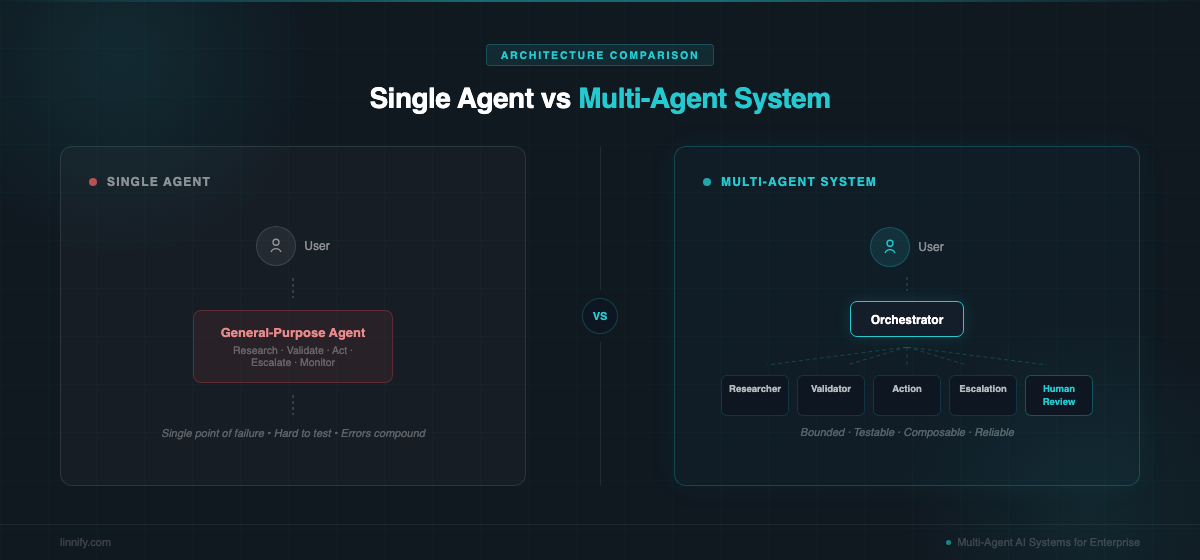
A multi-agent AI system is an architecture in which several specialized AI agents collaborate, each owning a narrow task, under a coordinating layer that routes work, manages state, and enforces control.
For example, instead of one general-purpose agent trying to do everything, you compose a team: a researcher agent, a validation agent, an action agent, and an escalation path to a human. Each is simpler, more testable, and more reliable than a monolith.
This matters because the enterprise moment for these systems has arrived.
Gartner and Forrester both identify multi-agent orchestration as the defining infrastructure priority of 2026, with multi-agent (three or more agents) orchestration estimated at roughly 22% of deployments in 2026 and projected to nearly double by 2027 (Gartner, Multiagent Systems).
The shared interoperability layer is consolidating too: the Model Context Protocol (MCP) is now running on more than 10,000 enterprise servers and is supported by Anthropic, OpenAI, Google, Microsoft, and AWS (analyst summary).
The promise is real. So is the failure rate. Understanding why tells you everything about how to design these systems correctly.
Why multi-agent systems fail in enterprise (and what it teaches us)
When a single agent makes a mistake, you see it and correct it.
When five agents pass work to each other, errors compound: a small inaccuracy in agent one becomes a wrong decision in agent three and an irreversible action in agent five. Reliability concerns from compounding errors are one of the most-cited risks of multi-agent architectures (Gartner analysis). Not to mention that it will cost you a lot.
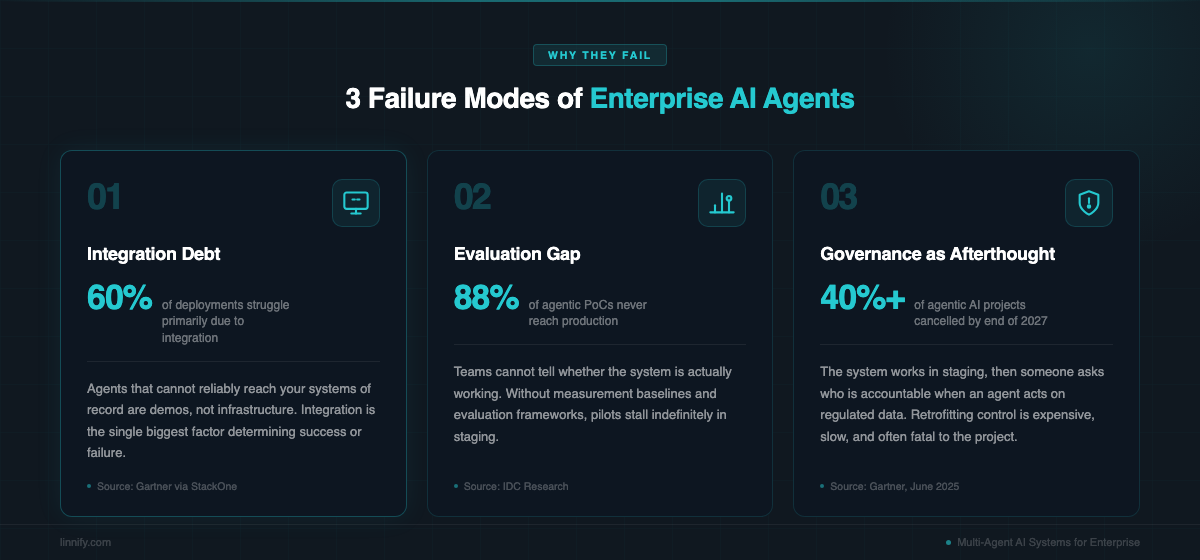
Three failure modes show up again and again in the enterprise systems we are brought in to rescue:
1. The first is integration.
Gartner's research is blunt: the integration layer is the single biggest factor determining whether enterprise AI agents succeed or fail, and roughly 60% of AI agent deployments are expected to struggle primarily because of integration rather than model quality (Gartner via StackOne).
Agents that cannot reliably reach your systems of record are demos, not infrastructure.
2. The second is the evaluation gap.
Teams cannot tell whether the system is actually working. This is why IDC reports that 88% of agentic AI proofs of concept never reach production, with evaluation gaps, governance friction, and model reliability cited as the top three blockers (analyst summary).
3. The third is governance as an afterthought.
The system is built, it works in staging, and only then does someone ask who is accountable when an agent acts autonomously on regulated data. By then, retrofitting control is expensive and slow.
At Linnify, every principle in how we design multi-agent systems is a direct answer to one of these three failures.
How do we design multi-agent AI systems at Linnify?
At Linnify, we treat multi-agent development as software development, not as prompt engineering. That single stance, one of the core principles of ARC framework (our proprietary process of building AI Agents), is why our systems reach production. Here is the design sequence we follow, mapped to the five phases of ARC.
Step 1: Start with value, not with agents
Most teams begin by asking “what agents should we build?”
We begin by asking “where is the value, and is it measurable?”
In Phase 1 of the ARC (Agentic Release Control) process, we score every candidate workflow on process repeatability, frequency, the execution-versus-creativity ratio, data availability, ROI clarity, and compliance risk.
Workflows with high repeatability and clear ROI become multi-agent systems; the exciting-but-fuzzy ideas are deliberately deprioritized. This is the discipline that keeps a project out of the 40% Gartner expects to be cancelled.
Step 2: Decompose the workflow into bounded agents
Once we know the workflow is worth automating, we break it into the smallest set of agents that each own a clear, testable responsibility.
For every agent we produce an Agent Requirements Document (ARD): its description, inputs and outputs, decision boundaries, performance metrics, edge cases, and explicit failure scenarios.
This is where we contain compounding errors; an agent that cannot exceed its boundaries cannot propagate a mistake beyond them. We also capture the human expert's knowledge first. The biggest risk in multi-agent AI is not a hallucination; it is encoding the wrong expertise into an otherwise functional system.
Step 3: Design orchestration and human-in-the-loop as architecture
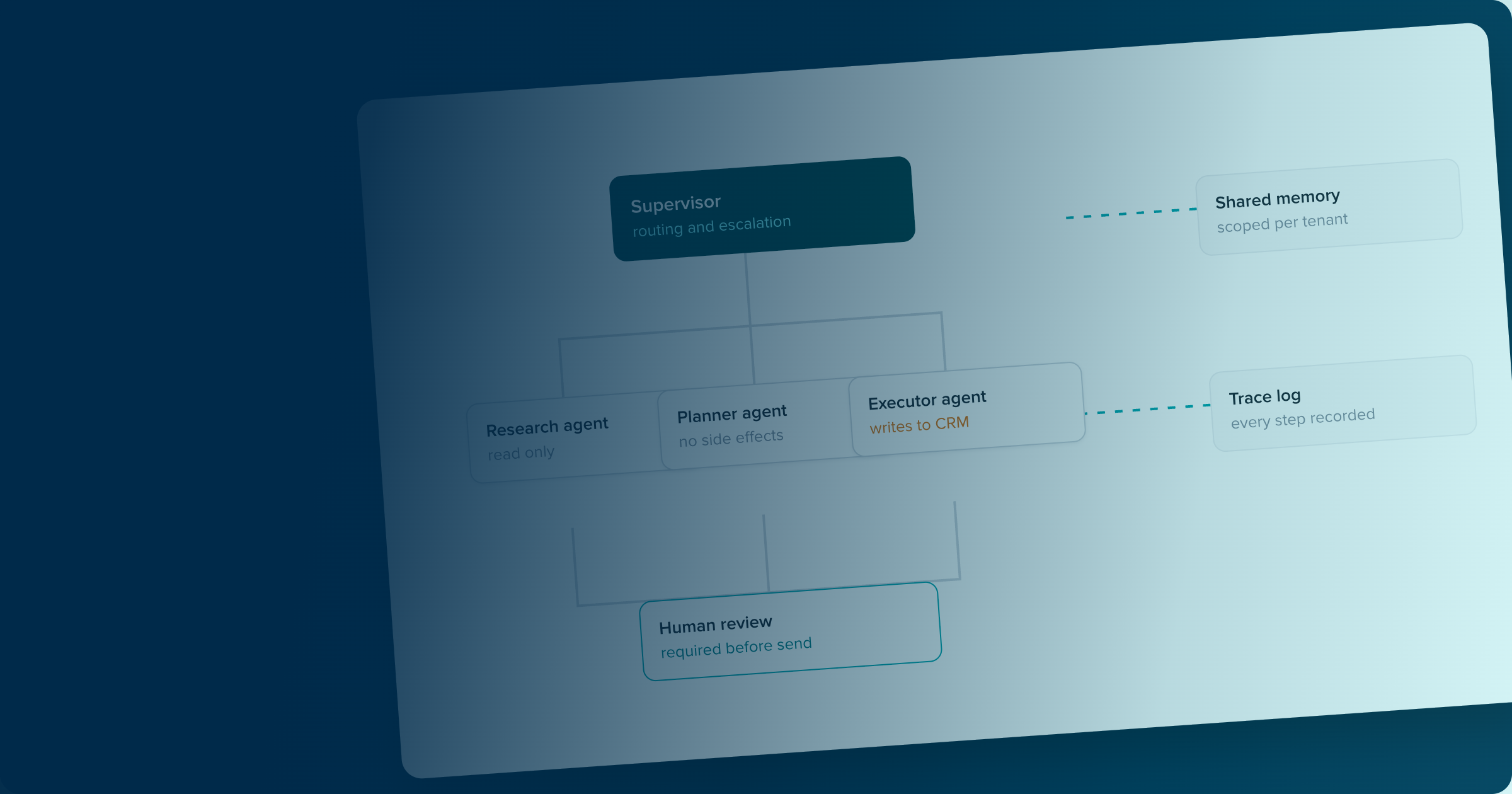
A multi-agent system needs a coordinator: a layer that routes tasks, manages shared state, sequences hand-offs, and decides when a human must approve before work continues.
We design this orchestration layer alongside the human-in-the-loop (HITL) experience, review steps, approval gates, escalation logic, and clear ownership of every output.
Keeping the domain expert in the loop is not a limitation of today's AI; it is a design principle for scalable AI. It is a non-negotiable standard for us, precisely because every production failure we have seen traces back to removing the human too early.
In a multi-agent system, the human is not reviewing every token; they are positioned at the few high-stakes decision points where being wrong is expensive, while the agents handle the high-volume, low-risk work autonomously.
Step 4: Validate against a baseline before scaling
Before any agent touches production, we build an end-to-end prototype and validate it against real scenarios with measurable baselines.
We instrument the orchestration layer so we can see where work fails and why.
The difference between a multi-agent demo and a deployable system is a validated baseline and a roadmap to production.
Step 5: Deploy under production controls
Deploying a multi-agent system without software development lifecycle discipline is like shipping software with no staging environment.
In this phase, we apply versioned agents, dev/staging/prod environments, rollback strategies, access control, logging, and auditability.
Every agent's behavior is monitored; every autonomous action is traceable.
Step 6: Improve continuously and reuse
Once live, the system enters a continuous improvement loop: anomaly detection, model and prompt evaluation, human feedback, and Agent Level Agreements (ALAs) that govern production performance the way SLAs govern software services.
Just as importantly, the components are reusable. The next multi-agent system is faster and cheaper to build because the orchestration, governance, and monitoring foundation already exists.
Conclusion
Designing multi-agent AI systems for enterprise is not about wiring together as many agents as possible.
It is about decomposing real, measurable workflows into bounded agents, coordinating them through an orchestration layer that doubles as your governance layer, keeping a domain expert accountable for the decisions that matter, and deploying the whole thing with the discipline you would apply to any production software. That is what separates the systems that scale from the 40% that get cancelled.
If you are moving from a single-agent pilot toward a multi-agent system, and you want it to survive production, book a discovery call with us. We will map your highest-value workflow and show you what a production-grade multi-agent architecture looks like for it.
For the broader journey, start with our guide on moving from AI pilot to production.
Sources
40% of Enterprise Apps Will Feature Task-Specific AI Agents by 2026
Over 40% of Agentic AI Projects Will Be Canceled by End of 2027 (June 2025)
Multiagent Systems in Enterprise AI
Gartner on AI agent integration (via StackOne)
IDC / multi-agent adoption and pilot-to-production data (analyst summary)
How to move from Agentic Ai from Pilot to Production
The real cost of a failed AI Pilot (it's more than you think)




.png)
