"Production-ready" is one of the most overused phrases in enterprise AI. Every vendor uses it. Almost none define it. This matters, because without a clear definition, teams deploy systems that aren't ready and discover what was missing when something breaks in production.
Key takeaway
What you will learn
✓
A working definition of production-ready agentic AI you can apply to any system.
✓
The three dimensions technical, operational, compliance that determine readiness.
✓
Why human-in-the-loop is a first-day architecture decision, not a final-stage accommodation.
✓
A complete readiness checklist you can use before any go-live decision.
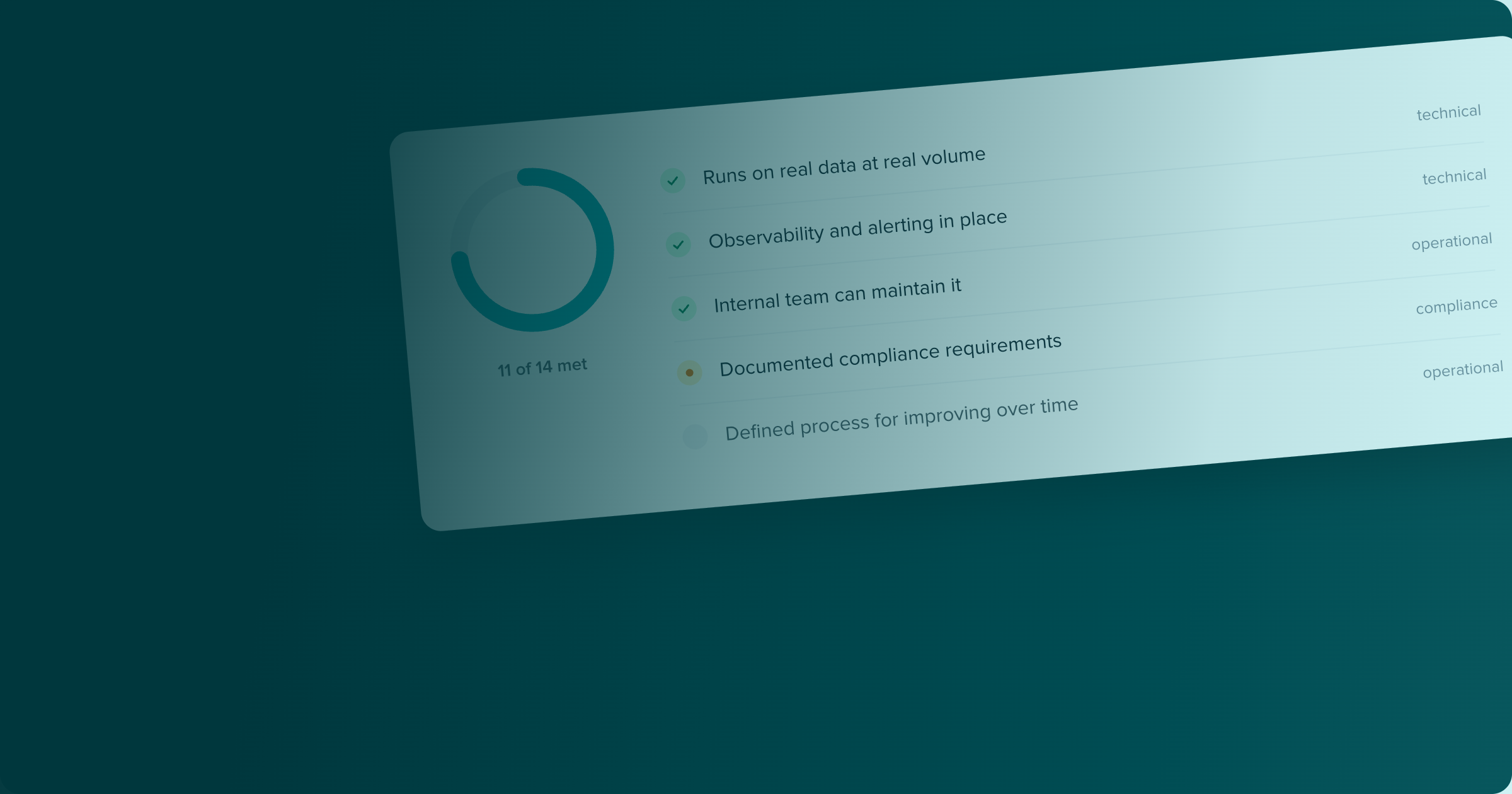
A production-ready agentic AI system is one that runs reliably in real workflows, meets documented compliance requirements, can be maintained by the internal team, and has a defined process for improving over time.
It is not a system that worked well in a demo or passed a controlled evaluation it is a system that operates under real conditions, with real data, at the scale the business actually requires.
Here is what production-ready actually requires.
Why the definition matters
Most enterprise AI projects begin with a pilot.
The pilot answers a specific question: can this work? If the answer is yes, the next step is production deployment.
But 'can this work' and 'is this production-ready' are different questions.
A system that works in a controlled pilot environment can fail in production for reasons that have nothing to do with the AI itself: data inconsistency at scale, a compliance requirement that wasn't designed for, a workflow edge case the pilot never encountered, an internal team that wasn't prepared to own the system.
The gap between pilot success and production readiness is where most enterprise AI initiatives fail.
The 3 dimensions of production readiness
1. Technical readiness
A technically production-ready agentic AI system meets measurable performance standards under real operating conditions, not controlled ones.
Production requirement
What it means in practice
Reliability at scale
The system performs consistently across the full range of inputs it will encounter in production not just the clean, well-formatted inputs used in evaluation.
This means accuracy benchmarks have been established and validated against real production data, not pilot data.
At Linnify, we apply a 95% accuracy threshold as our production gate: below that level, errors in production create more work than the system saves."
Below that threshold, the volume of errors in production creates more work than the system saves.
Defined behaviour for edge cases
Edge cases inputs the system wasn't designed for, incomplete data, ambiguous instructions are inevitable in production.
A production-ready system has documented behaviour for each category of edge case: what it does, what it escalates, and what it refuses to process.
Systems that encounter unexpected inputs and produce unreliable outputs are not production-ready, regardless of their average accuracy.
Observability
You cannot manage what you cannot see.
A production-ready system logs every decision it makes in a format that allows for audit, diagnosis, and improvement.
If something goes wrong in production, the team needs to be able to trace what the system did, why it did it, and what data it acted on.
Systems without observability infrastructure are not production-ready.
Graceful failure
Production systems fail. Databases go down, data formats change, upstream systems become unavailable.
A production-ready agentic AI system fails gracefully it identifies the failure, escalates appropriately, and does not produce unreliable outputs in degraded conditions.
2. Operational readiness
Technical performance is necessary but not sufficient. A system that performs well but can't be maintained by the internal team is not production-ready.
Operational requirement
What it means in practice
Internal ownership
The internal team not the build team must be able to maintain, update, and diagnose the system independently.
This requires genuine knowledge transfer throughout the build process, not a documentation handoff at the end.
If the first production incident requires the external build team to diagnose and fix, the system wasn't handed over in a production-ready state.
Documented runbooks
What does the team lead do when the system produces an anomalous output rate at 2 am? What is the escalation path when the human-in-the-loop reviewer is unavailable?
Production-ready systems have documented procedures for the operational scenarios that occur in real-world deployment not just the expected ones.
Human-in-the-loop architecture
Human oversight is not an add-on. It is a structural component of a production-ready agentic AI system.
The specific outputs or decision types that require human review before action are defined in the architecture, not determined ad hoc. Escalation criteria are clear.
Feedback from human reviewers flows back into the system in a structured way.
In practice, the teams that get this right treat human-in-the-loop as a first-day architecture decision not a final-stage compliance accommodation.
In the engagements Linnify runs, the named human responsible for each class of agentic output is identified during assessment, before orchestration is even sketched.
Defined success metrics
A production-ready system has pre-defined metrics that determine whether it is performing as expected.
Time saved, accuracy rate, escalation rate, error frequency these are established before deployment, not after.
Without them, there is no way to demonstrate value to leadership, no way to detect performance degradation, and no way to justify continued investment.
3. Compliance readiness
For enterprise organisations particularly those operating in regulated industries or under EU law compliance readiness is a hard requirement.
Compliance requirement
What it means in practice
Audit trail and traceability
Every decision the AI system makes must be logged with sufficient detail to reconstruct the reasoning.
This is a requirement for GDPR compliance, for the EU AI Act, and for most internal risk frameworks at enterprise scale.
Data governance
Where does the data the AI acts on come from? Who has access? Where is it stored?
For companies subject to GDPR, data processing agreements and data residency requirements are non-negotiable.
EU AI Act compliance
For organisations in the EU, the AI Act introduces specific requirements for high-risk AI systems: technical documentation, accuracy and robustness standards, human oversight mechanisms, and conformity assessments before deployment.
Governance documentation
Who is responsible for the AI system's outputs? What is the escalation path when it makes a consequential error?
The absence of governance documentation is one of the most common reasons enterprise AI deployments fail compliance review.
Why most AI systems fail the production-ready test
The most common reason is that production-readiness is treated as a deployment gate rather than a design standard.
Teams build their AI system, reach the end of the build phase, and run a checklist before going live. If the checklist passes, the system ships.
If it doesn’t, the team fixes whatever was flagged. This approach misunderstands what production-readiness actually requires.
The requirements above are not things you can add at the end.
Research insight
“Moving from pilot to production is arguably the most important step in capturing AI value, yet this is where many companies stall.”
Production-readiness is a design standard, not a final quality check.
The organisations that consistently get agentic systems to production are the ones that treat these four requirements as constraints from the first week of the project, not as conditions to be satisfied before the last.
The Production-Readiness Checklist
A system is production-ready when all of the following are true.
Readiness area
Security
Readiness area
Reliability
Readiness area
Auditability
Readiness area
Monitoring
If any item on this checklist isn't true, the system is not production-ready, regardless of how well it performs technically.
This checklist is the working version of the standard we apply at Linnify before any agentic system enters production the line every deployment crosses, not a finishing polish at the end.
What “production-ready” is NOT
There are several things teams commonly conflate with production readiness.
A successful pilot is not production readiness. Pilots are controlled environments. Production is not.
A system that performs well in a pilot has demonstrated that the approach is viable it has not demonstrated that it will perform reliably under real conditions.
A completed build is not production readiness. The system being built and tested does not mean it is ready to run in your workflow. Completion and readiness are different milestones.
Vendor certification is not production readiness. A vendor certifying their platform as "enterprise-grade" or "production-ready" is describing the platform's capabilities, not your deployment of it.
Production readiness is specific to the system you've built, in your workflow, on your data.
A pilot-ready system demonstrates that an AI approach can work in a controlled environment with curated data.
A production-ready system has been validated against real data at production scale, has compliance and governance documentation in place, operates with defined human oversight, and can be maintained by the internal team independently.
At Linnify, we apply a 95% accuracy threshold as our production gate: below that level, errors in production create more work than the system saves.
The specific threshold depends on the workflow, in regulated industries, a higher threshold may be required.
The critical requirement is that the threshold is defined before deployment.
With a structured approach and compliance requirements addressed from the start, most enterprise agentic AI systems reach production readiness in weeks.
The most common cause of delay is discovering compliance or governance gaps late in the process — requirements that take significantly longer to address when retrofitted.
Production readiness should be assessed against a pre-defined checklist agreed on by technical, operational, legal, and compliance stakeholders before the build begins.
It should not be a unilateral decision by the build team.
Lorem ipsum dolor sit amet, consectetur adipiscing elit. Suspendisse varius enim in eros elementum tristique. Duis cursus, mi quis viverra ornare, eros dolor interdum nulla, ut commodo diam libero vitae erat. Aenean faucibus nibh et justo cursus id rutrum lorem imperdiet. Nunc ut sem vitae risus tristique posuere.
Let’s build your next digital product.
Subscribe to our newsletter
Thank you! Your submission has been received!
Oops! Something went wrong while submitting the form.


.svg)

.svg)






.png)
