


Agentic AI in Accounts Payable and the Financial Close

Accounts payable automation is not new. Most finance teams already have OCR for invoices, matching rules in the ERP and maybe a few RPA bots. Yet invoices still pile up in exception queues, and month-end close still depends on people chasing missing information.
Agentic AI in accounts payable means AI agents that read invoices, match them to purchase orders and receipts, code them, resolve exceptions and prepare payments for approval, by reasoning over the data and calling the same systems your team uses. In the financial close, the same kind of agent reconciles bank transactions, proposes accruals and drafts variance commentary for review.
The difference from older automation is where it helps most: not the clean invoices that rules already handle, but the messy ones that land on someone's desk. This guide covers where AI agents work in AP and the close today, the controls finance teams need, how to measure ROI, and what we learned building one.
What agentic AI changes in accounts payable
Each generation of AP automation solved a different part of the problem.
An agent can notice that an invoice is 2% above the purchase order because of a freight line, check the contract for freight terms, and propose an approval with the evidence attached. A rule would simply flag it. That is why the value of agents sits in exception handling, the part of AP that still eats the most time.
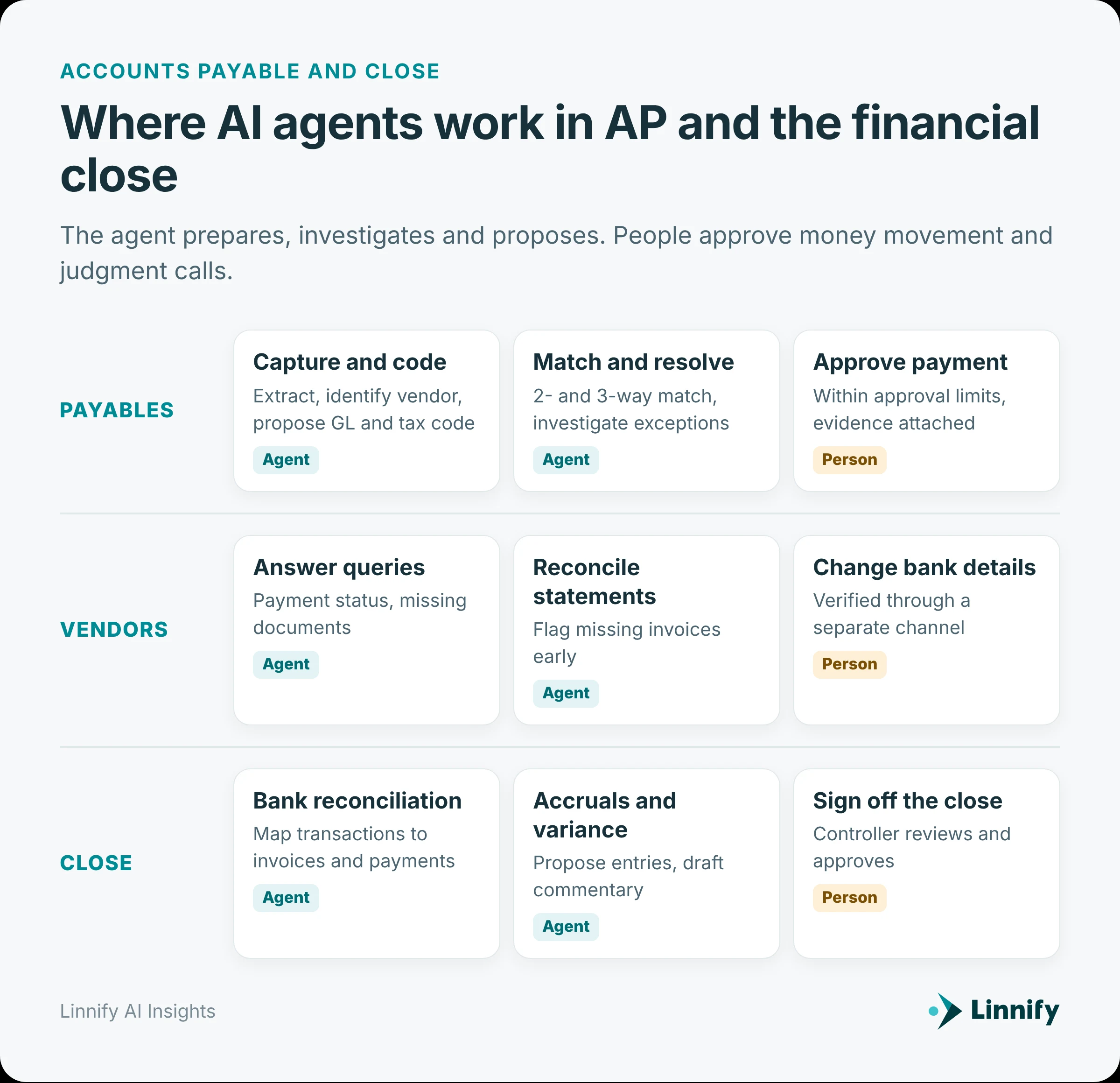
6 accounts payable and close workflows for AI agents
1. Invoice capture and coding
The agent extracts invoice data, identifies the vendor, and proposes the GL account, cost center and tax code based on history and policy. This is the foundation of touchless invoice processing.
2. Two- and three-way matching with exception resolution
When the invoice, purchase order and goods receipt disagree, the agent investigates: partial deliveries, price changes, duplicate invoices, freight lines. It resolves what policy allows and routes the rest with a clear explanation.
3. Vendor questions and statement reconciliation
Agents can answer routine vendor questions about payment status and reconcile vendor statements against open items, flagging missing invoices before they become late fees.
4. Bank reconciliation
The agent maps bank transactions to open invoices, payments and customers, including partial and combined payments with unclear references. This is where we have seen some of the largest gains.
5. Accruals and the close checklist
During month-end close, an agent can identify received-but-not-invoiced items, propose accrual entries for review, and track the status of each close task.
6. Variance and flux commentary
Agents compare balances with prior periods and budgets, investigate the largest movements and draft the explanation a controller would otherwise write from scratch.
What we learned building an AP and bank reconciliation agent
Three lessons from that project apply to most finance teams:
- Start with the highest-volume, best-documented workflow. Bank transaction mapping had clear rules, huge volume and an obvious metric, so progress was easy to measure.
- Design for variation from day one. Every customer's financial logic was slightly different. The agent had to adapt per workspace without being rebuilt per customer.
- Measure against the existing baseline. Starting from a known automatic mapping rate made the improvement visible to finance and to leadership in weeks, not quarters.
The controls finance teams need before an agent touches payables
Short answer: the agent can prepare, propose and explain; a person approves anything that moves money or changes vendor data.
- Segregation of duties: the agent that proposes a payment never approves it, and approval limits stay with named people.
- Vendor master protection: changes to vendor bank details are always verified by a person through a separate channel. This is the most common route for payment fraud.
- Complete audit trail: for every invoice, the data the agent used, the decision it proposed, the rule or evidence behind it, and who approved it.
- Limits and thresholds: amount limits, vendor lists and confidence thresholds decide what the agent may resolve and what it must route.
- Internal controls evidence: if your company is subject to SOX, the agent's steps become part of your internal controls over financial reporting and need the same documentation and testing.
We cover the technical side of these controls in how to design permissions for AI agents in a SaaS product, and the regulatory side in agentic AI compliance in healthcare and finance.
How to measure the ROI of AI in accounts payable
Measure the same handful of metrics before and after, on the same invoice population.
Will AI replace accounts payable jobs?
Not in the way the question suggests. Agents take over the repetitive matching, coding and chasing. The work that remains is the work that needs judgment: complex exceptions, vendor relationships, controls, cash planning and supervising the agents themselves. Finance teams that adopt agents early tend to handle more volume with the same team and move people toward analysis.
How to start with agentic AI in finance operations
Pick one workflow with high volume, clear rules and a measurable baseline, usually invoice matching or bank reconciliation. In our ARC (Agentic Release Control) framework, we then document the decision boundaries with your finance experts, validate the agent against your historical data, and release it with approval gates and monitoring in place. The agent runs in your environment, and your data stays there.
For the mechanics behind these agents, read how the agent loop works.
References and further reading
• Ardent Partners. (2026, January 22). State of ePayables: AP benchmarks and best-in-class performance. ardentpartners.com
• Linnify. Automating accounting workflows with agentic AI (case study). linnify.com
• Linnify. (2026). Agentic AI compliance in healthcare and finance. linnify.com


