


Agentic AI Frameworks and Platforms Compared (2027)

Two years ago, choosing an agent framework meant picking between a few experimental libraries. By late 2026, every major model provider and cloud has its own, the open-source options have matured, and most teams are asking a different question: which one will we still be happy with in two years?
An agentic AI framework is a software library that provides the building blocks of an AI agent: the agent loop, tool calling, memory, multi-agent coordination and tracing. An agent platform is a managed service that hosts and runs agents for you, adding identity, scaling, monitoring and security. Most production systems use one of each.
This guide compares the main agentic AI frameworks and platforms as they stand in November 2026, explains the trade-offs that actually matter, and gives you a decision guide. It is written from the perspective of a team that builds agents on several of them, as a partner of Anthropic, OpenAI and Google Cloud.
Agentic AI frameworks vs agent platforms
It helps to see an agent system as layers. The framework and the platform solve different problems.
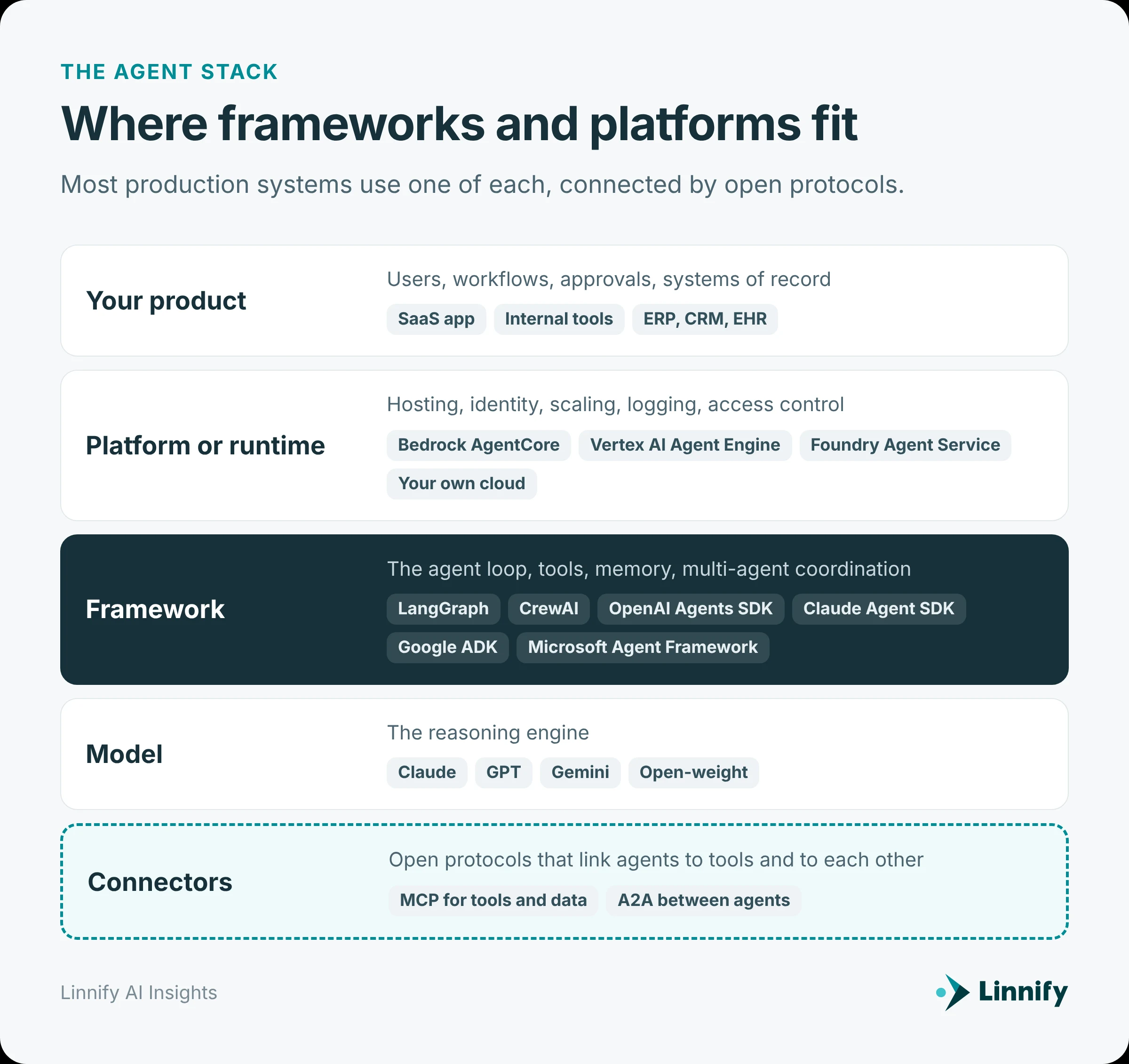
- Model: the language model that reasons, from Anthropic, OpenAI, Google or an open-weight provider.
- Framework: the code that runs the agent loop, defines tools and memory, and coordinates multiple agents.
- Platform or runtime: where agents run in production, with hosting, identity, scaling, logging and access control.
- Connectors: open protocols such as the Model Context Protocol (MCP) for tools and data, and A2A for agent-to-agent communication.
The main agentic AI frameworks compared
LangGraph
LangGraph models an agent as a graph of steps with explicit state, branches and loops. It gives you the most control, which is why it is popular for production systems with strict rules, and it has the steepest learning curve. It works with any model.
CrewAI
CrewAI organizes agents into "crews" with roles and tasks. It is the quickest way to get a multi-agent prototype running. For production, teams usually add their own controls around it, or move the hardest paths to a more explicit framework.
OpenAI Agents SDK
A lightweight SDK built around agents, handoffs, guardrails and tracing. It is quick to adopt if you use OpenAI models; some features work best, or only, with OpenAI's own services. We look at OpenAI's wider tooling in OpenAI's AgentKit: the missing layer for production-ready AI agents.
Claude Agent SDK
Anthropic's SDK, renamed from the Claude Code SDK in September 2025, exposes the same agent loop that powers Claude Code: built-in tools, subagents, sessions, permissions, hooks, skills and MCP. It is a strong choice when you have standardized on Claude and want a proven loop rather than building your own.
Google Agent Development Kit (ADK)
Google's open-source framework supports several languages, multi-agent setups and deterministic workflows, and deploys naturally to Vertex AI. It is model-agnostic but tuned for Gemini.
Microsoft Agent Framework
Microsoft merged AutoGen and Semantic Kernel into a single framework, which reached version 1.0 in April 2026 with long-term support. It adds graph-based workflows and common multi-agent patterns, supports MCP, and is the obvious choice for .NET teams.
Strands Agents, Pydantic AI and Mastra
Strands is AWS's open-source, model-driven agent SDK, with Bedrock as the default provider. Pydantic AI brings typed, validated agents to Python with simple model switching. Mastra is a TypeScript framework with agents, workflows, memory and evals for web teams.
LangGraph vs CrewAI
Choose LangGraph when you need to know exactly what happens at every step: regulated workflows, long-running processes, branching logic, human approval at specific points. Choose CrewAI when you want to explore a multi-agent idea quickly and the workflow is still changing. Many teams prototype in CrewAI and rebuild the parts that reach production in a more explicit framework.
OpenAI Agents SDK vs LangGraph
The OpenAI Agents SDK is simpler and faster to start with, especially on OpenAI models. LangGraph is more verbose but model-agnostic and gives finer control over state and flow. If model independence or complex workflows matter, LangGraph is the safer long-term choice; if you are committed to OpenAI and want speed, the Agents SDK is hard to beat.
Managed agent platforms compared
Platforms host and run agents for you. Each cloud now offers one, usually paired with its own framework.
The trade-off is control. Managed platforms remove infrastructure work, but your agents, logs and sometimes your data move into the provider's environment. For regulated or core workflows, many companies prefer to run the framework in their own cloud account.
How to choose an agentic AI framework
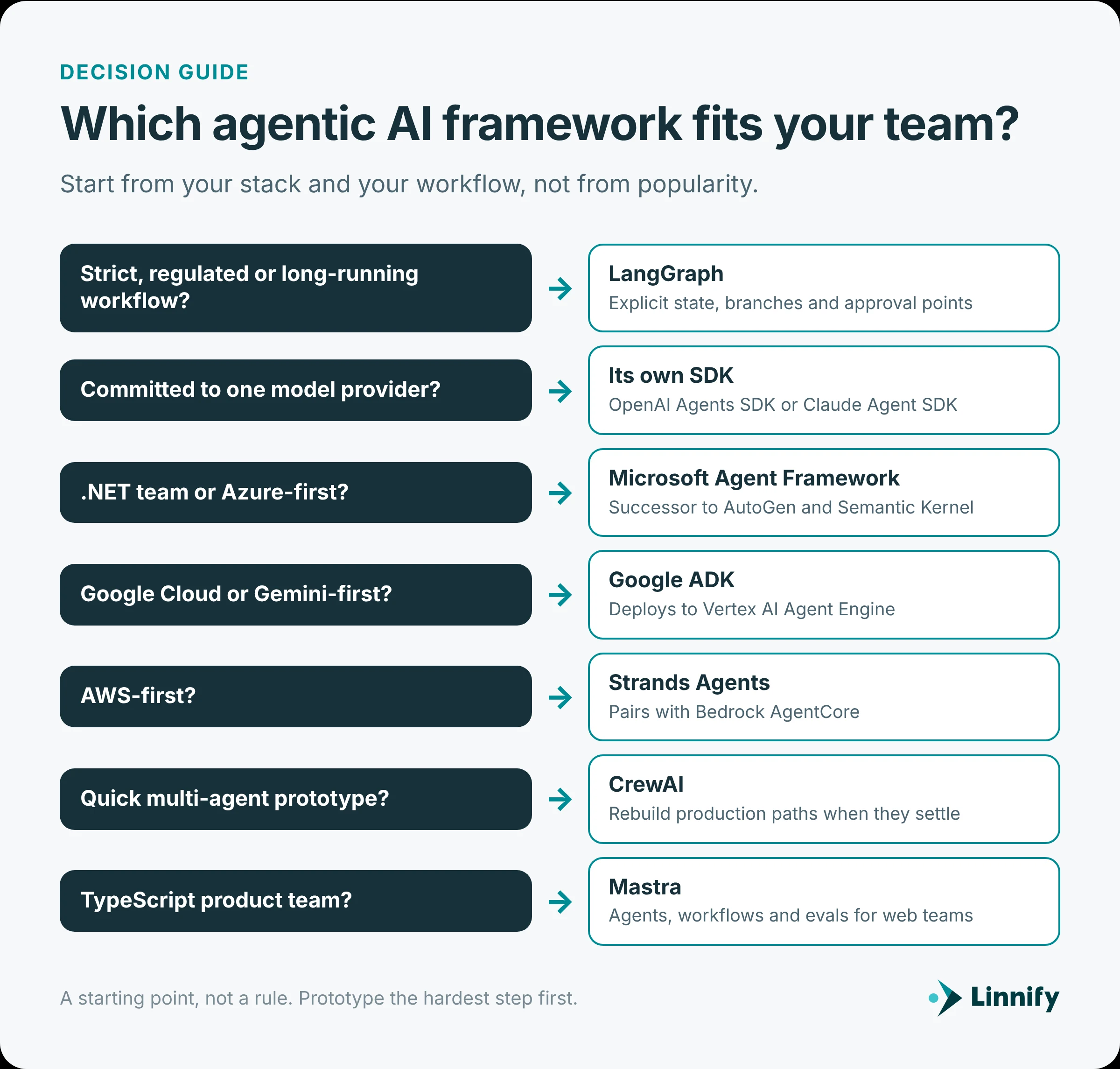
- Start from your cloud and your language. A .NET team on Azure, a Python team on AWS and a TypeScript product team will have different natural fits.
- Decide how much model independence you need. Provider SDKs are the fastest path on one model family. Model-agnostic frameworks protect you if prices, quality or regulations push you to switch.
- Match the framework to the workflow. Explicit graphs for strict, regulated or long-running processes; lighter loops for open-ended assistants.
- Check the production basics. Tracing, evaluation hooks, human approval steps, MCP support and a stable release cadence matter more than the number of GitHub stars.
- Prototype the hardest step, not the easiest. Build the part with the messiest data or the strictest rule first. That is where frameworks show their differences.
What matters more than the framework
The framework is usually the easiest decision to reverse. What is hard to change later is everything around it: how you evaluate agents, how you observe them in production, how tools are exposed and secured, and who owns the infrastructure and the data. If those are designed well, swapping a framework is a refactor, not a rewrite.
That is the approach in our ARC (Agentic Release Control) framework: we choose the framework per project, but every agent is built with evaluation baselines, monitoring, MCP-based tools and approval gates, inside the client's own environment. As a Select Partner in Anthropic's Claude Partner Network, with partnerships with OpenAI and Google Cloud, we work across these ecosystems rather than for one of them. For the multi-agent side, see how we design multi-agent AI systems for enterprises.
Agentic AI frameworks: the bottom line
There is no single best agentic AI framework. LangGraph leads for explicit control, provider SDKs for speed on one model family, Microsoft Agent Framework for .NET, and cloud platforms for teams that want hosting handled. Pick the one that fits your stack and workflow, then invest in the evaluation, observability and ownership that will outlast it.
References and further reading
• Visual Studio Magazine. (2026, April 6). Microsoft ships production-ready Agent Framework 1.0 for .NET and Python. visualstudiomagazine.com
• Anthropic. (2025, September 29). Building agents with the Claude Agent SDK. claude.com
• Linnify. (2026). How the agent loop works: memory, tools and planning explained. linnify.com
• Linnify. (2026). OpenAI's AgentKit: the missing layer for production-ready AI agents. linnify.com


